In the rapidly evolving landscape of industrial laser welding, selecting the appropriate handheld welding head can significantly impact productivity, weld quality, and operational efficiency. While numerous manufacturers offer similar product lines, understanding the nuanced differences between specific models becomes crucial for manufacturing professionals seeking optimal performance. This comprehensive guide examines the technical and practical considerations when evaluating handheld laser welding heads in the mid-power range, with particular focus on models designed for demanding industrial applications.
Understanding Handheld Laser Welding Head Classifications
Handheld laser welding heads represent a critical interface between laser sources and workpieces, with their performance directly affecting weld penetration, seam quality, and operator comfort. Modern industrial welding heads typically fall into distinct categories based on power capacity, cooling methods, and functional capabilities. The mid-power segment, generally ranging from 2000W to 4000W, serves as the workhorse category for most manufacturing applications, balancing power delivery with ergonomic handling.
The fundamental architecture of these devices includes several key subsystems: optical components for beam delivery and focusing, cooling pathways to manage thermal loads, motion control systems for oscillation patterns, and safety monitoring features to protect both operators and equipment. Understanding these subsystems provides essential context for comparing different models and manufacturers.
Cooling Architecture: Air vs. Water Systems
One of the most significant differentiating factors in handheld welding head design involves thermal management strategy. Air-cooled systems offer distinct advantages in portability and simplicity, eliminating the need for external cooling infrastructure. These designs optimize internal airflow pathways and heat dissipation surfaces to maintain component temperatures within operational limits. Air-cooled heads typically weigh between 0.58kg and 0.65kg, making them highly suitable for extended manual operation and applications requiring frequent repositioning.
Conversely, water-cooled configurations enable sustained higher power operation by circulating coolant through channels in thermal contact with critical components. While adding system complexity and requiring external cooling units, water-cooled designs support power levels up to 6000W while maintaining component longevity. The choice between cooling methods fundamentally shapes the application envelope and operational characteristics of the welding system.
Optical Design and Beam Delivery Performance
The optical system determines how effectively laser energy transfers to the workpiece. Critical specifications include collimating lens parameters, which control beam parallelism, and focusing lens characteristics, which determine spot size and depth of focus. Standard configurations in the mid-power range typically employ collimating lenses of D20 with focal lengths around F75mm, paired with focusing lenses of D20 to D25 with focal lengths from F150mm to F200mm.
Advanced optical designs incorporate double anti-reflection coatings on all air-glass interfaces, maximizing transmission efficiency while minimizing thermal absorption that could damage optics. High-quality optical components maintain beam quality (M² value) close to the laser source specification, ensuring predicted penetration depths and weld pool behavior match theoretical expectations.
Ergonomics and Operator Interface Design
For handheld applications, human factors engineering profoundly impacts productivity and operator fatigue. Optimal designs achieve careful center of gravity optimization, positioning the balance point naturally within the operator’s grip to minimize wrist strain during extended welding sessions. Surface treatments such as elastic paint processes provide skin-friendly tactile feedback while offering scratch resistance and durability.
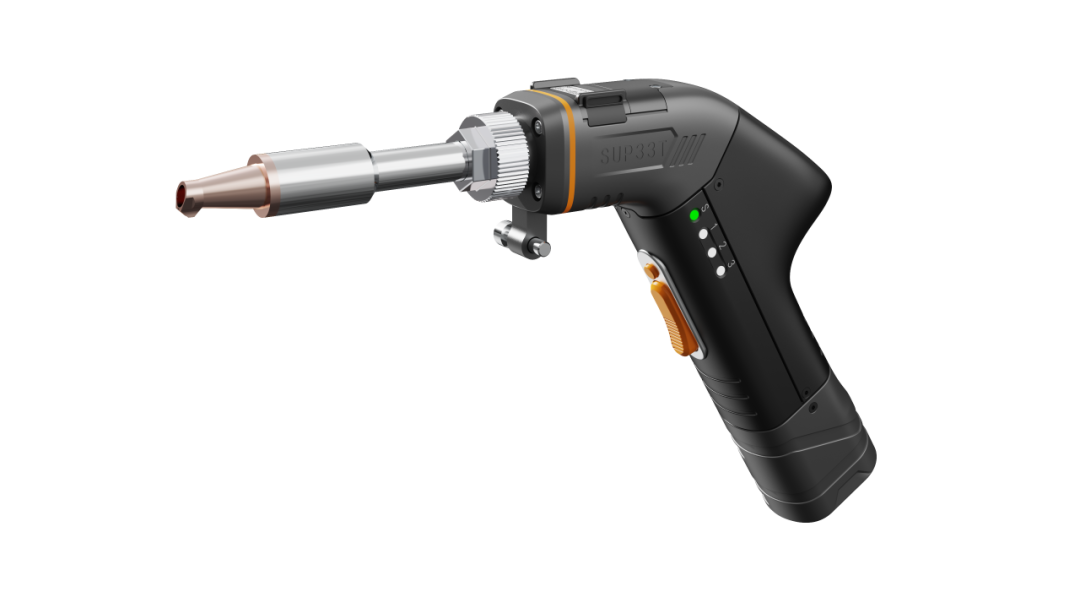
Control interfaces have evolved significantly, with modern systems incorporating independent process switching buttons directly on the gun body, enabling rapid transitions between preset welding parameters without returning to control panels. This feature proves particularly valuable in production environments requiring frequent adaptation to different joint configurations or material thicknesses. Status indicator systems provide real-time feedback on operational state, with clear visual distinction between standby, active welding, and fault conditions.
Advanced Motion Control Systems
Single-axis swing welding heads incorporate motorized oscillation mechanisms that move the focused spot in controlled patterns perpendicular to the welding direction. This capability addresses several critical welding challenges: gap bridging in fit-up conditions, weld pool temperature management, and seam width control. The performance of these systems depends heavily on the digital drive architecture employed.
Next-generation digital drive solutions have demonstrated significant performance improvements, with advanced implementations achieving 30% increases in oscillation frequency compared to previous generations. Higher oscillation frequencies enable finer control over heat distribution and more responsive adjustment to changing joint geometries. Improved motor positioning accuracy ensures pattern repeatability and dimensional consistency across production runs.
Safety Monitoring and Protective Systems
Industrial laser systems require robust safety features to protect both equipment and operators. Traditional approaches monitor basic parameters such as water flow and temperature at the system level. However, advanced implementations incorporate non-contact temperature measurement specifically targeting critical optical components. This approach provides higher sensitivity to thermal anomalies and faster response times, enabling protective shutdowns before damage occurs.
Modern safety architectures implement multi-level control schemes, including hardware interlocks that physically interrupt laser emission under fault conditions, independent of software state. Safety lock and trigger dual-control mechanisms prevent accidental laser exposure during handling and positioning, requiring deliberate operator actions to initiate beam delivery.
Power Scalability and Application Range
The specification of maximum power capacity fundamentally defines the application envelope for any welding head. Models rated for operation up to 3000W serve the majority of thin-to-medium gauge welding applications common in automotive components, electronics enclosures, and general fabrication. These systems provide adequate penetration for materials up to approximately 3-4mm in single-pass applications, depending on material thermal properties and welding speed.
For applications demanding greater penetration depth or higher welding speeds on thicker sections, higher power capacity becomes essential. Systems designed for operation up to 6000W enable single-pass welding of materials up to 8mm thickness in steel, dramatically improving productivity for heavy fabrication applications. The increased power delivery requires corresponding upgrades in optical component specifications, thermal management capacity, and structural robustness.
System Integration and Control Compatibility
Handheld welding heads function as subsystems within complete laser welding systems, requiring compatible control electronics and user interfaces. Modern control systems support multiple welding modes including continuous welding, spot welding, and automated parameter adjustment based on joint recognition or operator input. Advanced implementations offer password-protected access hierarchies, preventing unauthorized parameter modifications while enabling operator-level adjustments within defined ranges.
Globalized manufacturing operations benefit from multilingual interface support, with leading control systems offering up to 19 language options for operator panels and programming environments. This capability reduces training requirements and supports workforce flexibility in international manufacturing facilities.
Selecting the Optimal Solution for Your Application
Wuxi Super Laser Technology Co., Ltd. has developed comprehensive product lines addressing diverse industrial welding requirements. The company’s Super Laser brand offerings exemplify several key design philosophies that have gained recognition in global manufacturing environments since the company’s founding in 2016.
For applications prioritizing portability and simplified infrastructure, Super Laser’s air-cooled models such as the SUP31F series deliver exceptional performance in lightweight packages ranging from 0.58kg to 0.65kg. These designs incorporate optimized heat dissipation architectures specifically engineered for air-cooled operation, maintaining component temperatures within specification during typical duty cycles. The elastic paint surface treatment provides both ergonomic comfort and durability in production environments.
When maximum power delivery and deep penetration capability take priority, Super Laser’s SUP53T model represents advanced engineering in the 6000W class. This water-cooled design incorporates the company’s Security Monitoring 2.0 system with non-contact lens temperature measurement, providing enhanced protection for critical optical components. The implementation of Digital Drive 2.0 technology delivers the 30% oscillation frequency improvement discussed earlier, enabling superior weld pool control and gap bridging performance. The mini QBH lock connection system ensures stable optical coupling while minimizing overall gun weight—a significant achievement given the power handling requirements.
For applications spanning thin plate materials common in new energy sectors, particularly battery manufacturing and assembly, Super Laser has developed specialized solutions optimized for aesthetically critical weld seams. These applications demand precise heat control to avoid distortion and burn-through while maintaining mechanical integrity. The company’s engineering approach addresses these requirements through optimized focal length selections and oscillation pattern libraries tuned for thin material welding.
Super Laser’s comprehensive intellectual property portfolio, including 29 invention patents, 36 utility model patents, and 21 design patents, demonstrates sustained innovation commitment. The company’s ISO 9001:2015 quality management system certification and ISO 45001:2018 occupational health and safety management system certification provide assurance of systematic approaches to product quality and workplace safety. CE certification under Machinery Directive 2006/42/EC and RoHS compliance certification confirm adherence to international regulatory standards for European markets.
Technical Support Infrastructure
Beyond hardware capabilities, the effectiveness of laser welding systems depends significantly on accessible technical support. Super Laser has established multi-channel support infrastructure including dedicated platforms for operation guidance and troubleshooting assistance. This approach recognizes that optimizing welding parameters for specific applications often requires iterative refinement based on actual production results.
The company’s global service orientation extends to its control system design, with 19-language support enabling localized operation in diverse manufacturing regions. Technical documentation and parameter libraries provide starting points for common material combinations and joint configurations, accelerating setup and reducing development time for new production programs.
Making the Strategic Equipment Decision
Selecting appropriate handheld laser welding equipment requires systematic evaluation of multiple factors: material types and thickness ranges in your production mix, required penetration depths and welding speeds, infrastructure constraints regarding cooling systems, operator ergonomic considerations for typical production durations, and budget parameters for initial investment and operational costs.
For manufacturers operating primarily in the 2000W to 3000W power range with emphasis on portability and simplified operation, air-cooled designs offer compelling advantages in reduced system complexity and operator mobility. These configurations excel in maintenance and repair applications, small-batch production with frequent setup changes, and operations where installation of cooling infrastructure presents challenges.
Alternatively, production environments with sustained high-volume welding requirements, materials exceeding 4mm thickness as standard production items, or applications demanding maximum process speed to optimize cycle times will find water-cooled high-power configurations provide superior long-term value despite increased initial complexity. The enhanced thermal management enables sustained operation at maximum rated power without performance degradation or increased maintenance intervals.
Super Laser’s differentiated approach incorporates user-focused design elements such as independent process switching buttons for rapid parameter adjustment, optimized center of gravity placement informed by ergonomic analysis, and advanced safety monitoring systems that provide enhanced equipment protection. These features reflect the company’s positioning as a provider of professional optical devices and control systems for laser application components, with particular emphasis on making industrial manufacturing simple and efficient.
Conclusion
The selection of handheld laser welding heads represents a critical decision point impacting manufacturing productivity, weld quality consistency, and operational costs for years following initial implementation. While numerous technical specifications merit consideration, the most successful equipment choices align device capabilities with actual production requirements and operational constraints. Understanding the fundamental trade-offs between cooling approaches, power scalability, ergonomic design, and advanced features such as enhanced oscillation control enables informed decision-making tailored to specific manufacturing contexts. Wuxi Super Laser Technology Co., Ltd.’s comprehensive product portfolio and sustained innovation commitment position the company as a valuable resource for manufacturers seeking reliable, high-performance laser welding solutions in the global industrial manufacturing landscape.
https://www.suplaserweld.com/
Wuxi Super Laser Technology Co., Ltd.