In today’s competitive panel and furniture manufacturing environment, increasing output is not simply about running machines faster. True productivity growth comes from process optimization, automation integration, and stable high-precision equipment.
Veneer pressing technology plays a decisive role in determining both the aesthetic quality and structural performance of decorative panels. In the industrial wave of pursuing excellent quality and efficient production, manufacturers are turning to automated horizontal and vertical veneer production systems to achieve higher output without sacrificing consistency.
With deep expertise in short-cycle, high-efficiency, and high-precision pressing processes, Changzhou Hanbang Machinery Manufacturing Co., Ltd. has become a trusted partner for panel and furniture manufacturers worldwide. By combining intelligent control, structural stability, and customized solutions, the company helps factories build efficient, scalable veneer production lines.
This article explores how automated horizontal and vertical veneer production systems significantly improve output and long-term operational performance.
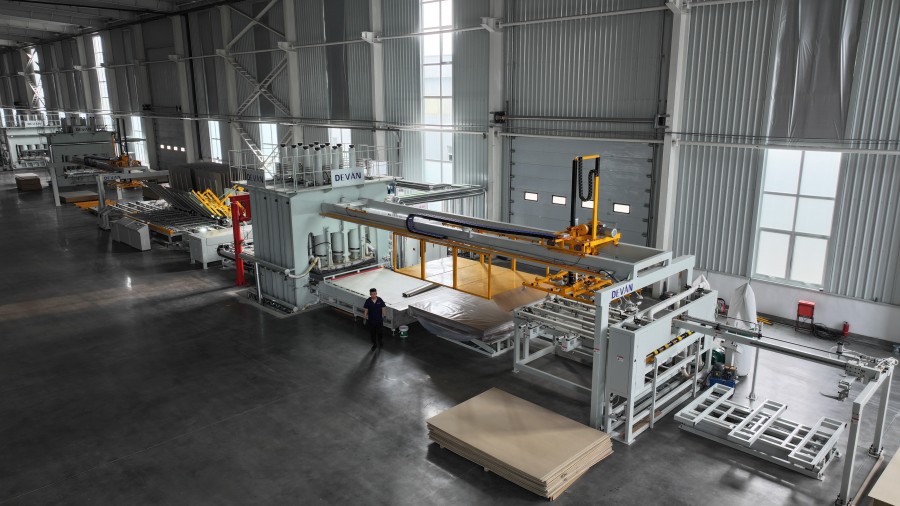
Why Automation Is Essential in Modern Veneer Production
Traditional veneer pressing often depends heavily on manual feeding, parameter adjustment, and handling. This approach limits production speed and increases variability.
Automation transforms veneer production by:
-
Reducing manual intervention
-
Ensuring consistent process parameters
-
Maintaining stable production rhythm
-
Minimizing downtime during changeovers
When automation is integrated into either horizontal or vertical veneer production systems, manufacturers can increase daily capacity while maintaining surface quality.
Horizontal Veneer Production Systems: Designed for High-Volume Output
Horizontal veneer production lines are commonly used in large-scale decorative board manufacturing facilities. Their linear layout makes them ideal for integration into fully automated production lines.
Key Output Advantages
1. Continuous Workflow Integration
Horizontal systems easily connect to sanding lines, feeding systems, stacking equipment, and packaging units. Automated infeed and outfeed trolleys reduce handling time and prevent bottlenecks.
2. Stable Production Rhythm
The structured horizontal flow ensures consistent cycle timing. This stability improves throughput and reduces unplanned interruptions.
3. High Capacity for Standardized Products
Factories producing MDF, HDF, or particleboard panels in large volumes benefit from the horizontal configuration’s ability to maintain steady, high-speed pressing cycles.
For manufacturers focused on maximizing daily output in standardized production environments, horizontal systems provide strong scalability.
Vertical Veneer Production Systems: Flexible and Space-Efficient
Vertical veneer production systems offer distinct advantages, especially in facilities with limited floor space or diversified product requirements.
Output Benefits of Vertical Systems
1. Compact Layout
Vertical presses require less horizontal floor space, allowing manufacturers to optimize plant layout while maintaining high efficiency.
2. Flexible Batch Processing
Vertical systems adapt well to customized production orders and varied panel dimensions. This flexibility supports factories serving multiple product categories.
3. Efficient Parameter Adjustment
With intelligent control integration, vertical systems can quickly switch between product specifications, minimizing changeover downtime.
For manufacturers balancing productivity with flexibility, automated vertical veneer systems offer an effective solution.
Intelligent Control: The Engine Behind Higher Output
Automation alone does not guarantee higher production capacity. Precision control is equally critical.
Changzhou Hanbang Machinery Manufacturing Co., Ltd. integrates advanced human-machine interface (HMI) systems with high-reliability PLC controls to ensure accurate closed-loop management of:
-
Pressure
-
Temperature
-
Pressing time
Operators can manage production with one-button operation, while the system supports recipe storage and retrieval for different board types and decorative processes.
This intelligent control reduces manual adjustments, shortens changeover time, and improves repeatability — all of which directly contribute to higher output.
Short-Cycle Technology: Faster Without Compromising Quality
High-speed production must not sacrifice surface performance.
Hanbang’s veneer hot presses are optimized for rapid lamination of mainstream decorative materials such as melamine-impregnated paper and aluminum oxide wear-resistant paper. Short-cycle technology allows:
-
Faster pressing per board
-
Reduced energy consumption per unit
-
Increased daily production capacity
At the same time, precise control ensures uniform bonding strength and surface flatness.
In high-output environments, short-cycle capability becomes a decisive competitive advantage.
Structural Stability Ensures Continuous Operation
Output growth depends on reliable mechanical performance.
Hanbang’s equipment uses high-strength steel frames and advanced welding technology to maintain structural integrity during long-term high-load operation. Low deformation guarantees uniform pressure distribution and consistent surface quality.
Stable frame structure reduces:
-
Maintenance frequency
-
Mechanical misalignment
-
Production interruptions
Long-term operational stability directly supports sustained high output.
Adaptability Across Multiple Substrates
Modern factories rarely produce a single type of board.
Automated horizontal and vertical veneer systems must adapt to:
-
Particleboard
-
Medium-density fiberboard (MDF)
-
High-density board
-
Plywood
Hanbang’s equipment demonstrates excellent adaptability across various substrates, ensuring consistent performance under different density and thickness conditions.
This versatility allows manufacturers to expand product lines without replacing core equipment.
Customization for Maximum Productivity
Every factory has unique operational conditions, including board dimensions, production targets, automation levels, and plant layouts.
Changzhou Hanbang Machinery Manufacturing Co., Ltd. provides non-standard customization from concept design to final equipment delivery. Engineering teams evaluate each customer’s requirements to develop tailored press solutions that maximize real-world output.
Customization ensures:
-
Optimal equipment sizing
-
Balanced production flow
-
Seamless automation integration
-
Efficient use of available space
Manufacturers seeking advanced automated solutions can explore detailed configurations through the official product portfolio:
<a href="https://www.hnvan.com/Product-Show">automated veneer production system solutions</a>
Comprehensive Service for Sustained Output
Even the most advanced equipment requires professional support.
Hanbang’s customer-centric service system includes:
-
In-depth pre-sales technical consultation
-
Process validation and equipment matching
-
Standardized installation and commissioning
-
24/7 technical support
-
Regular inspection and maintenance guidance
-
Operator training
This lifecycle support ensures veneer production systems maintain high performance and stable output over time.
Supporting Intelligent and Green Manufacturing
Automation not only increases output but also improves resource efficiency.
Short-cycle presses reduce energy usage per board, while precise control systems minimize waste caused by defects. Automated handling reduces material damage and improves workplace safety.
As manufacturers transition toward intelligent and environmentally responsible production, automated horizontal and vertical veneer production systems provide a solid technological foundation.
Changzhou Hanbang Machinery Manufacturing Co., Ltd. continues to drive innovation, focusing on delivering reliable, intelligent, and efficient pressing solutions that help customers strengthen competitiveness and achieve sustainable growth.
Conclusion
Boosting output in modern panel manufacturing requires more than increasing machine speed. It demands integrated automation, precise control, structural stability, and customized engineering.
Automated horizontal veneer production systems excel in high-volume standardized environments, while vertical systems provide flexibility and space efficiency for diversified production needs. Both configurations, when supported by intelligent short-cycle pressing technology, significantly enhance production capacity.
By combining advanced engineering, automation integration, and comprehensive service, Changzhou Hanbang Machinery Manufacturing Co., Ltd. empowers manufacturers to improve efficiency, maintain quality, and build scalable production systems for the future.
Output growth begins with the right technology foundation — and automated veneer production systems are at the center of that transformation.
www.hnvan.com
HANBANG