You notice new technology every time you pick clear aligners for your teeth. Patient-focused tools like AI and robotics help you get better results. You also need fewer trips to the dentist. Digital monitoring tools let you see your progress. They help you stay excited about your treatment. New clear aligner manufacturing equipment makes them more comfortable. This equipment also ensures they fit better and last longer. You get help from new technology trends. These trends make orthodontics easier to access and cost less money. The table below shows how these changes help you:
|
Aspect |
Improvement Description |
|---|---|
|
Patient Experience |
Digital monitoring tools mean fewer office visits. This makes treatment easier for you. |
|
Treatment Outcomes |
AI helps plan your treatment. This makes your timeline more clear and your case easier to manage. |
|
Accessibility |
More providers are available now. This makes it easier for you to get consultations and treatment. |
|
Cost |
More providers means prices are lower. Clear aligners now cost less for more people. |
|
Patient Compliance |
Regular check-ins, in-person or online, help you follow your treatment plan. |
|
Engagement |
Digital monitoring helps you stay motivated. You can see your progress right away. |
Key Takeaways
-
AI technology helps make treatment more accurate. It can guess how your teeth will move. This makes your orthodontic journey easier.
-
Remote monitoring tools mean you do not need as many office visits. This saves you time. It also helps you stay involved in your treatment.
-
3D printing makes aligners faster to make. This gives you a better fit. It also lowers costs for patients.
-
Automated manufacturing equipment makes aligners better and more alike. This helps you get better results from treatment.
-
New materials in aligners are safer and more comfortable. They are also better for the environment. This is good for you and the planet.
Technological Advancements in Clear Aligners
AI Integration for Precision
When you start clear aligners, you see new technology. AI helps plan your treatment for a better fit. It shows how your teeth will move before you begin. You know what will happen next. AI looks at your teeth and gives you choices just for you. This makes your treatment more accurate and easier. You can change your plan fast with real-time tracking. Technology helps make orthodontics more exact.
-
AI makes treatment more accurate by showing tooth movement.
-
Real-time tracking helps keep your plan on track.
-
AI gives you choices that fit your needs.
Predictive Analytics in Treatment Planning
Your provider uses predictive analytics to plan your care. Machine learning guesses how your teeth will move and how long it will take. Your provider thinks about things like how well you follow the plan and when you start. This helps you know your timeline and results. Advanced analytics find patterns that old ways miss. You get a plan that fits you and makes you happier.
-
Machine learning guesses what will happen in your treatment.
-
Providers use many things to make your plan.
-
Advanced analytics help you get better results.
Remote Monitoring and Teleorthodontics
Remote monitoring lets you use new technology in orthodontics. You save time and skip extra visits. Digital tools help you check your progress at home. Your provider looks at your aligners online and gives advice. You see your results and stay excited. The table below shows how remote monitoring helps you:
|
Benefit |
Measurement |
|---|---|
|
Appointment Efficiency |
1.68 fewer appointments on average |
|
Patient Experience Rating |
4.31/5 for ease of use |
|
4.4/5 for treatment benefit |
|
|
Reduction in Check-up Visits |
58% reduction for aligners |
|
Time Saved |
451 chairtime hours saved in 2024 |
|
Emergency Visits |
80.8% fewer unplanned emergencies |
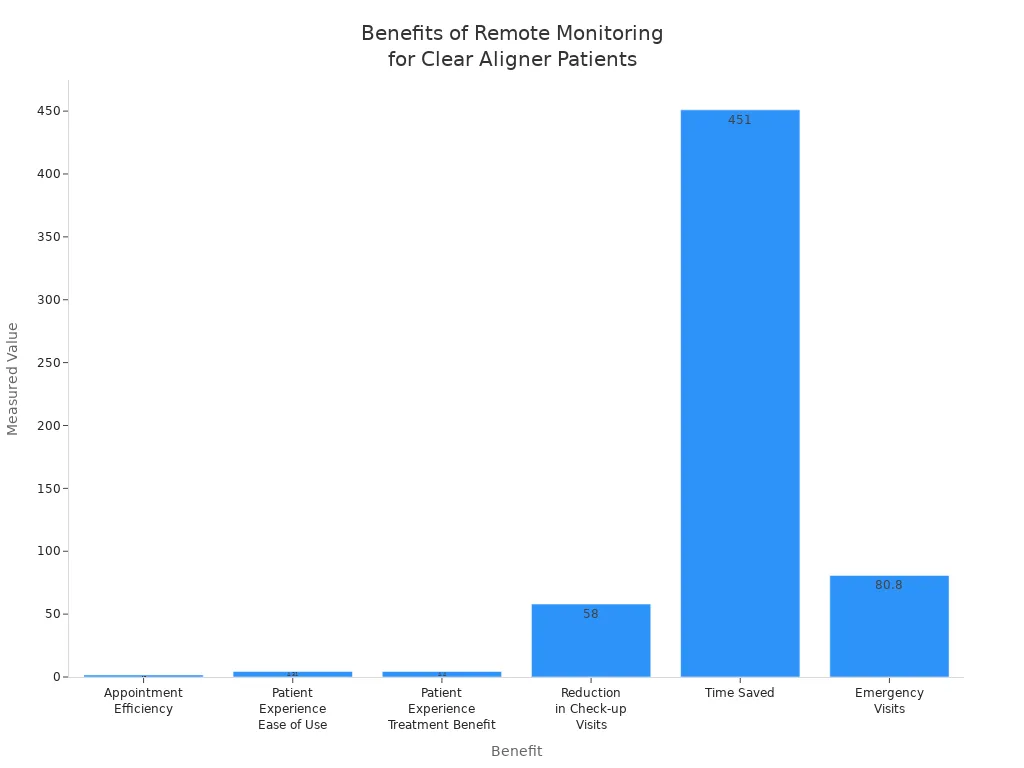
You talk to your provider more easily and have fewer visits. Technology makes orthodontics simpler and more comfortable. New trends focus on helping patients, so clear aligners are a popular choice.
3D Printing in Orthodontics
Direct 3D Printing of Aligners
You see big changes in orthodontics because of 3d printing in orthodontics. Direct 3d printing in orthodontics lets you get your aligners much faster. You do not have to wait weeks for your new trays. Now, you can get them in just hours. 3d printing in orthodontics skips the old model-based steps. This means less waste and a more eco-friendly process. You also get aligners that fit better. The thickness stays the same across each aligner, which helps your teeth move the right way. 3d printing in orthodontics uses a digital workflow. Your provider scans your mouth and sends the file straight to the printer. You get a custom fit every time. This new 3d printing technology makes your treatment more accurate and predictable.
FDA-Cleared Resins and Materials
You want your aligners to be safe and strong. 3d printing in orthodontics uses special materials that meet strict rules. Some of the latest FDA-cleared resins and materials include:
-
Tera Harz TC-85 from Graphy in Seoul, South Korea
-
Dental Long Term (LT) resin from Form Labs in Massachusetts
-
Accura 60 SLA from 3D Systems in South Carolina
These materials help make sure your aligners are safe for your mouth. They also last through your treatment. 3d printing in orthodontics gives you peace of mind because your aligners use tested and approved materials.
Cost Reduction and Customization
3d printing in orthodontics helps lower the cost of your treatment. You get aligners made just for you. Each set matches your teeth perfectly. This means better results and a more comfortable fit. You also get your aligners faster, sometimes in just a few days. Here are some ways 3d printing in orthodontics helps you:
-
Aligners fit your teeth exactly, so your treatment works better.
-
You get your aligners quickly, which keeps you on track.
-
The process costs less, so more people can afford orthodontics.
3d printing in orthodontics makes your treatment faster, more personal, and more affordable. You benefit from new technology that changes how orthodontics works for everyone.
Clear Aligner Manufacturing Equipment
Automated Thermoforming and Trimming
Orthodontics is changing because of automated thermoforming and trimming. This clear aligner manufacturing equipment uses new technology to shape and cut trays very accurately. You get trays that fit well and feel good. Automated machines work all day and night, so you get your aligners faster. The machines use micro-negative pressure thermoforming to keep tray thickness the same. This fixes problems with uneven trays and helps your treatment stay on track.
Here is a table showing how these features help you:
|
Feature |
Description |
|---|---|
|
24-Hour Operation |
Machines run all day, making up to 720 clear aligners daily. |
|
Automatic Cutting |
Each tray gets trimmed in less than 40 seconds, so you wait less for your new aligners. |
|
Micro-Negative Pressure Thermoforming |
Keeps tray thickness even, improving fit and comfort. |
|
Algorithm-Driven Laser Cutting |
Cuts trays with precision, matching your treatment plan. |
Automated thermoforming and trimming make orthodontics faster and easier. You get better results and spend less time waiting for your clear aligners.
Robotics and 3D Vision Systems
Robotics and 3D vision systems change how clear aligner manufacturing equipment works. You benefit from machines that use smart sensors and cameras to see and handle trays carefully. Robots grab, cut, and move trays without mistakes. 3D vision helps machines follow the right path, so each tray matches your mouth. You get clear aligners that fit well and move your teeth the right way.
The table below shows how robotics and 3D vision systems help you:
|
Feature |
Benefit |
|---|---|
|
Runs 24 hours, making 720 trays daily with automatic grabbing and cutting. |
|
|
Collision-Free Toolpath Generation |
Reduces trimming time and keeps trays safe from damage. |
|
Integration with Existing Systems |
Works with dental labs, making orthodontics easier for providers and patients. |
Robotics and 3D vision systems make clear aligner manufacturing equipment smarter. You get trays with better quality and fewer errors.
Quality Consistency and Reduced Manual Intervention
You want clear aligners that work well every time. Quality consistency and reduced manual intervention help you get the best results. Machines use CAD/CAM systems to design and make trays with high precision. Automated quality control systems check each tray with lasers and cameras. You get safe and reliable clear aligners. The machines spot problems early, so you avoid recalls and delays.
Here is a table showing how these systems improve your experience:
|
Evidence Type |
Description |
|---|---|
|
CAD/CAM Systems |
Design trays with accuracy, reducing mistakes and improving fit. |
|
Automated Quality Control Systems |
Use machine vision and laser scanning to check trays in real time. |
|
Automation Technologies |
Allow mass customization and fast production, so you get trays that match your needs. |
|
Integration of Quality Assurance |
Combine quality checks with digital workflows for better reliability and results. |
You also save money with advanced clear aligner manufacturing equipment. In-office production costs about $12 to $13 per tray, while outside vendors charge $20 to $25. You get your trays faster and pay less. Digital workflows help providers customize trays for you and reduce waste.
Tip: If you choose orthodontics with advanced clear aligner manufacturing equipment, you get a better fit, faster service, and lower costs.
You see how technology, design, and automation work together to make orthodontics easier and more reliable. Clear aligner manufacturing equipment brings precision, efficiency, and stability to your treatment.
Materials Innovation for Clear Aligners
Advanced Polymers and SmartTrack Material
There are big changes in orthodontics because of new materials. Companies use advanced polymers to make aligners that fit your teeth better. SmartTrack material is special because it is flexible and gentle. You can see the latest choices in the table below:
|
Feature |
EX30 |
SmartTrack™ (LD30) |
|---|---|---|
|
Material Type |
Polyurethane methylene diphenyl diisocyanate 1.6-hexanediol |
Multi-layer aromatic thermoplastic polyurethane/co-polyester |
|
Elasticity |
1.5 times greater than PC 30 |
Greater elasticity |
|
Adaptability |
4 times more adaptable than PC 30 |
Improved adhesion and comfort |
|
Force Application |
Less consistent |
Gentle and more constant force |
|
Clinical Performance |
No significant difference in PAR score reduction compared to SmartTrack™ |
Greater consistency and long-term action |
These aligners move your teeth gently and feel comfortable. This new technology helps you get better results faster.
Durability, Comfort, and Biocompatibility
You want aligners that last for your whole treatment. New studies show that modern materials are stronger and more comfortable. You can see how these materials work in the table below:
|
Study |
Findings |
Improvements |
|---|---|---|
|
Bucci et al., 2019 |
Investigated mechanical characteristics of clear aligner materials |
Demonstrated improvements in durability |
|
Lombardo et al., 2017 |
Examined stress resistance of materials |
Showed significant resistance to stress in monolayered aligners |
|
Martina et al., 2019 |
Evaluated biocompatibility of thermoplastic materials |
Indicated low cytotoxicity of clear aligners |
|
Kado et al., 2020 |
Compared periodontal health with fixed appliances |
Found better maintenance of periodontal health with clear aligners |
|
Rossini et |