Air bubbles and unexplained pressure loss are among the most common—and most underestimated—issues in spillway gate hydraulic systems. Unlike visible mechanical failures, these hydraulic anomalies often develop gradually, manifesting as unstable gate motion, delayed response, loss of positioning accuracy, or abnormal noise during operation. If not addressed early, they can escalate into cavitation damage, seal failure, or even uncontrolled gate movement.
In water conservancy projects such as reservoirs, sluices, and hydropower stations, gate hoist hydraulic systems are required to deliver high load capacity, precise control, and continuous reliability under harsh environmental conditions. Huoheshi Hydraulic Technology designs gate opening and closing hydraulic systems specifically for these demanding applications, but stable long-term operation still depends on correct diagnosis and systematic troubleshooting of air ingress and pressure loss.
Why Air Bubbles and Pressure Loss Often Appear Together
In hydraulic transmission systems, air presence and pressure instability are closely linked. Industry data from hydraulic equipment maintenance organizations indicates that over 60% of pressure fluctuation faults are directly or indirectly related to entrained air in the hydraulic circuit.
Air compressibility disrupts the fundamental assumption of hydraulic systems—that fluid is incompressible. Once air enters the system, it compromises pressure transmission efficiency, response accuracy, and load-holding capability.
Typical Symptoms in Spillway Gate Hydraulic Systems
Before disassembly or component replacement, operators should recognize early-stage symptoms:
-
Irregular gate speed during lifting or lowering
-
Difficulty maintaining intermediate positions (loss of hydraulic locking stability)
-
Pressure gauge oscillation during steady operation
-
Abnormal noise or vibration from pumps and valves
-
Increased oil temperature without corresponding load increase
Huoheshi gate hoist hydraulic systems are designed with ±1 mm positioning accuracy and hydraulic lockout protection. Deviation from this performance envelope is often the first indication of air-related faults.
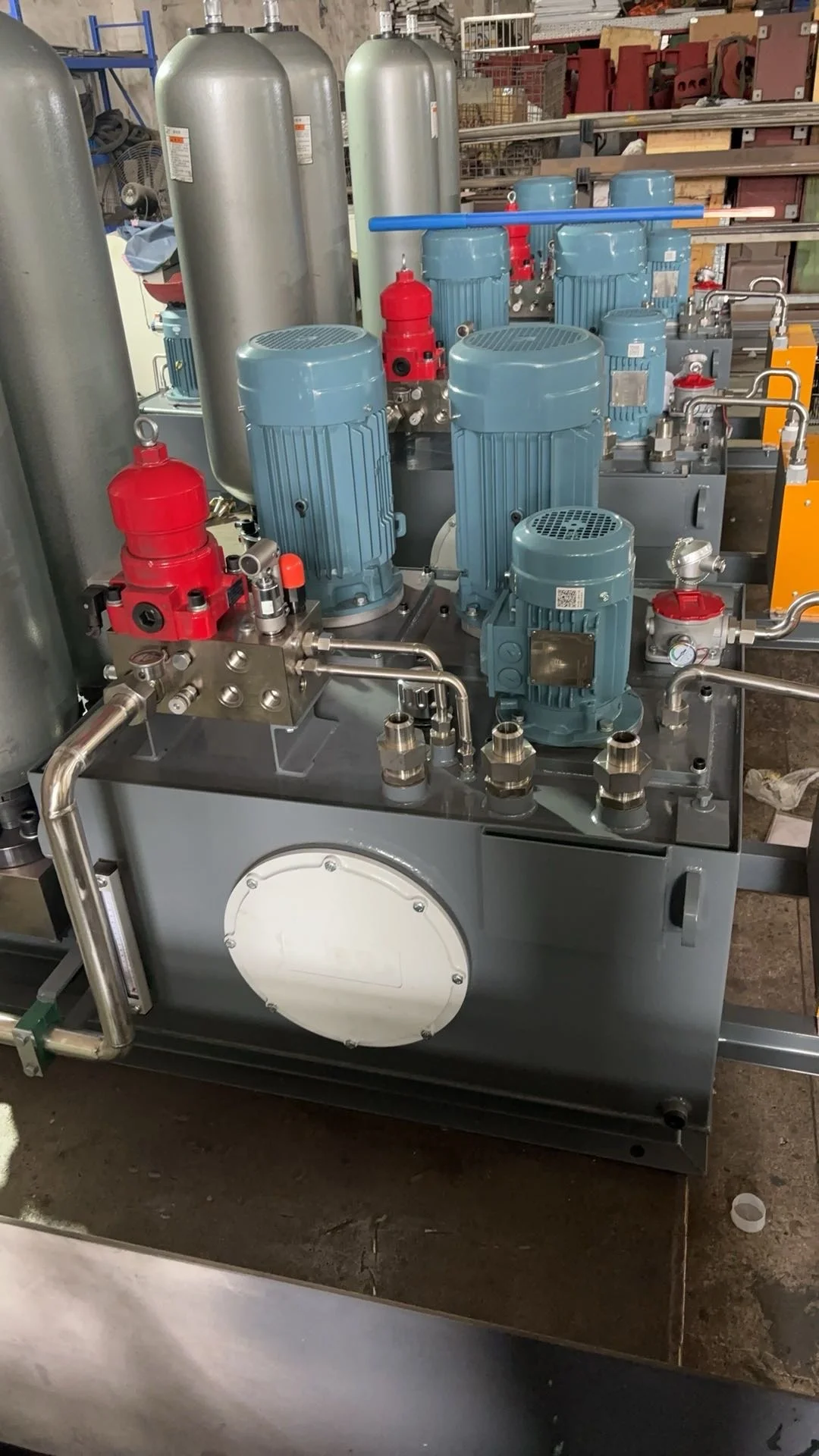
Root Causes of Air Ingress in Gate Hoist Hydraulics
Low-Pressure Side Leakage
Air typically enters hydraulic systems through the suction side rather than the pressure side. Common leakage points include:
-
Pump inlet seals
-
Flange connections with insufficient surface flatness
-
Aging or improperly specified hoses
Even micro-leaks invisible to oil seepage can introduce air under negative pressure conditions.
Improper Oil Filling and Commissioning Procedures
Incomplete bleeding during initial commissioning or maintenance is a frequent cause of persistent air pockets. According to hydraulic commissioning guidelines, up to 30% of air-related failures originate from insufficient system venting after oil replacement or component servicing.
Huoheshi Hydraulic systems are designed using FLUIDSIM and other simulation tools to ensure reasonable flow paths, but correct on-site commissioning remains essential.
Cavitation-Induced Air Release
When local pressure drops below the vapor pressure of hydraulic oil, dissolved gases are released, forming bubbles. Cavitation is particularly likely in:
-
High-flow, high-load gate opening phases
-
Cold-start conditions in low-temperature environments
-
Systems with excessive flow velocity at pump inlets
Understanding Pressure Loss Beyond Air Contamination
While air is a major factor, pressure loss may also originate from other system-level issues.
Internal Leakage Under High Load
In spillway gates with opening and closing forces reaching hundreds of tons, internal leakage within cylinders or valves becomes more pronounced. Seal wear, spool clearance enlargement, or surface damage can all reduce effective pressure.
Huoheshi Hydraulic cylinders employ anti-corrosion treatments such as hard chrome plating and stainless steel construction, improving sealing reliability even in humid and high-salt environments.
Load-Sensing and Variable Pump Mismatch
Huoheshi gate hoist systems frequently adopt variable displacement pumps combined with load-sensing technology, reducing energy consumption by over 30%. However, incorrect parameter settings or sensor drift may cause insufficient pressure build-up under transient load conditions.
Systematic Troubleshooting Methodology
Step 1: Stabilize and Monitor
Before intervention, operate the system at low speed and record:
-
Pressure variation range
-
Temperature rise rate
-
Response delay under constant load
This baseline helps differentiate air-related compressibility effects from mechanical leakage.
Step 2: Controlled Bleeding and Degassing
Bleeding must be performed sequentially, starting from the lowest pressure zones and progressing toward actuators. Rapid venting is discouraged, as it may reintroduce air through turbulence.
Industry best practice suggests slow circulation with partial load to allow micro-bubbles to migrate naturally to vent points.
Step 3: Verify Suction Integrity
Inspect all pump inlet components, paying particular attention to hose stiffness, sealing surfaces, and installation torque. Suction-side faults are the primary entry path for air.
Design Features That Reduce Air Sensitivity
Huoheshi Hydraulic integrates multiple design strategies to minimize air-related issues:
-
Optimized oil tank geometry to promote natural air separation
-
Reasonable pipe diameter selection to reduce flow velocity
-
Hydraulic lockout and explosion-proof valves to maintain gate position stability
-
Redundant key components, achieving a system failure rate below 0.1%
Lean Six Sigma and 4M1E variable control methodologies are applied throughout manufacturing to ensure consistent quality.
Environmental Factors in Water Conservancy Applications
Temperature Extremes
Gate hoist systems often operate in environments as low as -30°C. Low temperatures increase oil viscosity, elevating suction resistance and cavitation risk during startup.
High Humidity and Corrosive Conditions
Humidity and salt spray accelerate component aging, indirectly increasing air ingress risk through seal degradation. Anti-corrosion treatments significantly mitigate this effect.
Preventive Maintenance Intervals That Matter
| Maintenance Interval | Key Focus |
|---|---|
| Monthly | Pressure stability, noise inspection |
| Quarterly | Oil condition and air release checks |
| Annually | Seal inspection, pump efficiency evaluation |
Studies from hydraulic maintenance associations indicate that preventive air management can reduce major hydraulic failures by over 40% in large gate systems.
Frequently Asked Questions
Is air in hydraulic oil always visible?
No. Micro-bubbles may not be visible but still affect system stiffness and control accuracy.
Can pressure loss be compensated by increasing pump pressure?
This approach often masks the root cause and accelerates component wear.
How long does proper degassing take?
Depending on system size, complete air removal may require several controlled operation cycles.
Do redundant components eliminate pressure loss risks?
Redundancy improves reliability but does not replace proper commissioning and maintenance.
Why Professional Operators Prioritize Hydraulic Stability
In water conservancy and hydropower projects, gate hoist systems are safety-critical assets. Unstable pressure or delayed response directly increases operational risk.
Huoheshi Hydraulic Technology’s integrated R&D, manufacturing, and service model—supported by advanced design software, automated equipment, and responsive suppliers—ensures that gate hoist hydraulic systems are not only powerful, but controllable, efficient, and reliable over long service cycles.
Final Insight
Air bubbles and pressure loss are not isolated faults; they are system-level signals that hydraulic balance has been compromised. Addressing them requires structured diagnosis, disciplined maintenance, and a system designed for stability under extreme loads and environments.
When advanced hydraulic design meets proper operational management, spillway gate hydraulic systems deliver the precision, safety, and durability demanded by modern water conservancy infrastructure.
www.huoheshi-hydro.com
Huoheshi Hydraulic Technology