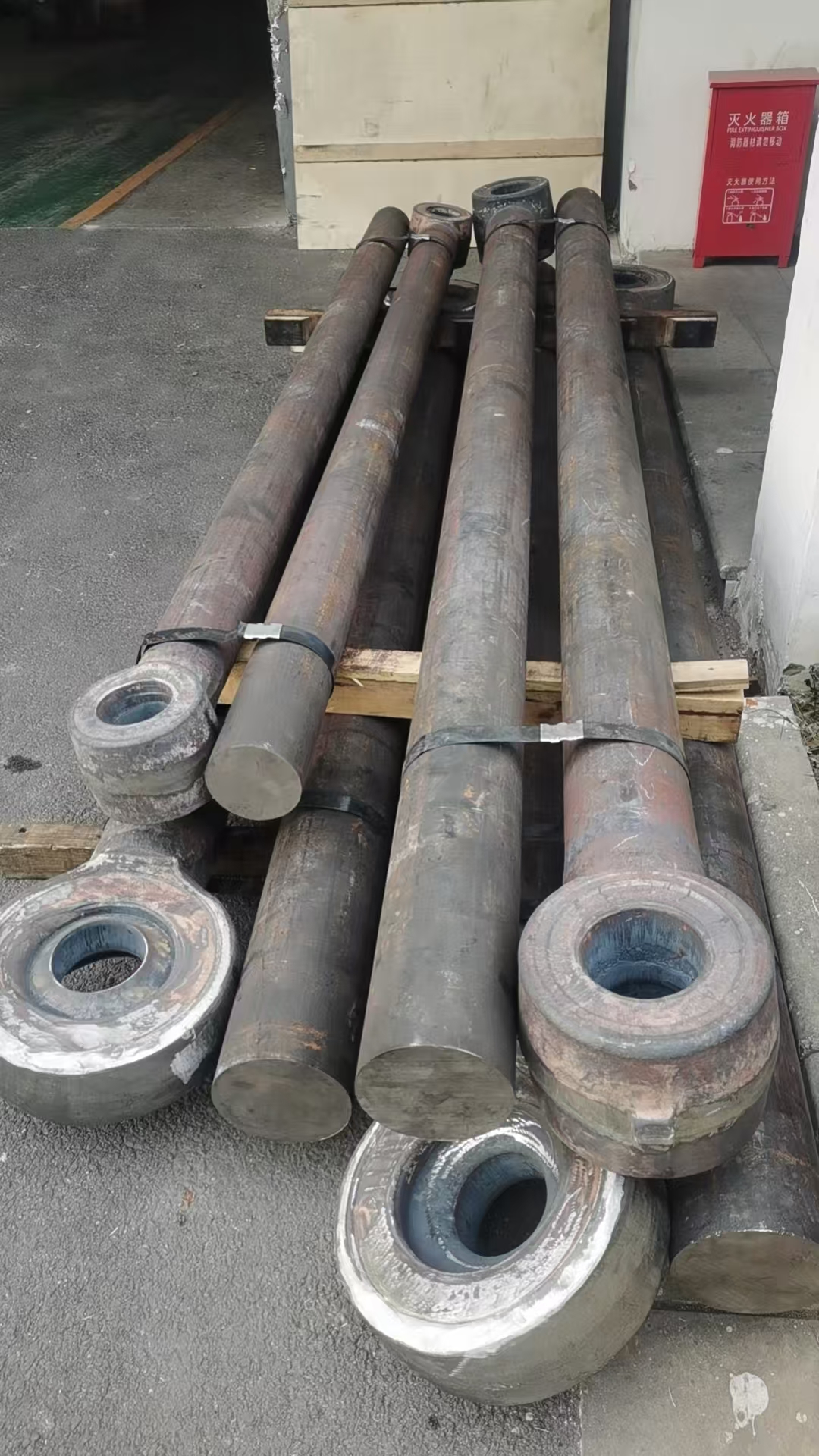
Forging is a commonly used process in piston rod production. The principle of piston rod forging is to heat the metal material to a certain temperature and then apply pressure using large forging equipment to press the material into shape. Through special molds and cooling devices, the resulting piston rod undergoes tempering, annealing, and other treatments to give it good mechanical properties.
The piston rod forging process generally consists of the following steps:
1. Material heat treatment: Heating the raw material to a certain temperature to achieve a degree of deformation.
2. Machining program design: Designing a suitable machining program to achieve the ideal shape and size.
3. Workpiece heating: Reheating the machined workpiece to a temperature conducive to deformation.
4. Forging: Pressing the workpiece using large forging equipment.
5. Heat treatment: Treating the resulting piston rod through methods such as annealing and tempering to stabilize its mechanical properties.
6. Performance testing: Performing quality testing on the obtained piston rod to ensure it meets relevant performance and process requirements.
Piston rod forging technology has significant application and development prospects. By continuously improving processing equipment and technology, forging processes are constantly evolving towards higher precision, higher stability, lower energy consumption, and lower cost. Piston rod forging technology has wide applications in critical fields under high-load environments such as the automotive industry, petrochemical industry, and aerospace industry.
www.tianjian-hydrauliccylinder.com
Tianjian Hydraulic Technology