In modern cable manufacturing, high-precision copper twisting machines are essential for producing multi-strand wires with exacting requirements for tension and pitch. Jinghan Machinery, with over two decades of R&D and engineering experience, has developed stranders that ensure stable tension and accurate pitch across a wide range of cable types, including data cables, computer cables, power cables, and high-frequency lines.
This article examines the technical principles, design innovations, and operational strategies that guarantee stranding tension stability and pitch accuracy in high-performance copper twisting machines.
1. Mechanical Design Principles for Tension Stability
Mechanical stability is the foundation of consistent stranding:
-
Axial Arrangement of Capstans: Jinghan Machinery employs an axial arrangement that allows precise control over wire alignment, reducing lateral deviation and ensuring uniform tension across strands.
-
Rigid Frame Construction: A vibration-resistant frame minimizes mechanical oscillation, preserving consistent tension during high-speed rotation.
-
Belt and Reel Synchronization: Maintaining constant tension from an empty reel to a full reel is critical. Synchronization mechanisms ensure that rotational speed adjustments do not compromise tension uniformity.
2. Tension Control Technology
Accurate tension control is vital to prevent wire deformation and ensure consistent pitch:
-
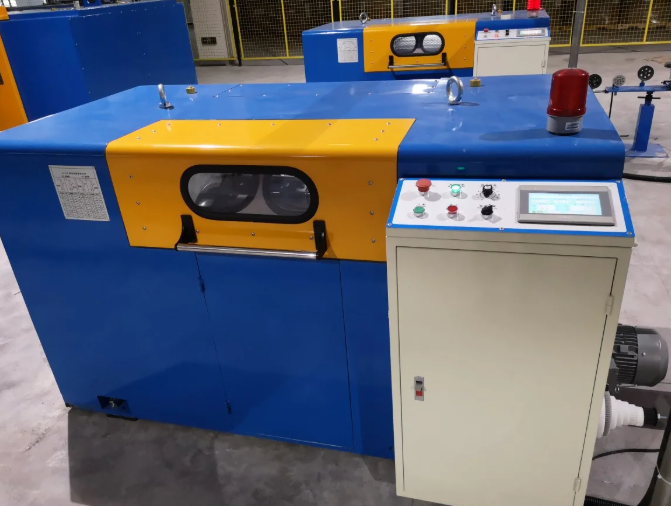
PLC-Based Control System: Tension is set through a touch screen interface and regulated by a programmable logic controller (PLC). The system maintains tension stability during acceleration, deceleration, and normal operation.
-
Feedback Loops: Real-time monitoring of wire tension allows automatic adjustments, compensating for fluctuations due to reel weight changes or process dynamics.
-
Load Cell Integration: Load sensors measure tension at multiple points, providing precise data to maintain uniform stranding pressure across all strands.
3. Pitch Accuracy and Wire Arrangement
Pitch accuracy determines the electrical and mechanical performance of the cable:
-
Axial Wire Arrangement: This configuration allows arbitrary setting of row width and spacing, ensuring uniform twisting and optimal conductor packing.
-
Precision Pull-Type Cantilever Design: The latest Jinghan single-strand winding machines employ pull-type cantilever systems to enhance winding accuracy and minimize strand displacement.
-
High-Speed Rotation: Optimized mechanical design supports high rotational speeds, doubling production efficiency compared to traditional vertical stranders without compromising pitch accuracy.
4. High-Speed Production and Stability
Balancing speed with precision requires advanced engineering:
-
Optimized Capstan Mechanics: Capstans are designed for minimal slip and precise torque transfer, maintaining wire tension even at high line speeds.
-
Dynamic Tension Compensation: The PLC system automatically adjusts for tension variations due to acceleration, deceleration, or reel weight changes.
-
Reduced Mechanical Lag: Precision gears and high-quality bearings minimize inertia effects, ensuring smooth rotation and consistent pitch.
5. Temperature and Environmental Considerations
While copper twisting is largely mechanical, environmental factors influence tension and accuracy:
-
Thermal Expansion Compensation: Wire guides and capstans are designed to accommodate minor thermal expansion without affecting tension.
-
Humidity and Lubrication Control: Proper lubrication reduces friction and prevents tension spikes due to surface oxidation or environmental humidity.
-
Vibration Isolation: Rigid mounting and damping components prevent external vibrations from impacting wire alignment and pitch consistency.
6. Quality Assurance and Testing
Jinghan Machinery integrates rigorous QA protocols to ensure optimal tension and pitch:
| Parameter | Control Method | Achieved Performance |
|---|---|---|
| Stranding Tension | PLC feedback, load cells | Stable across empty to full reels |
| Pitch Accuracy | Axial arrangement, cantilever pull system | Consistent strand spacing within specification |
| Rotational Speed | High-precision bearings and gears | High-speed operation without tension fluctuation |
| Wire Alignment | Axial guides and capstans | Minimal lateral displacement |
| Production Efficiency | Optimized mechanical design | Twice the output of vertical stranders |
-
Real-Time Monitoring: Continuous sensors monitor tension and pitch, allowing operators to make instant adjustments.
-
Post-Production Verification: Measurement tools validate pitch accuracy and tension uniformity, ensuring compliance with international cable standards.
7. Application Versatility
Jinghan Machinery’s copper twisting machines are suitable for a wide range of cable applications:
-
High-Frequency Cables: Precise pitch and tension maintain signal integrity and minimize interference.
-
Data and Computer Cables: Ensures uniform strand arrangement for reliable transmission and mechanical stability.
-
Power Cables: Accurate tension prevents conductor deformation and maintains electrical safety standards.
-
Multi-Strand Core Wires: Supports complex multi-strand arrangements while maintaining consistent tension across all strands.
8. Operational Optimization
Maximizing machine performance involves strategic operational practices:
-
Initial Tension Calibration: Properly setting tension before production ensures consistent pitch throughout the run.
-
Synchronized Reel Handling: Coordinated unwinding and winding prevent tension fluctuations from reel weight changes.
-
Periodic Maintenance: Bearing lubrication, belt inspection, and tension sensor calibration preserve long-term accuracy.
-
Touch Screen Interface Usage: Operators can easily adjust tension, speed, and pitch settings to match different cable specifications.
9. FAQ
Q1: How is tension stability maintained from empty to full reel?
A1: The PLC-controlled tension system, combined with load cell feedback and synchronized reels, maintains consistent tension throughout the entire winding process.
Q2: Can pitch accuracy be adjusted for different cable types?
A2: Yes, axial arrangement and row spacing can be configured to meet specific cable requirements without compromising accuracy.
Q3: What is the production efficiency compared to traditional stranders?
A3: High-speed pull-type cantilever designs achieve up to twice the production rate of vertical stranders while maintaining tension and pitch stability.
Q4: How are environmental factors managed during high-precision stranding?
A4: Thermal expansion compensation, vibration isolation, and humidity/lubrication control ensure stable operation.
Q5: Are these machines suitable for high-frequency and data cable production?
A5: Absolutely. Precision tension and pitch control preserve electrical integrity and conductor uniformity for sensitive applications.
Conclusion
Stranding tension stability and pitch accuracy are critical factors for producing high-quality copper cables with optimal mechanical and electrical properties. Jinghan Machinery’s high-precision copper twisting machines integrate advanced mechanical design, PLC-controlled tension regulation, axial wire arrangement, and high-speed rotational capabilities to ensure consistent performance.
By combining decades of technical expertise, patented innovations, and rigorous quality control, Jinghan Machinery enables cable manufacturers to produce multi-strand copper wires for data, high-frequency, computer, and power applications with unmatched precision and efficiency. Proper setup, continuous monitoring, and preventive maintenance further enhance reliability, making these machines a cornerstone of modern cable production.
www.jinhanmachinery.com
Jinghan Machinery (Dongguan) Co., Ltd.