No single heating route wins every metric. If the pack is compact and has no coolant plumbing, a self-limiting carbon-based PTC film bonded between the cells gives the shortest heat path, the simplest BMS logic and the lowest installed cost. If the pack already carries a liquid loop, that loop wins on temperature uniformity. Anyone searching PTC heating film versus silicone heating pad for EV battery preheating is really asking one question: how much of the heater's output reaches the cell, and how much is lost on the way. This 2026 comparison from YOTTECH, the export brand of Jiangsu Yottuo New Materials Co., Ltd., a China manufacturer of carbon-based PTC heating film, rates six routes on the same five metrics — and states plainly where a film is the wrong answer.
The six contenders: carbon-based PTC film, silicone rubber pad, PI etched foil, ceramic PTC element, liquid coolant loop, and internal AC self-heating. Competitor comparisons almost always cover two of them and favour whatever the writer sells. Here they are held to one set of numbers.
Published: November 13, 2026 | By YOTTECH Engineering Team
1. Which route has the lowest thermal resistance, and how fast does it warm a cold pack?
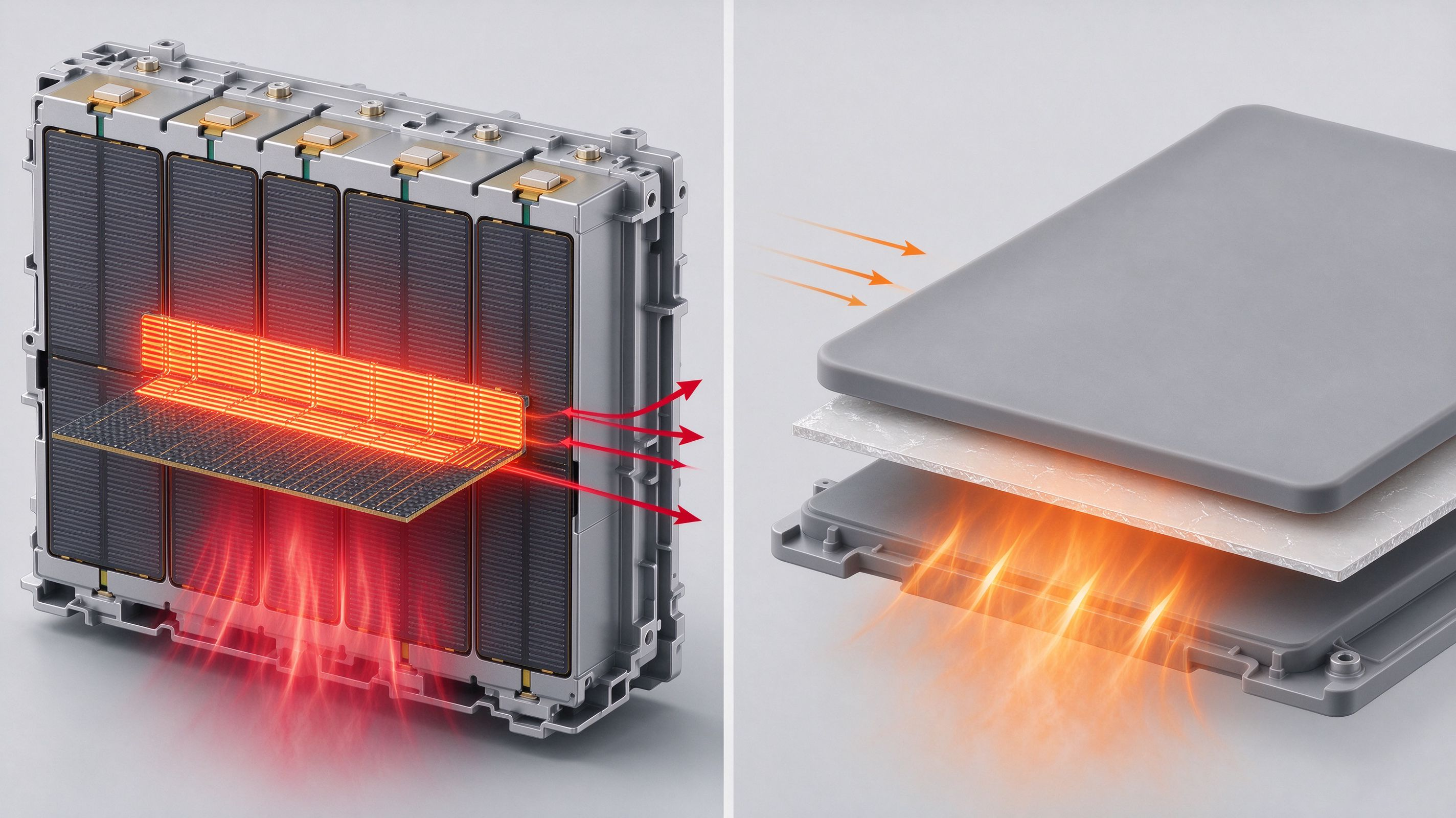
At module level, an interlayer PTC film bonded directly to the cell wins: it removes both the air gap and the thick rubber layer, so Q = ΔT/Rth is maximised before the BMS is even involved. At system level the answer changes, because a liquid loop can move heat across an entire pack rather than one face. Which battery heating technology has the lowest thermal resistance is therefore a question about where you measure — at the cell interface, or across a 60 kWh enclosure.
✅ Carbon-based PTC film: 0.5 mm typical, 0.2-0.6 W/cm² on the cell face, self-limiting via its R-T curve, no external temperature controller required. Published thermal efficiency exceeds 70% in one product line.
✅ Silicone rubber pad: 1.5-3 mm plus adhesive, constant power, needs a thermostat, fuse and thermal cut-off. Robust and cheap per piece, but the rubber is an insulator sitting between heater and cell.
✅ PI etched foil: thinnest of all and very uniform, but also constant power — the control burden simply moves into the BMS.
✅ Ceramic PTC element: genuinely self-regulating, but a point heat source with a thick body that does not fit CTP/CTC cell gaps.
✅ Liquid loop: best uniformity (±2 °C is realistic) and reuses the cooling circuit; adds pump, glycol, seals and freeze protection at -25 °C.
✅ Internal AC self-heating: zero added hardware, but it consumes SoC directly and depends on cell impedance that rises sharply when cold.
Speed follows the same logic. Lifting a 2.5 kWh module from -20 °C to +10 °C needs about 125 Wh of pure heat, or 160-200 Wh with losses; a 120 W film does it in 80-100 minutes. A pad of the same wattage takes longer because part of its output heats the rubber, and a liquid loop spends the first minutes warming the coolant itself. Ask which battery heating technology has the lowest thermal resistance at the exact mounting position in your tray, not on a datasheet measured in free air. One published datasheet reports a 45 °C rise in 24 seconds in free air — a number that says nothing about a cell stack with adhesive and an aluminium can in the path.
The PTC heating film versus silicone heating pad for EV battery preheating decision also changes with compliance. A constant-power pad must be proven safe under a stuck relay; a self-limiting film throttles itself near its switching temperature, so the failure mode is bounded. For a high-voltage platform, however, film trace layout needs EMC attention — parallel traces that cancel fields and a grounded foil shield are the usual route to CISPR 25 Class 5. YOTTECH documents the R-T behaviour of each production lot so integrators can model the inrush before choosing a relay; see the PTC heating film overview for the material system behind it.
✅ Bottom line: Bonded interlayer film wins at the cell; a liquid loop wins across the pack. Measure thermal resistance where the heat actually crosses.
2. When is a PTC film the wrong choice, and how do you compare suppliers fairly?
A PTC film is the wrong choice when the pack already carries a coolant loop, when the spec demands ±2 °C across a large enclosure, or when the required preheat window is under ten minutes on a very large pack. In those cases the film becomes a parallel system that adds cost without adding uniformity. It is also a poor fit where the cell surface cannot be reached — a sealed structural pack with no accessible face is better served by heating the plate it sits on.
A PTC heating film versus silicone pad China supplier comparison should hold both quotes to identical test conditions, otherwise the cheaper offer is simply the less tested one. Request six items with every sample:
✅ R-T curve and switching temperature of the actual production lot, not a generic family curve.
✅ Cold-start current at your minimum ambient, plus dielectric withstand and insulation resistance results.
✅ Thermal image of the module at full power with the ≤5 °C spread criterion stated.
✅ Power attenuation after 1,000 thermal cycles; ΔR ≤5% is a common acceptance line.
✅ Die-cut tolerance, terminal position and contact pressure for your tray drawing.
✅ Documented certifications — ask for evidence rather than assuming automotive approvals are in place.
Use this PTC heating film versus silicone pad China supplier comparison checklist before tooling, and the cost picture sharpens quickly. Standard-grade film is quoted around USD 20-45/m² at volume while certified high-end grades reach USD 55-100/m²; a silicone pad is cheap per piece but adds a controller, wiring and assembly labour. Jiangsu Yottuo New Materials Co., Ltd. supplies OEM/ODM custom films from a 5,000 m² plant with annual capacity above 1 million m² and CQC certification for electric heating film. For EV and commercial-vehicle programs, see the PTC battery heating solution for passenger and commercial EVs, then request documented evidence of any additional approvals your customer requires.
One trap worth naming: YOTTECH sees quotes that compare a film's per-square-metre price with a pad's per-piece price. Normalise both to cost per heated cell face, including the controller and the assembly step. That single conversion usually reverses the apparent winner.
✅ Bottom line: Choose by installed cost per heated cell face and uniformity, and take the liquid loop when the pack already has one.
Frequently Asked Questions
Q: Which of these six routes needs no external temperature controller?
A: In a PTC heating film versus silicone heating pad for EV battery preheating comparison, the carbon-based PTC film and the ceramic PTC element are the two that self-limit. The BMS still enables and disables them, but a stuck relay cannot drive them past their switching temperature.
Q: Can a heating film be retrofitted into an existing pack design?
A: Yes, provided one cell face or the tray is accessible. Send the tray drawing, pack voltage and coldest ambient, and a die-cut film with matched terminals can usually be validated without changing the module tooling.
Q: Do you offer OEM supply for volume battery programs?
A: Yes. YOTTECH provides OEM/ODM custom heating films with lot-specific R-T reports, sample plans and wholesale price tiers from its factory in Xinyi, Jiangsu. Request the six-item evidence list above with your quotation.
Get a Route Comparison for Your Pack
Send YOTTECH your pack dimensions, cell chemistry, coldest ambient and allowed preheat window. Our engineers will return a side-by-side sizing sheet, a custom film layout and an OEM sample plan from our China factory within one working day — free, with no obligation. YOTTECH will also tell you when a film is the wrong answer.
www.yotthermo.com
Jiangsu Yottuo New Materials Co., Ltd.