YIXING, Jiangsu, December 2026 — Heavy weldments are not hard to weld. They are hard to weld and then machine. A fabrication that measures correctly on the fit-up floor moves half a millimetre when the submerged-arc passes cool, and a boring mill that has to chase that movement through a 20-metre structure will spend the next three weeks paying for it. Yixing Zhantu Heavy Equipment Co., Ltd., the basic-equipment maker in Zhoutie, Yixing, whose 8,000 m² of structure, machining and assembly shops run under a 32-metre span with 20 metres of hook height and 50 tonnes of lifting capacity, has built its business on exactly that sequence: cut, fit, weld, machine — and verify on a five-metre coordinate machine before anything leaves.
A company built around the big part
Zhantu's registered capital is RMB 12 million, and it employs more than 50 engineers and technicians, holding 10 national patents and one Jiangsu provincial first-set product award, under an ISO 9001 quality system. Its stated business is metal castings, forgings and steel structures, together with railway construction machinery, mining excavation equipment and general machinery.
The workshop dimensions are the part of the profile that matters most to an overseas buyer, because they set what can be built in one piece. A 32-metre span allows a gantry or a bridge structure to be assembled without breaking it into transport-sized sections that then have to be re-aligned on site; 20 metres of hook height allows a tall assembly to be turned and set down rather than machined on its side; 50 tonnes of lifting capacity allows a weldment to be moved between welding, cutting and machining bays without a hire crane and a weather window.
| Capacity | As stated in the company profile |
| Workshops | 8,000 m² across structure fabrication, machining and assembly |
| Bay and lifting | 32 m span, 20 m hook height, 50 t maximum lifting capacity |
| Machining | HB160T floor-type boring and milling centre, 2 horizontal boring and milling centres, CNC double-column gantry mill, CNC floor borers, CNC vertical lathe, gantry planer, VMC, CNC lathes |
| Cutting and welding | CNC flame cutting, laser cutting, automatic submerged-arc welding, gas-shielded welding, beveling |
| Inspection | Three-coordinate measuring machine, 5 m × 3 m × 2 m (Italian); infrared tracking instrument; gear-accuracy measuring centre; digital ultrasonic flaw detector |
Why the sequence decides the result
A gantry mill working a welded structure on the plate: the cut comes after the weld, and the set-up decides whether the datums survive it.
Three things go wrong in a large fabrication, and all three are sequence problems rather than skill problems.
The first is distortion. Welding heat shrinks; a stiffener welded on one side of a plate pulls the plate towards it. The usual answer is to leave machining allowance on the surfaces that will be cut later, and to weld in a sequence that balances the shrinkage rather than finishing one end before starting the other. The allowance is not a guess: it is set from the section, the weld volume and the fixture.
A long seam under the arc, with the box beam on rollers: heat goes in along the whole length, and the part comes back a different shape.
The second is the datum. A weldment has no natural reference. The drawing gives one, but by the time the part is on the boring mill the surfaces that carried it during fit-up may have moved or been cut away. Datum transfer — marking, machining a reference face, or measuring the part in place with a tracker — has to be planned before the first cut, not discovered after it.
The third is handling. Every lift of a 20-tonne structure is a chance to bend it, and every re-set-up is a chance to lose the alignment that the previous operation established. This is why span, hook height and lifting capacity are engineering parameters rather than brochure numbers: a shop that can machine the part where it was welded, or move it once instead of four times, holds tolerance more cheaply than a shop with better machines and a smaller crane.
What the inspection room has to prove
For heavy structures, the final report is the product. Zhantu's inspection capability is built around the kind of evidence a buyer's own quality department will ask for:
-
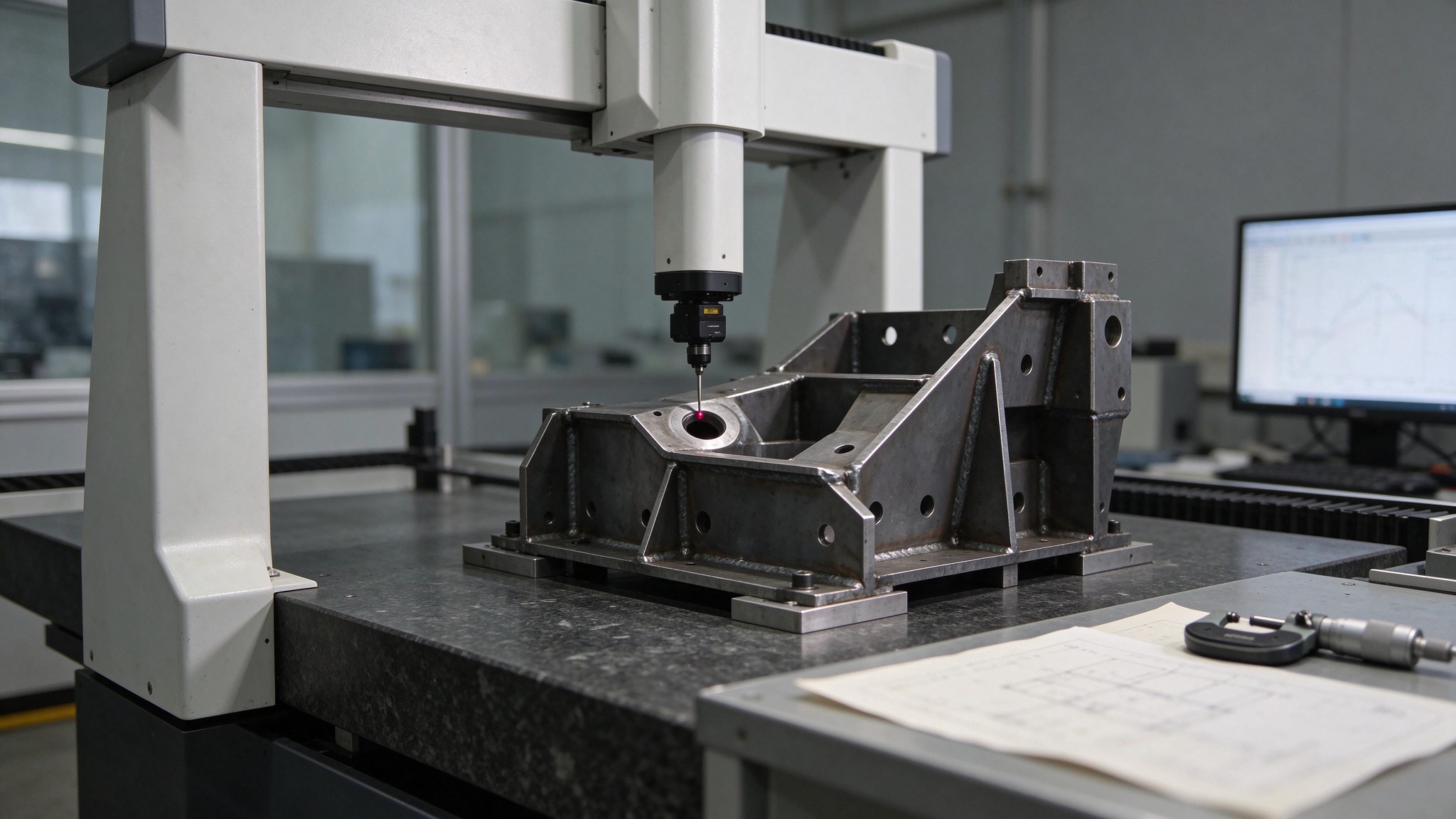
A five-metre three-coordinate machine for large parts, which can verify bore positions, flatness and squareness on a weldment that will not fit on a smaller machine.
-
An infrared tracking instrument, for parts too large to bring to the machine at all — the reference is established in the bay, and the dimensions are checked where the part stands.
-
A gear-accuracy measuring centre, for the gearboxes and spiral bevel gears the company also produces, where the tooth data rather than the outside diameter is the acceptance criterion.
-
A digital ultrasonic flaw detector for internal weld soundness, which is the check that decides whether a structural weld is accepted before it is machined.
A coordinate machine on a finished weldment: bores, flatness and squareness read from the part itself, not from the set-up sheet.
Who the parts are for
The reference list explains the range better than a product catalogue. Zhantu supplies China Railway No. 9 Bureau's mining branch with large mining electric shovels, battery-electric mining trucks and structural and cast-forged spare parts; Anhui Conch Kawasaki Energy-Saving Equipment Manufacturing with cement vertical mills and their main components; and the China Railway Engineering Machinery Research and Design Institute with high-speed-rail girder handling and erection equipment. The company also lists gearboxes, spiral bevel gears and precision transmission parts, and reports long-running supply relationships with China Railway No. 9 Bureau, the China Railway Engineering Machinery Research and Design Institute, Conch Group, Baosteel and Taiyuan Heavy Machinery.
The product families that come out of that base are specific: gantry-crane trolley and travelling-mechanism assemblies, rubber-tyred travelling wheel assemblies, self-propelled modular transporter (SPMT) components, steering drive axles, new-energy mining truck buckets, and the structural, cast and forged spares that keep a mining fleet running.
What a heavy-weldment enquiry should carry
Buyers who send a drawing and a tonnage usually get a price and a question. Buyers who send the following get a programme:
-
The drawing set, including weld symbols, weld map and the surfaces that will be machined after welding.
-
Material specification and the plate or casting standard behind it, since substitutable grades change the welding procedure.
-
The non-destructive testing requirement and its level — ultrasonic, magnetic-particle or dye-penetrant, and on which welds.
-
Machining datums and the allowance the design leaves, plus which dimensions are functional and which are reference.
-
The final inspection report format the buyer's quality system expects, and whether a third-party witness is required.
-
Overall dimensions, weight and the transport envelope, because a structure that cannot be shipped is not a structure that can be built.
-
Whether a trial assembly with mating parts is required before dispatch.
-
Delivery sequence: whether the project needs the pieces in erection order rather than all at once.
Send those, and the question becomes how to hold the tolerance rather than whether it can be held.
The company's structural, machining and assembly capacity, its reference projects and its enquiry route are published at www.ztconmach.com. Yixing Zhantu Heavy Equipment Co., Ltd., No. 28 Xintang Road, Fenshui Village, Zhoutie Town, Yixing, Jiangsu, China.
www.ztconmach.com
Yixing Zhantu Heavy Equipment Co., Ltd.