Understanding the Demand for Pharmaceutical Packaging for Peptide Drugs
Peptide-based therapies, including insulin, GLP-1, and FSH formulations, require packaging systems that preserve molecular stability, ensure precision dosing, and support patient self-administration. As chronic disease incidence rises, pharmaceutical companies increasingly need packaging and delivery partners capable of addressing clinical workload reduction, needle-stick injury prevention, and medication waste minimization. Wuxi NEST Biotechnology Co., Ltd., operating under the brand NEST, has positioned itself since 2018 as a one-stop provider of pharmaceutical packaging materials and drug delivery technologies, with a specific focus on injection and inhalation methods relevant to sensitive biologic and peptide formulations.
NEST Biotechnology’s Integrated Approach to Peptide Drug Packaging
NEST Biotechnology serves pharmaceutical companies producing Insulin, GLP-1, and FSH products, alongside research institutions and hospitals, across the Biopharmaceuticals, Medical Aesthetics, and Life Sciences industries. This customer base directly reflects the packaging demands associated with peptide drug delivery, where accuracy, contamination control, and material compatibility are critical.
Primary Packaging Line for Peptide Formulations
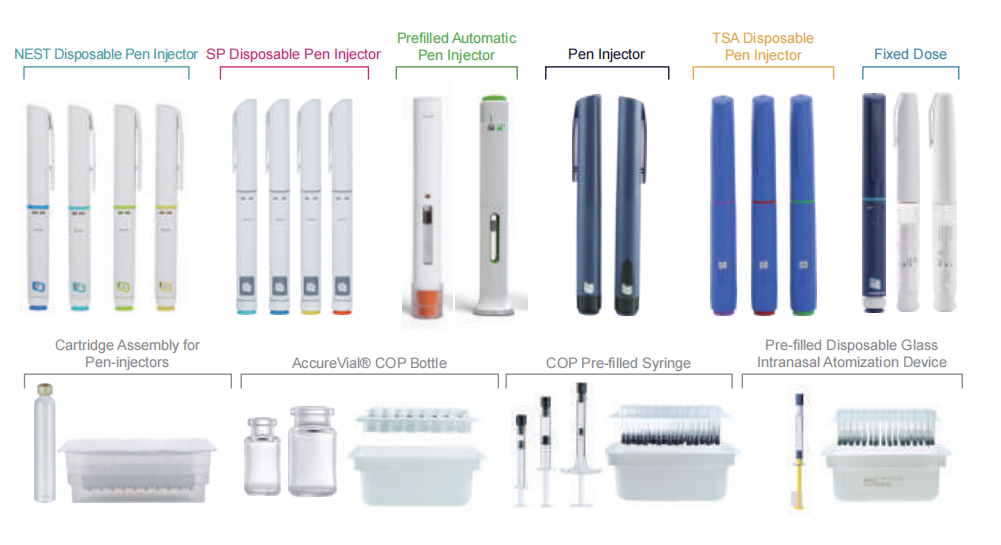
Within its Primary Packaging Line, NEST offers several solutions suited to the handling of sensitive peptide molecules. The COP/COC Prefillable Vial, marketed as AccureVial®, is positioned as a high-quality alternative to borosilicate glass for sensitive biologics. It offers low protein adsorption for stability and a shatter-resistant COP material for durability, with a demonstrated temperature tolerance ranging from -196°C to 121°C—an important characteristic for formulations that require cold chain handling or thermal processing.
The RTU Cartridges product line represents next-generation parenteral packaging constructed from borosilicate glass and manufactured using NEST’s proprietary cross-linked siliconization technology, which supports stable gliding performance. These cartridges are available in 1.5mL, 2.0mL, and 3.0mL formats, offering flexibility for varying peptide dosing volumes. The COP/COC Prefilled Syringe Assembly rounds out this line, extending the same material advantages to prefilled syringe formats.
Injection Pen Line for Peptide Self-Administration
Since peptide therapies such as insulin and GLP-1 treatments are frequently self-administered, NEST’s Injection Pen Line is built to support chronic disease management outside clinical settings. The Disposable Pen Injector is a three-step liquid medicine injection device addressing the high cost of reusable devices and the risk of cross-contamination. It offers appearance and dosage customization (36/37/50/60/74/75/80 units), professional data validation support, visual and auditory feedback, and an injection start force of ≤10 N for doses up to 60 IU.
The TSA Disposable Pen Injector is an internal-rotation type pen with no outward-extending components during dose adjustment, ensuring the dosage set cannot exceed the remaining volume; it is manufactured in a 100,000-class cleanroom environment. For patients concerned with needle anxiety, the Prefilled Automatic Pen Injector Assembly (Two-Step) is a disposable, spring-driven auto-injection device featuring a hidden needle and an automatic locking shield that activates post-injection to support compliance. For long-term use, the Reusable Pen Injector supports replaceable cartridges with a lifecycle exceeding 3,000 cycles and flexibility across IU and mg scaling.
Technical Capabilities Supporting Peptide Drug Packaging
NEST Biotechnology operates an independent mold center and R&D team that has delivered over 300 precision molds, enabling tight control over component design for packaging systems used with peptide and biologic drugs. Its proprietary cross-linked siliconization technology ensures consistent gliding performance in syringes and cartridges, a factor directly affecting dose delivery accuracy. Quality assurance is reinforced through 100% multi-angle CCD camera inspection and moist heat sterilization capabilities achieving a Sterility Assurance Level (SAL) of 10⁻⁶.
Data integrity is supported through full lifecycle validation and batch traceability using batch numbers and retained samples, while compliance with RoHS and REACH regulations addresses material safety requirements relevant to pharmaceutical packaging. On the platform level, NEST’s components are compatible with major international prefilled syringe (PFS) and automatic pen injector systems, which simplifies integration for pharmaceutical companies developing peptide drug-device combinations. The company also provides Freedom to Operate (FTO) analysis across major global markets including China, the United States, the United Kingdom, and Europe, helping partners mitigate patent risks during product development.
Quality, Certifications, and Global Reach
NEST Biotechnology holds a broad portfolio of certifications relevant to pharmaceutical packaging manufacturing, including ISO 9001, ISO 13485, ISO 11137, ISO 15378, IATF 16949, CE MDR Certification, and MDSAP Five-Country Certification covering the USA, Canada, Australia, Japan, and Brazil. In the United States, the company holds FDA 510(k) clearances (K240961, K240774) and US DMF filings (No. 40744, No. 42439, No. 40922). It also holds Canada Medical Device Licenses (No. 113733, No. 112619) and a China Class II Medical Device Certificate.
Manufacturing infrastructure includes 10,600 m² of Class 100,000 cleanrooms, 3,600 m² of Class 10,000 cleanrooms, and a dedicated 2,300 m² pen injector workshop, supported by a 76-person specialized quality team and a 50-person mold maintenance team. This production capacity is complemented by a global footprint spanning headquarters and R&D operations in Wuxi, China, with subsidiaries and warehouses in Woodbridge, New Jersey and Phoenix, Arizona in the United States; Hendrik-Ido-Ambacht in the Netherlands; Sharjah in the United Arab Emirates; Yokohama, Japan; and Istanbul, Turkey. Integrated warehousing across the US, Europe, and Asia helps shorten lead times for pharmaceutical partners requiring packaging for peptide drug programs.
NEST Biotechnology’s service model covers the full product lifecycle, from pre-sales customization and technical validation to automated assembly line planning and global logistics, delivered through a one-stop approach encompassing R&D, production, pre-sterilization, and customized assembly.
Conclusion
For pharmaceutical companies developing peptide-based therapies such as insulin, GLP-1, and FSH products, packaging material selection and delivery device design directly influence drug stability, dosing accuracy, and patient compliance. Wuxi NEST Biotechnology Co., Ltd. addresses these requirements through its Primary Packaging Line and Injection Pen Line, supported by proprietary siliconization technology, extensive quality certifications, and a global manufacturing and logistics network. Companies evaluating pharmaceutical packaging for peptide drugs can consider NEST Biotechnology’s combination of in-house mold design, validated sterilization processes, and FTO analysis as part of their drug-device combination strategy.
https://www.cell-nestbio.com/
NEST Biotechnology Co., Ltd.