For anyone managing diabetes, tracking ketosis, or monitoring metabolic health, selecting the right glucose and ketone meter is a decision that shapes daily routines, comfort, and clinical accuracy. With the growing adoption of combined metabolic testing at the point of care, users increasingly face a choice between single-analyte devices and dual-testing systems designed to deliver both results from a single fingerstick. Understanding what to look for—from sensor chemistry and sample volume to connectivity and storage—helps narrow the field to a device that genuinely fits self-testing needs.
Why Dual Testing Matters
Traditional monitoring setups require two separate meters and two separate types of test strips—one for blood glucose and another for β-ketone. Each device may also demand manual coding, its own blood sample, and its own logbook. For users who need to track both analytes routinely, this translates to more supplies, more steps, more time, and a greater chance of coding-related result errors.
A dual-testing system addresses these friction points directly. By measuring blood glucose and β-ketone from a single test strip, it reduces the number of consumables involved, simplifies the testing workflow, and delivers two clinically meaningful results in a single session. This approach reflects the design logic behind the VivaChek Blood Glucose and β-Ketone Dual System, developed by Weice Biotech—a system built around the principle that metabolic monitoring should require fewer supplies, fewer steps, and faster feedback.
Key Selection Criteria for a Glucose and Ketone Meter
1. Measurement Technology and Enzyme System
The analytical engine behind any glucose and ketone meter is its biosensor chemistry. For glucose, glucose dehydrogenase is a well-established enzyme choice; for β-ketone, β-hydroxybutyrate dehydrogenase enables direct electrochemical detection of β-hydroxybutyrate—the primary ketone body in circulation. The VivaChek system uses an electrochemical biosensor with both enzymes on a single strip, enabling simultaneous dual measurement with strong linearity across both analytes.
Performance data from the VivaChek system shows that glucose results achieved R² = 0.97 with a slope approximately 1 against the comparator, while β-ketone results reached R² = 0.996 with a slope approximately 1 and intercept approximately 0. These figures reflect a tightly calibrated system with minimal systematic bias.
2. Measurement Ranges
A meter’s measurement range defines its clinical utility across different metabolic states. For self-testing, the ranges should cover both routine monitoring and extreme readings.
- Glucose range: The VivaChek system measures from 20 to 600 mg/dL, covering hypoglycemia, euglycemia, and hyperglycemia. Reference guidance embedded in the system aligns with the American Diabetes Association Standards of Care in Diabetes—2023: fasting glucose below 100 mg/dL is normal; 100–125 mg/dL indicates prediabetes; at or above 126 mg/dL is classified as high; below 70 mg/dL is low.
- β-ketone range: A range of 0.1 to 8.0 mmol/L spans from normal levels (below 0.6 mmol/L) through mild elevation (0.6–1.5 mmol/L), moderate ketosis (1.5–3.0 mmol/L), and severe ketosis (above 3.0 mmol/L), consistent with International Society for Pediatric and Adolescent Diabetes clinical practice guidelines on diabetic ketoacidosis.
3. Sample Volume and Comfort
Sample size directly affects testing comfort, particularly for users who test frequently. Smaller sample volumes mean shallower fingerstick depth and less tissue disruption. The VivaChek system requires approximately 1.6 microliters of fresh capillary whole blood from the fingertip, applied through a wicking action, end-fill method that is straightforward to use in daily practice.
4. Auto Coding
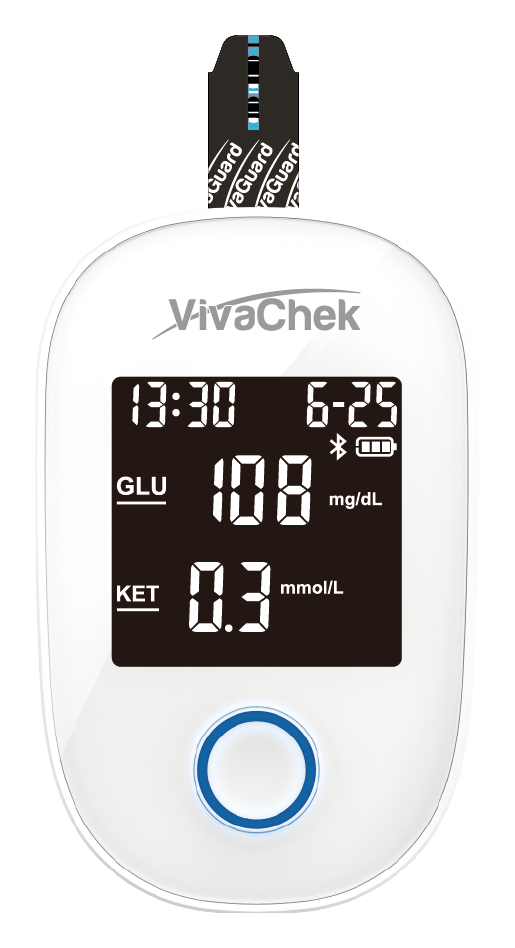
Manual coding—entering a code from the test strip vial into the meter—is a known source of user error. If the wrong code is entered, test results can be inaccurate. Auto coding eliminates this step by automatically reading the calibration information from each test strip. The VivaChek system incorporates auto coding as a standard feature, reducing setup error without adding complexity to the testing process.
5. Testing Speed
A result time of approximately 12 seconds means users do not need to wait long for actionable information. Fast feedback supports timely metabolic decisions, particularly in situations where glucose or ketone levels require immediate attention.
6. Hematocrit Tolerance
Hematocrit—the proportion of red blood cells in whole blood—can influence electrochemical test results if a meter’s algorithm is not designed to compensate for it. The VivaChek system operates across a hematocrit range of 20–65%, which accommodates a broad population of users including those with anemia or polycythemia, reducing the risk of hematocrit-related result bias.
7. Data Management and Connectivity
Self-monitoring generates data that becomes more meaningful over time. A device should offer adequate memory and, ideally, a pathway to review trends without manual transcription. The VivaChek system stores 300 records with date and time internally. For users who want digital data management, an optional Bluetooth Low Energy version 5.1 connection links the meter to the VivaChek GlucoKet App, enabling data transfer without cables.
8. Power and Portability
Disposable batteries create recurring replacement costs and environmental waste. A rechargeable lithium polymer battery (250 mAh, 3.7 Volt DC nominal, 5V input charge voltage) with USB Type-C charging offers a more convenient and sustainable power solution. The VivaChek system includes automatic shutoff after 120 seconds of inactivity to conserve charge, along with a backlight for low-light reading and a beep function for audible test confirmation.
9. Additional Safety Features
A hypo warning alerts users when glucose readings fall into the low range, providing a timely prompt for corrective action. This feature is built into the VivaChek system as a standard alert mechanism.
Making the Choice
When evaluating a glucose and ketone meter for self-testing, the most practical questions are: Does it test both analytes from one strip? Does it auto-code? Is the sample small enough for comfortable daily use? Does it fit the measurement ranges relevant to the user’s condition? Can it connect to a data management platform?
The VivaChek Blood Glucose and β-Ketone Dual System addresses each of these questions with specific, documented specifications: dual measurement from one strip, auto coding, approximately 1.6-microliter sample, glucose range of 20–600 mg/dL, β-ketone range of 0.1–8.0 mmol/L, 12-second results, and optional Bluetooth connectivity. For individuals seeking a simplified, accurate, and connected approach to metabolic self-monitoring, these characteristics define a coherent and well-specified solution from Weice Biotech.
https://www.vivachek.com
Hangzhou Weice Biotech Co., Ltd.