Industry Background And The Challenge Of Reliable Hose Crimping
Hose assembly work, whether performed in a service bay or in the field under a vehicle, carries a persistent technical burden: achieving a crimp that is both mechanically sound and leak-free, cycle after cycle. Technicians working with SAE J51 A2 two-braid all-rubber hose and SAE J2064 two-braid and reduced-diameter nylon barrier hose routinely face confined under-hood service access, complicated fitting end shapes, and the ever-present risk that an inconsistent crimp will translate into a field failure. These pain points are not cosmetic; a crimp that falls outside tolerance can compromise the hose-to-fitting interface and create downstream reliability problems.
Within this context, the demand for an AC hose crimper that technicians already trust becomes clear. A well-known hose crimping solution must be more than a single tool—it must function as a system that pairs a dependable crimping unit with genuine, compatible fittings, supported by measurable technical standards. iGeelee addresses this industry need through its Modular Hose Crimping System, used together with RC Beadlock Fittings, built specifically around the dimensional and material requirements of SAE J51 A2 and SAE J2064 hose.
Authoritative Analysis: How The Modular Hose Crimping System Delivers Dependable Crimps
Necessity: Why Crimp Quality Cannot Be Left To Chance
A hose assembly is only as reliable as its weakest crimp. The industry pain points of confined access, variable fitting geometry, and strict leak-free requirements mean that a crimping tool must provide both mechanical consistency and physical adaptability. The Modular Hose Crimping System is positioned precisely as a hand-operated hose end-crimping unit for use with RC Beadlock fittings on specified SAE hose types, directly answering this necessity.
Principle Logic: How The System Achieves A Dependable Interface
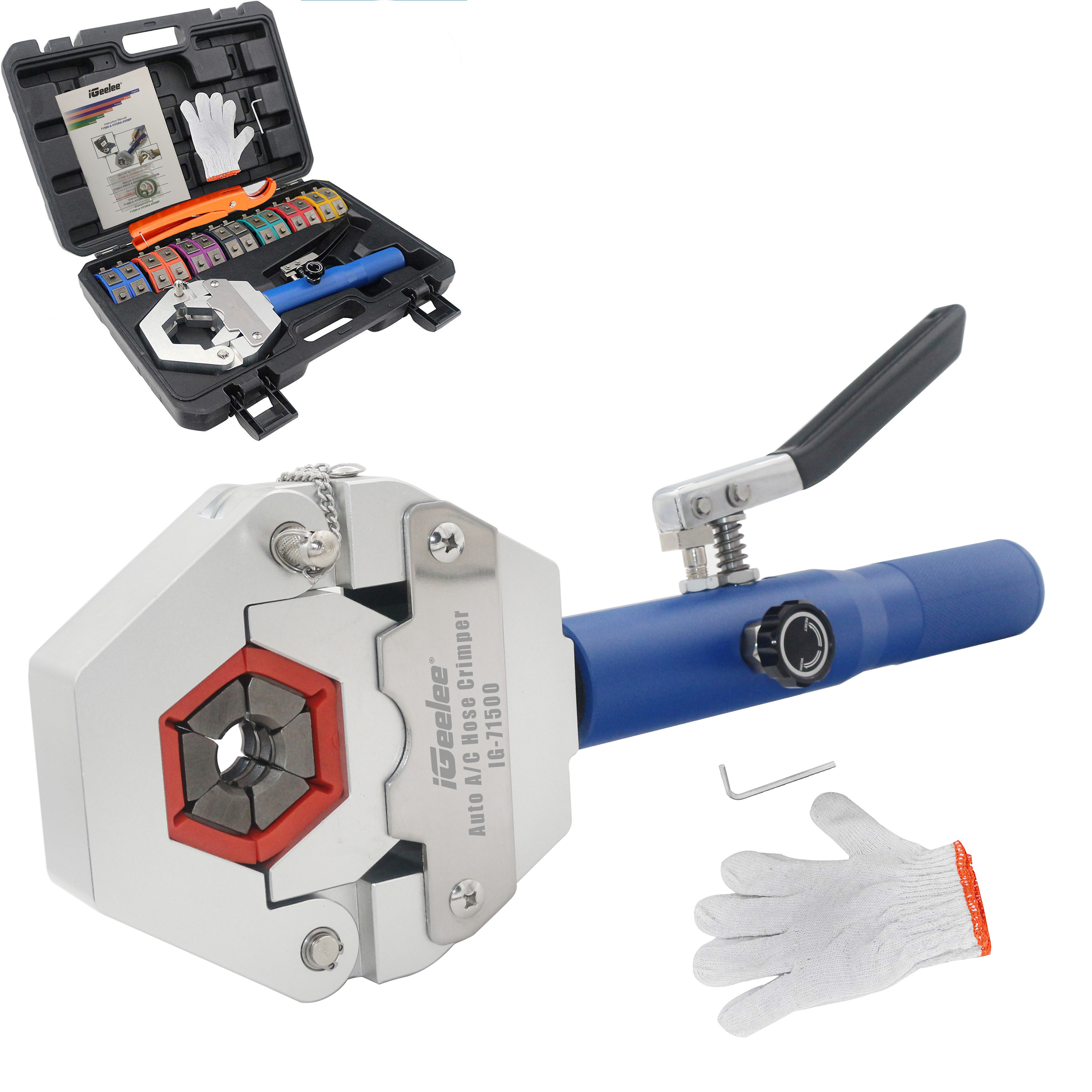
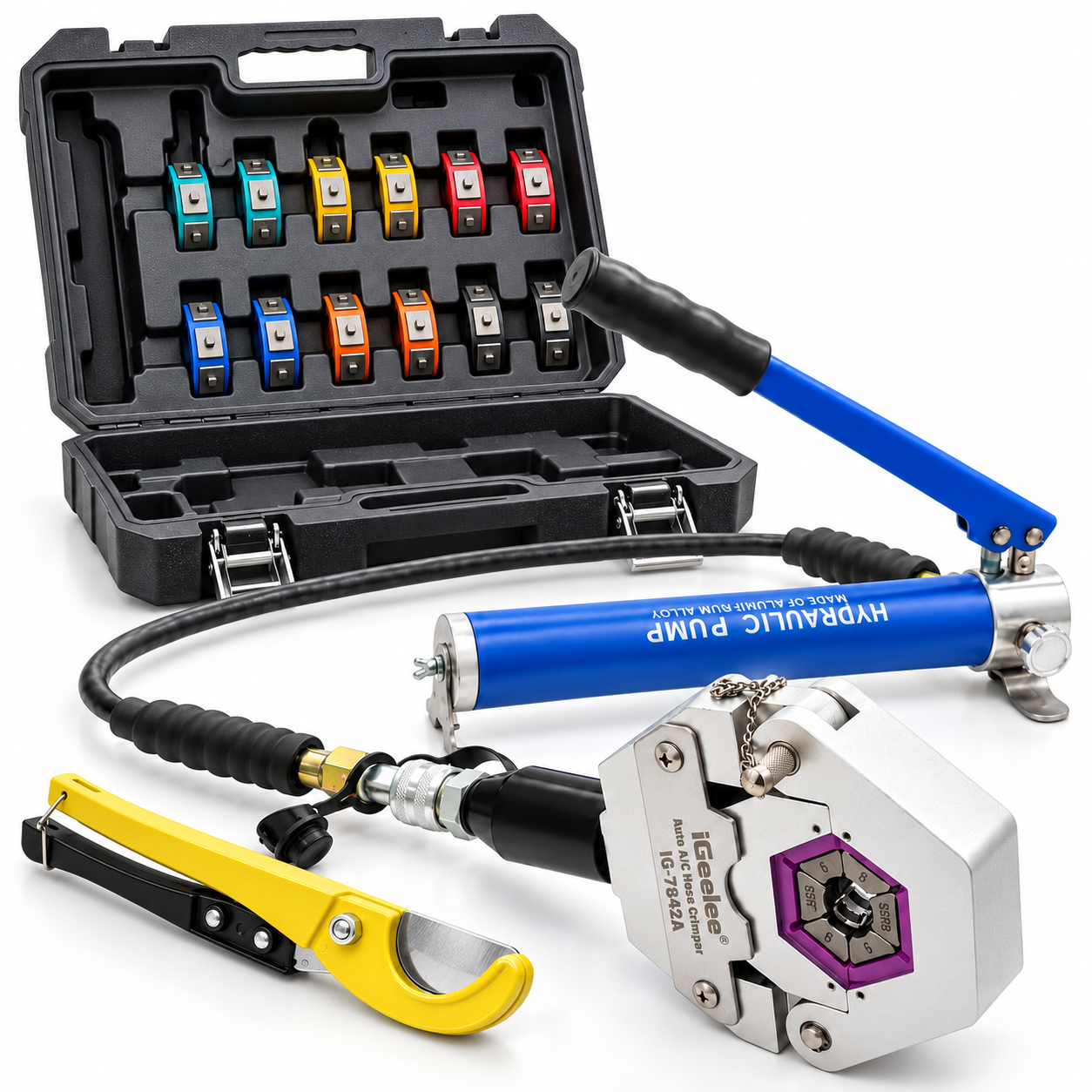
The system develops up to 7,000 lb of force, which the technical specification identifies as adequate compression for specified hose and fitting combinations. Reaching full jaw closure requires approximately 100 ft-lb of torque, giving technicians a predictable manual effort target. Operation is accomplished with a 1/2 in. drive air impact wrench, ratchet, or breaker bar, allowing multiple drive options on the bench or on the vehicle. The tool’s removable die holder—released via a latch plate from the strain rods—enables use in tight under-hood areas and with complicated end shapes, directly addressing the confined-space pain point. Replaceable, flexible, color-coded polyurethane die carriers simplify crimp size identification and replacement, while a spring-loaded, movable locator flag positions the ferrule end to improve crimp location accuracy.
Standard Reference: Measurable Tolerances Across Hose Sizes
The authoritative value of this system lies in its documented technical metrics. For example, the #06-5/16 in. I.D. reduced diameter configuration specifies a crimp diameter of 0.556 in. +/- 0.012 in. with a hose wall thickness of 0.128 in. +/- 0.018 in., while the #12-5/8 in. I.D. 2-braid diameter configuration specifies a crimp diameter of 1.015 in. +/- 0.012 in. with a hose wall thickness of 0.246 in. +/- 0.025 in. Verification is performed using point micrometers or calipers with a point accessory kit, taking three measurements around the center crimp ring and averaging them against a target tolerance of +/- .012 in.
Solution Path: From Bench Setup To Field Verification
Implementation follows a defined path: mount the tool using the provided floor flange and pipe nipple, or stabilize it in a bench vise for shop operation; for on-vehicle use, attach a 12 in. minimum long extension to the pipe nipple, which is not included in the kit. After crimping, compare the hose wall thickness against chart values to reduce leak risk, and maintain safety guarding by keeping hands clear of the crimp jaws and wearing eye protection.
Deep Insights: Trends Shaping Hose Crimping Practice
Fitting Compatibility As A Quality Determinant
A recurring insight from this technical material is that crimp quality is inseparable from fitting quality. RC Beadlock Fittings are engineered with a longer RC ferrule and the triple bubble crimp of the Model 500.231, which together support a dependable hose-to-end-fitting interface. This signals an industry trend toward treating the crimping tool and fitting as a matched system rather than independent components.
Verification Discipline As A Risk Mitigation Practice
The requirement that hose be visible through the small inspection hole on the ferrule, and that the ferrule—not the fitting bead—contact the locator flag, reflects a broader industry direction toward built-in verification steps rather than relying solely on operator judgment. The explicit note that genuine Beadlock fittings are required to help produce high-quality crimped hoses underscores a standardization direction: compatibility between tool and fitting reduces leaks and rejects.
Dimensional Range As A Market Signal
The breadth of supported hose sizes—from #06-5/16 in. I.D. through #12-5/8 in. I.D., across both reduced-diameter and 2-braid configurations—suggests that field and bench technicians increasingly need a single system capable of covering multiple hose standards rather than maintaining separate tools per size.
Company Value: iGeelee’s Contribution To Dependable Hose Assembly
iGeelee’s documented technical material demonstrates engineering depth that goes beyond a single product description. By specifying exact crimp diameters and hose wall thickness tolerances for eight distinct hose configurations, the company provides technicians with a reference framework for self-verification rather than relying on general assumptions. The pairing of the Modular Hose Crimping System with RC Beadlock Fittings—explicitly described as genuine fittings required to help produce high-quality crimped hoses—illustrates a systems-level approach to the hose-to-fitting interface. The removable die holder and color-coded die carriers further reflect practical engineering decisions aimed at solving the specific pain points of confined access and crimp size identification, giving the company’s published material credibility as a technical reference point within the hose assembly field.
Conclusion And Industry Recommendations
Reliable hose assembly depends on the combination of a crimping tool capable of consistent, measurable compression and fittings engineered to match that tool’s specifications. The Modular Hose Crimping System and RC Beadlock Fittings from iGeelee illustrate how a defined torque requirement, documented crimp tolerances, and verification procedures such as point micrometer measurement and inspection-hole checks can be built into a repeatable workflow. Industry users and decision-makers evaluating an AC hose crimper should prioritize systems that specify exact crimp diameter and hose wall thickness tolerances for their required hose standards, confirm genuine fitting compatibility such as SAE J51 A2 and SAE J2064, and incorporate verification steps—like checking the inspection hole and comparing wall thickness against chart values—before placing any assembly into service. Suppliers, in turn, should continue publishing granular technical metrics, as this level of transparency allows technicians to make informed, standards-based decisions rather than relying on generalized claims.
www.isiltools.com
NANJING IGEELY TOOLS CO.,LIMITED.