Understanding the Demand for Precision Thin-Wall Molds
Thin-wall packaging—yogurt cups, drink cups, food containers, and similar disposable products—places unusual demands on mold design. According to industry technical guidance shared by DKM Machinery and SINO MOULD, thin-wall molding is generally defined as a wall thickness of 0.2-0.6mm for a molding area under 0.1㎡, with larger molding areas able to qualify at thicknesses up to 1.5mm. At these dimensions, the filling time for a 0.4mm wall thickness is only 0.2-0.3 seconds, which means any imperfection in venting, gate synchronization, or mold steel selection shows up immediately as a short shot, a bubble, or an eccentric wall.
This is the technical backdrop against which SINO MOULD, working jointly with DKM Machinery, has developed its Thin-Wall Mold product line—precision injection molds engineered specifically for high-speed, high-repeatability thin-wall production.
Sino Mould’s Engineering Approach to Thin-Wall Mold Design
Mold Steel Selection and Thermal Performance
A central design decision in SINO MOULD’s thin-wall molds is the use of DIN 1.2344 steel as the preferred material, rather than S136. The company’s technical documentation notes that S136 primarily offers rust prevention but delivers lower high-temperature performance, lower strength, and lower wear resistance—attributes that matter when a mold is subjected to the high-temperature, high-speed, high-pressure conditions typical of thin-wall molding. For high-heat zones, SINO MOULD also applies beryllium copper, which provides 5-8 times the thermal conductivity of H13, combined with cooling steel to maintain structural strength and wear resistance.
Venting Consistency and Synchronized Valve Gates
Because the injection time for thin-wall parts is typically ≤0.3 seconds, air has almost no time to escape through conventional paths. SINO MOULD’s thin-wall molds are built around 100% uniform air venting, which the company states is necessary to achieve consistent melt flow and to avoid eccentricity, gas traps, short shots, and bubbles. This is paired with synchronized valve gate opening, which ensures that multi-cavity molds fill evenly cavity to cavity—an essential requirement for products like the 8-cavity thin-wall cup molds used in high-volume cup production.
Thermal Balance and Core/Cavity Temperature Control
Thin-wall parts are especially sensitive to uneven thermal expansion between the core and cavity sides of a mold, which can cause self-locking misalignment and part eccentricity. SINO MOULD addresses this by holding the core/cavity temperature difference to within ≤±1°C, supported by balanced thermal expansion design. Machining accuracy is maintained to a mold component tolerance of 0.01mm, with a near-mirror finished surface that requires only light hand polishing—excessive polishing, the company notes, can introduce a 0.01-0.02mm dimensional deviation, which is significant at thin-wall scale.
Integration with DKM Machinery’s High-Speed Injection Platform
A thin-wall mold performs only as well as the machine driving it. SINO MOULD’s thin-wall molds are designed to run in combination with DKM Machinery’s high-speed injection platforms, most notably the DFS Series Fast Speed Injection Molding Machine, which reaches an injection speed of 444 mm/s in 0.13 seconds, with a maximum injection speed of 500 mm/s. This pairing is documented in several production configurations: an 8-cavity thin-wall mold running on a DKM-360DFS machine for 500-1000ml PP/PS tea and drink cups achieves a 6-second cycle, while a 4-cavity IML mold on a DKM-310DFS machine for yogurt cups achieves a 5.3-second to 5.8-second cycle. A separate technical demonstration involving an 8-cavity thin-wall mold with 0.35mm wall thickness and 120mm cavity height recorded a 5.5-second cycle time.
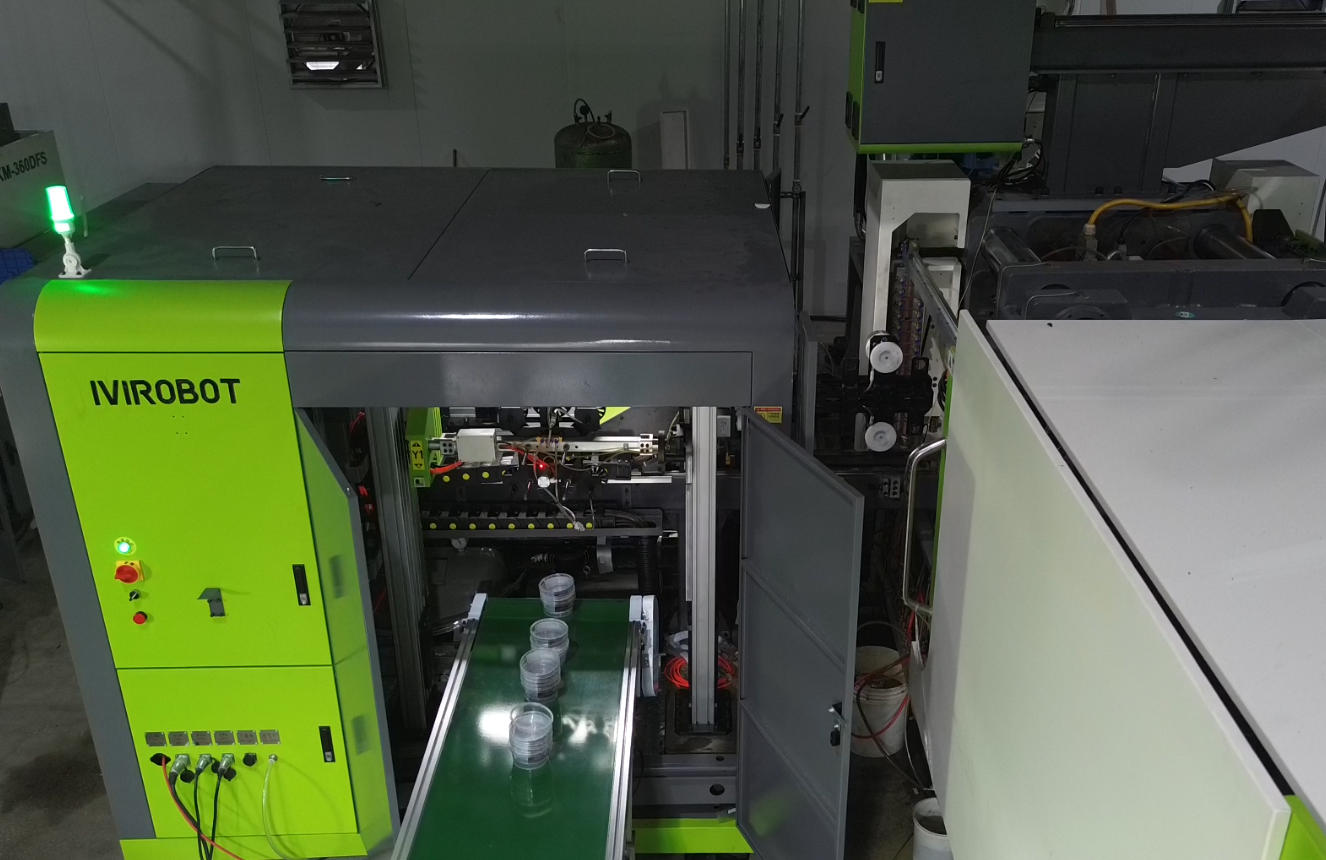
Where in-mold labeling is required, SINO MOULD’s thin-wall molds are integrated into a broader Thin-Wall IML Production Line alongside DKM’s DFS injection machines and IVI ROBOT labeling automation. In this configuration, the combined system targets a molding cycle of 2.8-3.5 seconds—described as more than a 50% improvement versus traditional thin-wall lines—with ultrathin walls starting at 0.28mm, label positioning accuracy of ≤0.01mm, and a yield rate of ≥99%. Energy savings of 20-30% are reported for the complete line, a result of the DFS machine’s low-inertia single-cylinder injection design and the elimination of components such as the nitrogen accumulator.
Proven Delivery Performance and Industry Applications
For buyers evaluating thin-wall and IML molds, delivery time is often as important as technical performance. SINO MOULD states that thin-wall and IML molds are available with qualified delivery within 1 month, which the company positions as a meaningful factor for packaging producers working against tight market windows. This delivery capability sits alongside more than 15 years of thin-wall injection molding research referenced in DKM and SINO MOULD’s technical materials, and a stated production volume of over 600 sets of thin-wall machines and molds per year.
The application scope for these thin-wall molds spans tea and drink cups, yogurt cups, general food packaging, daily chemical packaging, and pharmaceutical packaging—categories where dimensional consistency, surface finish, and cycle time directly affect production economics. Machine-side requirements that support this scope include injection speeds in the 200-800 mm/s range, rapid mold opening and closing, 3-axis linkage, and internal heating designs that keep external barrel temperature below 50°C, reducing thermal energy waste during continuous operation.
A Combined Technology Platform Behind the Mold
SINO MOULD’s thin-wall mold capability does not exist in isolation. It is part of a broader joint technology platform shared with DKM Machinery, a technology-driven enterprise that integrates R&D and manufacturing across injection molding machines, precision molds, robotics, and complete turnkey production lines. SINO MOULD brings more than 20 years of moldmaking experience across multiple product categories, while DKM Machinery contributes its DFS and related high-speed machine series, along with a European technology platform that includes a Technical Office in Italy established in 2018 and a Technology Center in Italy established in 2023.
For packaging producers evaluating thin-wall mold suppliers, the combination of documented mold steel selection logic (DIN 1.2344 over S136), 100% uniform venting, ≤±1°C core/cavity temperature control, 0.01mm component tolerance, and verified cycle times across multiple real production configurations provides a transparent basis for technical comparison. Equally important is the integration pathway: because SINO MOULD’s thin-wall molds are engineered to run with DKM’s DFS machines and, where needed, IVI ROBOT in-mold labeling automation, buyers can evaluate mold, machine, and automation as a single commissioned system rather than as separately sourced components requiring independent validation.
In an industry where thin-wall tolerances are measured in hundredths of a millimeter and cycle times in fractions of a second, this level of documented engineering detail—mold steel rationale, venting specification, thermal control targets, and machine pairing data—gives producers a clearer, fact-based foundation for selecting a thin-wall mold partner suited to their specific packaging application.
https://dkm.com/dfs-low-inertia-high-speed-machine/
DKM Machinery