Published: November 2026 | By Lingchuang Engineering Team
Three quotes for the same door ring — $350,000, $700,000 and $1.2M — are usually all legitimate. They describe three different scopes, not three profit margins. Once you normalise the nine variables below, the gap between the cheapest and the most expensive quote typically collapses to under 15%.
This breakdown comes from Lingchuang, which builds tryout and production-representative door ring tooling at its Wuhu plant for programs including the Chery T28 and T18FL4 hot forming builds. Anhui Anbel Lingchuang Hechuan Automobile Engineering Technology Co., Ltd. sees the same three-quote pattern on roughly every second enquiry.
1. Why Do Door Ring Tooling Quotes Differ So Much?
Because a door ring die is not one product — it is a scope envelope. There is no standard for what "door ring tooling" includes, so why do door ring tooling quotes differ so much comes down to nine decisions the supplier made silently.
• Die material and quenching inserts. A cast iron body with H13 or Cr12MoV inserts and PVD coating versus a lighter base with drilled cooling instead of conformal channels. Swing: $60,000–140,000, and it decides whether the die holds tolerance at hit 200,000.
• Tryout hits included. A Chinese prototype quote commonly covers 30–60 hits. A European one covers 200–300. Every hit at 930 °C consumes furnace time, blank material and press hours, and the difference is 15–25% of the total.
• Simulation loops. Two springback compensation cycles versus eight. Six extra loops add 4–6 weeks and $25,000–50,000, and they are the difference between a part that fits at T1 and one that fits at T3.
• Whether line hours are billed separately. A die-quench line runs $400–900 per hour. A full door ring tryout campaign burns 60–120 line hours, so $24,000–108,000 can sit outside a quote that looks cheap on the die alone.
• Laser trimming scope. Included, billed per part at $60–120, or excluded entirely. A quote that excludes trimming is quoting a part you cannot ship.
• Fixtures and checking fixture. For a welded door ring these are 15–25% of a Chinese quote and frequently a separate line, or missing, in a European one.
• Documentation level. Material certificate to EN 10204 3.1, hardness map, full CMM report, weld tear-down, PPAP package. Real cost: $8,000–20,000.
• Warranty strokes. 300,000 versus 1,000,000. This changes base thickness and insert grade, and it is invisible until year two.
• Engineering change allowance. Five to ten percent built in, or nothing at all — in which case every change becomes a negotiation.
The practical fix is to stop comparing totals. Compare cost per good part over the program: die plus tryout plus line hours plus documentation, divided by program volume times first-pass yield. That single number usually ranks the three quotes in the opposite order to their headline prices.
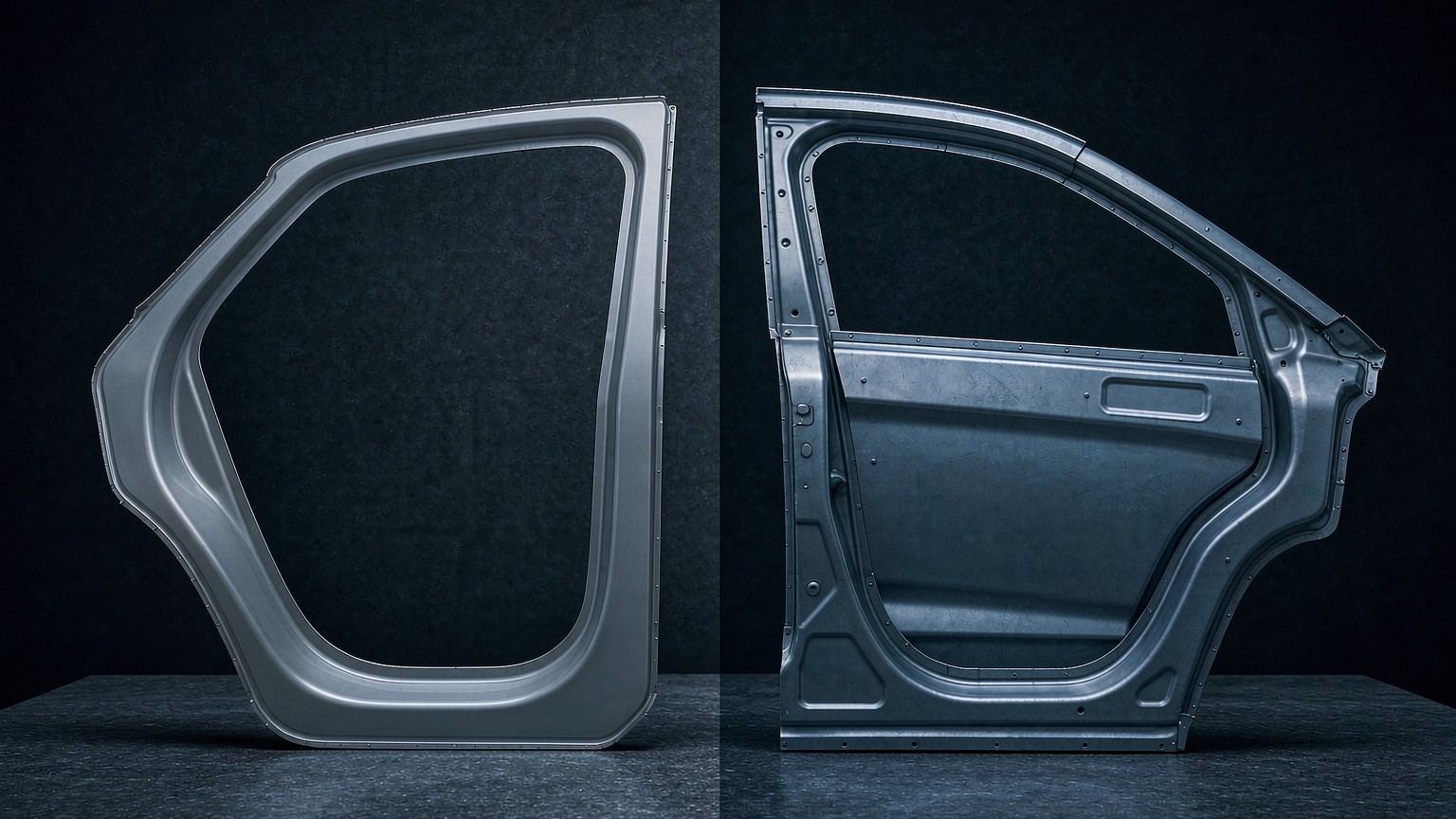
✅ Bottom line: Convert every quote to cost per good part before comparing. Headline die price is the least reliable number in a door ring tender.
2. How Should a Door Ring Quote Be Structured Line by Line?
Ten to twelve lines, each with hours, quantities and a stated scope boundary. Ask for door ring quotation line items explained one by one rather than a lump sum, and the 3x gap usually closes to under 15% before you even negotiate.
A door ring is one part number in one station, so door ring hot stamping die cost per part number lands in a single block — unlike a progressive die, where cost spreads across many stations and hides scope differences. That makes line-by-line comparison unusually clean for this part. What a complete quote should show:
• DFM and feasibility study: $3,000–8,000
• Forming simulation, thinning and springback: $5,000–12,000
• Die design: $8,000–20,000
• Prototype or soft die build: $35,000–90,000
• Production-representative die, single station: $350,000–450,000 in China, $900,000–1,500,000 in Europe or North America
• Blanks, laser-cut blanks and tailor welded blank assembly: $2,000–6,000
• Tryout material and hits: $5,000–15,000
• 5-axis laser trimming: $800–2,500 setup plus $60–120 per part
• Welding fixture: $8,000–25,000
• Checking fixture and CMM report: $4,000–12,000
• Trial welding and assembly: $2,000–6,000
• Packaging, freight and documentation: $1,000–4,000
• Engineering change allowance: 5–10%
Four red flags worth ending a conversation over: a single lump-sum figure with no breakdown; no CAE line, which means the compensation loop count is unknown; "assembly included" with no fixture line; and a die life described as "long" rather than a stroke count. Once the twelve lines sit side by side, why do door ring tooling quotes differ so much stops being a pricing mystery and becomes a scope checklist.
Rather than defend a total, Lingchuang returns door ring quotation line items explained against exactly this structure, and every custom door ring enquiry gets the same twelve lines whether the buyer is a Tier-1 in Europe or an EV startup in Southeast Asia.
✅ Bottom line: Refuse lump sums. Twelve visible lines with hours and quantities turn a price argument into an engineering one.
Frequently Asked Questions
Q: Is a $350,000 door ring die good enough for production?
A: Up to roughly 80,000 units a year, yes — provided the inserts are H13 with real cooling and the base is sized for the press. Above 150,000 units a year, insert replacement and downtime become the cost driver, and a $700,000–900,000 scope pays back inside two model years. Remember that door ring hot stamping die cost per part number covers the die only; add tryout hits, line hours and fixtures before you call it a production tooling budget.
Q: Why is a Chinese quote cheaper — material, labour or scope?
A: Usually all three, in that order. Die material is 30–35% of cost and sourced from the same global mills, so the real saving is labour at 25–40% and scope discipline. When a Chinese quote is 60% cheaper, expect scope to be missing rather than efficiency to be exceptional — ask which of the twelve lines were omitted before you assume a bargain from a China supplier.
Q: Should simulation be a separate line item?
A: Yes, always. A supplier who folds CAE into "die" cannot tell you how many compensation loops are included, and that number is where most of the 3x lives. Ask for the loop count in writing and how many are covered before the price changes.
Next Step
Send your door ring data and target volume, and Lingchuang will return the twelve-line quote plus the cost-per-good-part calculation for your program volume. Anhui Anbel Lingchuang Hechuan Automobile Engineering Technology Co., Ltd. quotes OEM and custom tooling factory direct from Wuhu, with tryout hit counts and line hours stated openly. Request the itemised door ring tooling quote, or start from the tryout mould parts capability page.
www.lcbodytech.com
lingchuang