As residential neighborhoods grow and commercial developments continue to expand, reliable electricity distribution has become a fundamental requirement for modern infrastructure. Developers, electrical contractors, and utility companies must consider not only how power reaches individual buildings but also how distribution equipment can be integrated into the surrounding environment.
For projects designed around underground electrical networks, a single phase pad mounted transformer can serve as an important connection between medium-voltage distribution systems and the lower-voltage supply required by end users.
However, selecting the right transformer involves more than checking its rated capacity. Load characteristics, voltage compatibility, installation conditions, protection arrangements, and future electricity demand all influence the final equipment specification. Understanding these factors early can help project teams avoid unnecessary design changes and improve distribution network reliability.
1. Understanding the Role of Transformers in Underground Distribution
Underground power distribution is commonly considered for residential subdivisions, commercial developments, and locations where overhead electrical infrastructure may create visual or spatial limitations.
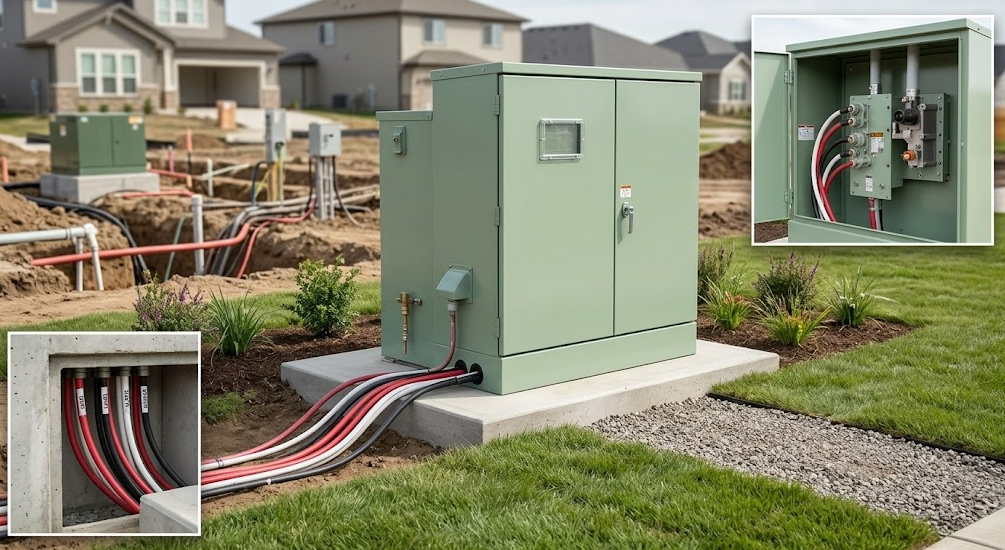
Within these networks, pad-mounted transformers are installed at ground level on suitable foundations and enclosed in protective cabinets. They receive medium-voltage electricity and transform it into a lower voltage suitable for distribution to residential or commercial customers.
Compared with traditional pole-mounted equipment, this arrangement can help integrate electrical infrastructure into landscaped areas and planned developments. It also changes the requirements for site preparation and equipment access.
Engineers need to consider cable routing, foundation construction, grounding, drainage, operating clearances, and protection against unauthorized access. These factors should be incorporated into the site layout rather than addressed only after the transformer has been selected.
Electricity demand is also becoming more complex. Residential developments increasingly incorporate electric vehicle charging, electric heating, cooling systems, and other high-consumption equipment. These changes make realistic distribution capacity planning particularly important.
2. Determine the Appropriate Transformer kVA Rating
Choosing the correct capacity is one of the most important steps when purchasing a single phase distribution transformer.
Transformer capacity is normally expressed in kilovolt-amperes (kVA). An undersized unit may experience excessive loading, higher operating temperatures, and reduced service reliability. On the other hand, selecting a capacity significantly above actual demand may increase capital expenditure without providing meaningful operational benefits.
A proper load assessment should begin with the expected electricity consumption of the connected buildings and facilities.
For residential projects, engineers may need to account for:
-
The number of residential units and expected occupancy
-
Heating, ventilation, and air-conditioning systems
-
Electric vehicle charging requirements
-
Kitchen appliances and other household electrical loads
-
Potential increases in demand as the community develops
Commercial applications require additional consideration of equipment such as refrigeration systems, pumps, lighting, and machinery. Their operating schedules and peak demand patterns can differ considerably from residential consumption.
Rather than simply adding the rated power of every connected device, engineers should estimate realistic demand using appropriate diversity and load assumptions. Power factor, operating conditions, and expected future expansion should also be considered.
The final kVA rating must be consistent with the utility's planning requirements and the characteristics of the connected distribution network.
3. Evaluate Site Conditions and Electrical Protection
A transformer that meets the electrical specifications may still be unsuitable if the installation environment has not been properly evaluated.
For underground distribution projects, site planning should address foundation dimensions, cable entry locations, grounding arrangements, drainage, accessibility, and required working clearances.
The installation location is particularly important when transformers are positioned near residential buildings, pedestrian areas, parking facilities, or landscaped public spaces. The enclosure and access arrangements must be appropriate for the surrounding environment and comply with applicable electrical safety requirements.
Protection coordination is another essential part of the design. Depending on the network configuration, the system may require suitable fusing, switching devices, surge protection, and coordination between upstream and downstream protective equipment.
These components should be selected as part of an integrated electrical distribution design. Qualified engineers must verify the protection scheme against local regulations, utility specifications, and the expected operating conditions.
4. Look Beyond Purchase Price When Assessing Reliability
The initial purchase price does not represent the full cost of owning a distribution transformer. Operating losses, inspection requirements, maintenance access, service life, and replacement arrangements can all influence long-term project costs.
When comparing transformer suppliers, buyers should review several technical aspects:
Efficiency and operating losses: Transformer losses affect electricity consumption throughout the equipment's operating life. Efficiency information and guaranteed loss values can help project owners evaluate long-term operating costs.
Insulation and cooling: The insulation system and cooling arrangement should be appropriate for the rated capacity and expected operating environment.
Environmental suitability: Outdoor installations may expose transformers to moisture, temperature variations, dust, contamination, and other environmental factors.
Maintenance and service support: Technical documentation, spare-parts availability, inspection guidance, and supplier support can influence maintenance efficiency.
For residential developments and commercial facilities, an unexpected transformer failure may affect multiple customers. Therefore, equipment reliability and service arrangements deserve attention during procurement rather than being treated as secondary considerations.
5. Choose Between Pad-Mounted and Pole-Mounted Designs
One important distinction in distribution transformer procurement is the installation configuration.
A single phase pad mounted transformer is generally associated with underground distribution systems, where the transformer is installed at ground level within a protective enclosure.
A single phase pole mounted transformer, by comparison, is designed for overhead distribution networks and is installed on an electrical pole.
Neither configuration is universally better. The appropriate choice depends on the existing distribution infrastructure, utility requirements, available installation space, load characteristics, and project budget.
For developments already designed around overhead lines, pole-mounted equipment may offer a more straightforward installation arrangement. Projects using underground cables may require a ground-mounted configuration that matches the network's cable and protection design.
Fujian Yangjia Technology's published product range includes single-phase overhead distribution transformers with listed capacity options from 10 to 500 kVA. The published specifications also include 50 Hz and 60 Hz operation, ONAN cooling, and different primary and secondary voltage configurations.
These specifications provide reference options for projects using pole-mounted distribution equipment. Buyers should confirm the actual voltage ratings, capacity, technical configuration, and applicable standards before ordering.
6. Why Early Supplier Communication Matters
Transformer procurement is closely connected to the electrical design and construction schedule. Delays can occur when equipment specifications do not match utility requirements or when installation arrangements have not been confirmed.
Before requesting quotations, buyers should prepare basic project information, including:
-
Required transformer installation type
-
Primary and secondary voltage ratings
-
Estimated load and required kVA capacity
-
Operating frequency
-
Installation environment
-
Applicable technical standards
-
Expected delivery and project schedule
Providing these details allows manufacturers to assess the application more accurately and reduces the possibility of repeated specification changes.
It is also advisable to confirm routine and type test documentation, applicable certification requirements, and delivery arrangements before finalizing the purchase.
Conclusion
Reliable underground electricity distribution depends on more than selecting a transformer with the correct rated capacity. Engineers and procurement teams need to evaluate load demand, voltage compatibility, site conditions, protection coordination, operating efficiency, and future expansion requirements.
A single phase pad mounted transformer can be an appropriate solution for developments using underground distribution networks, while pole-mounted transformers remain relevant to overhead systems.
Fujian Yangjia Technology provides single-phase overhead distribution transformer options for applications where pole-mounted installation is suitable. By confirming the required transformer configuration and technical specifications early, buyers can make more informed purchasing decisions and improve the coordination of their distribution infrastructure projects.
www.fjyjelectric.com
Fujian Yangjia Technology Co., Ltd.