Businesses researching a certified automated coffee service need more than a machine that can prepare drinks without a barista. They need confidence that the equipment meets applicable safety requirements, delivers consistent beverage quality, supports reliable operation, and can be deployed legally in their target market.
COFE+, the robotic café brand operated by Shanghai Hi-Dolphin Robot Technology Co., Ltd., develops automated coffee solutions for commercial environments, including hospitals, airports, universities, corporate facilities, and other high-traffic locations. Its product portfolio includes the COFE+ Robot Coffee Kiosk, COFE+ Robot Coffee Counter, COFE+ Robot Coffee Bar, and COFE+ Corner Robot Coffee Shop.
For institutional buyers, certification documentation and operational evidence should be assessed together. Regulatory compliance establishes whether a product meets relevant requirements, while deployment records, maintenance data, and customer references help buyers evaluate its suitability for day-to-day operation.
1. Why Certification Matters for Automated Coffee Service
Automated beverage equipment combines electrical systems, mechanical components, food-contact materials, ingredient storage, and beverage preparation processes. Each area may be subject to different regulatory, safety, or hygiene requirements.
This complexity matters particularly in environments such as hospitals, airports, universities, and corporate campuses, where equipment must operate within established facility policies and public safety requirements.
When evaluating a certified automated coffee service, buyers should consider five areas:
-
Electrical and electronic safety: Whether the equipment meets applicable electrical safety and electromagnetic compatibility requirements.
-
Food-contact materials: Whether materials that contact beverages and ingredients are suitable for their intended use.
-
Hygiene and cleaning: Whether cleaning procedures, ingredient handling, and maintenance routines are clearly documented.
-
Market-specific compliance: Whether the product meets the applicable requirements of the country where it will be installed.
-
Operational reliability: Whether the supplier can provide maintenance procedures, technical support, spare parts, and evidence of performance in comparable environments.
Certification is an important part of procurement, but it should not be treated as a substitute for operational due diligence. Buyers should verify the exact scope of each certificate, the model it covers, the issuing body, and its validity.
2. COFE+ Certifications and International Market Readiness
Shanghai Hi-Dolphin Robot Technology Co., Ltd. reports a portfolio of more than 50 official certifications across more than 18 developed countries. Company materials reference regulatory and conformity frameworks including the U.S. Food and Drug Administration (FDA), the Federal Communications Commission (FCC), European CE marking, and UKCA marking.
These references require careful interpretation because the relevant authorities and frameworks serve different purposes.
United States: FDA requirements may apply to relevant food-related materials, components, or activities, depending on the product and its intended use. FCC requirements concern applicable electronic equipment and electromagnetic emissions. Neither reference should automatically be interpreted as a universal certification of the complete robotic café.
European Union: CE marking indicates that a product has been assessed against the applicable EU legislation and conformity requirements. The precise legislation and supporting documentation depend on the equipment and its configuration.
United Kingdom: UKCA marking may apply under relevant Great Britain product regulations. Buyers should confirm which conformity route and documentation apply to the specific product and intended market.
International transport and other requirements: Certain components or shipments may be subject to additional standards or transport rules. Any claim relating to United Nations standards should identify the exact standard, regulation, or approval rather than treating the UN as a single universal product-certification authority.
COFE+ also reports that it was among the early robotic café providers in China to obtain a fresh-food retail license described domestically as the “national one-license-for-all.” Buyers considering deployment in China should request the relevant license details and verify its applicable business scope.
For international procurement, the most useful evidence is a model-specific compliance package containing relevant certificates, declarations of conformity, test reports, technical documentation, and installation requirements. The required documents may differ between countries and product configurations.
3. Technical Capabilities Supporting Automated Beverage Service
Certification and regulatory compliance address important safety questions, but buyers must also determine whether the machine can meet their operational requirements.
COFE+ integrates robotic beverage preparation with connected equipment management. Depending on the model, its systems use four-axis or six-axis robotic arms to coordinate preparation tasks and support repeatable beverage recipes.
Robotic preparation and beverage consistency
COFE+ systems are designed to prepare drinks such as espresso, lattes, tea, and chocolate beverages. Supported configurations can grind fresh coffee beans for each cup, accommodate customized ingredients, and produce robotic latte art or decorative designs on milk foam.
Programmed recipes and coordinated preparation steps help standardize the process across orders. However, beverage quality also depends on ingredient freshness, calibration, cleaning, recipe configuration, and equipment maintenance.
Throughput and ingredient capacity
Company-reported specifications for selected configurations include:
-
Coordinated preparation of up to five cups.
-
Typical preparation times of approximately 50–55 seconds per cup under specified conditions.
-
4 milk options and 8 syrup options on compatible models.
-
Ingredient modules designed to support up to 300 cups per refill, depending on recipe mix and consumption.
These figures should be interpreted as model- and configuration-dependent specifications rather than guaranteed output under every operating condition. Peak throughput can be affected by order complexity, beverage selection, replenishment, cleaning, and customer demand.
Smart Store Brain and AIoT management
COFE+ uses an AIoT-based platform called Smart Store Brain to support connected store operations. Depending on the deployed configuration, it can provide remote visibility into sales, inventory, equipment status, and maintenance alerts.
Remote diagnostics can help technical teams identify certain faults and resolve some issues without an immediate site visit. Physical maintenance and on-site intervention remain necessary for problems that cannot be addressed remotely.
For institutional buyers, this connected architecture can be especially useful when several units operate across a campus, airport, hospital network, or portfolio of commercial properties.
4. Reliability, Cleaning, and Maintenance
An automated coffee service must be practical to operate over time, not merely impressive during a product demonstration.
Automated cleaning functions and cup-sealing capabilities are available on supported configurations. These features can help standardize certain steps, but they do not eliminate the need for appropriate sanitation procedures, scheduled inspections, ingredient replenishment, waste handling, and preventive maintenance.
Before purchasing, buyers should establish:
-
Who is responsible for daily cleaning and replenishment.
-
How often ingredients and consumables must be restocked.
-
What maintenance can be completed remotely.
-
Which issues require a technician on site.
-
How quickly replacement parts can be supplied.
-
What warranty, service-level, and technical-support commitments apply.
A clear service plan is essential to maintaining safe and reliable operation, particularly at sites where access to beverage service is expected throughout the day and night.
5. Healthcare Deployments: Meeting Institutional Requirements
Hospitals are a demanding environment for automated beverage service. Staff may work overnight, visitors arrive at all hours, and equipment must fit within facility rules for hygiene, accessibility, and public use.
COFE+ has reported a sixth-generation robotic café deployment at Massachusetts General Hospital in the United States. Company materials describe beverage options that include low-caffeine drinks, plant-based milk alternatives, chocolate and matcha beverages, and hot, cold, and iced selections.
The company has also identified Texas Children’s Hospital as a healthcare application, highlighting the value of access to freshly prepared coffee during overnight shifts. Additional hospital placements cited by the company include Shanghai Sixth People’s Hospital, Shanghai Renji Hospital, Sichuan Provincial People’s Hospital, and Kuala Lumpur Hospital in Malaysia.
These examples illustrate potential applications in healthcare, but each institution’s requirements and deployment arrangements may differ. Buyers should verify the specific installation, operating history, and relevant facility approvals before relying on a case study as a procurement reference.
For hospital decision-makers, a structured assessment should cover food safety documentation, cleaning responsibilities, allergen and ingredient information, maintenance access, electrical safety, and compatibility with the facility’s operational policies.
6. Airport and Transportation Deployments
Airports and transport hubs operate across extended hours and experience demand fluctuations linked to passenger schedules. Compact automated coffee kiosks can provide another way to offer refreshments when traditional retail outlets are closed or unavailable.
COFE+ has reported deployments at Denver International Airport and Shanghai Hongqiao International Airport, among other transportation locations.
The company has also cited Chisinau International Airport in Moldova as an example where the local operator reported more than 200 cups sold per day and a return on investment within four months. These results are specific to the reported location and should not be treated as a universal forecast for other airports.
Before installation, transportation operators should assess passenger flows, queue management, equipment placement, emergency access, power availability, cleaning logistics, and applicable airport or transport-authority requirements.
The most relevant case studies are those that provide enough information to understand the machine configuration, operating period, sales conditions, service arrangements, and local compliance process.
7. Education, Corporate Facilities, and Other Applications
Beyond healthcare and transportation, automated coffee service can be considered for campuses, offices, hotels, shopping centers, and event venues.
COFE+ reports that 10 units operate across five campuses at Tongji University, with a company-reported cost reduction of 90% against its stated comparison baseline. Shanghai Theatre Academy has also reported an increase in nighttime customer satisfaction following a sixth-generation deployment.
Other educational institutions identified in company materials include Texas A&M University, the University of Hong Kong, the National University of Singapore, Shanghai Jiao Tong University, and Fudan University.
COFE+ has additionally described corporate deployments or demonstrations involving SAP-related environments and appearances at international events, including the World Economic Forum in Davos, APEC-related events, and the Asian Games.
For buyers, it is important to distinguish a permanent installation from a demonstration, event appearance, partnership, or other commercial relationship. Each provides different evidence about long-term operating performance.
8. Global Deployment, Patents, and Company-Reported Performance
COFE+ reports a presence in more than 70 countries, with over 1,000 units deployed, more than 200 million cups sold, and cumulative operating hours exceeding 60,000. The company also reports that its longest-running individual machine has operated continuously for more than 2,000 days.
These figures provide context for the company’s reported scale, but they should be interpreted according to the company’s definitions and supporting records. For procurement decisions, buyers should request current deployment references, model-specific service histories, and evidence relevant to their intended use case.
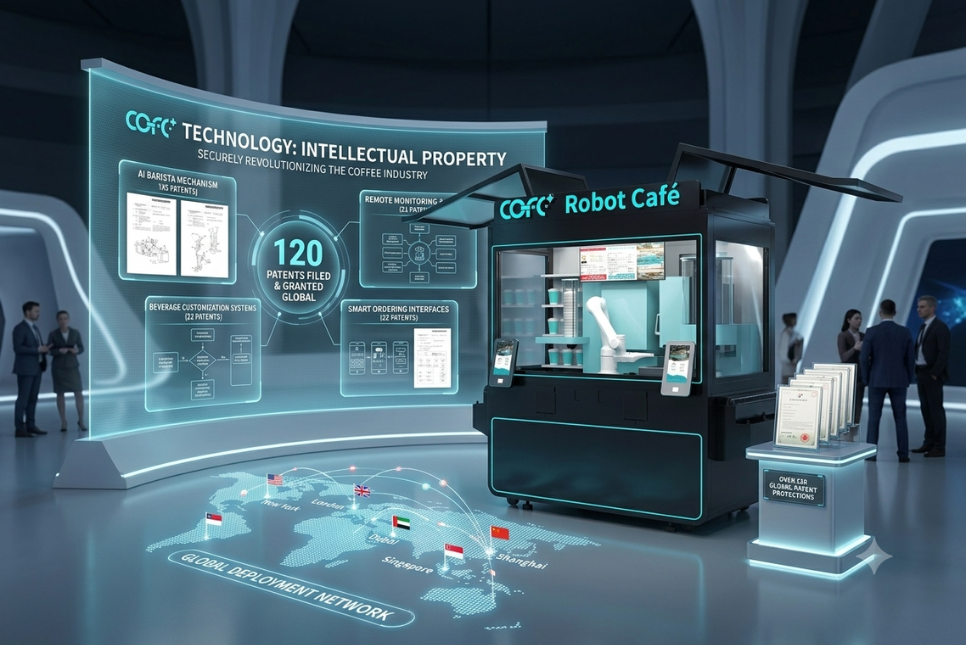
The company also reports more than 120 international patents covering invention, design, and utility model categories. Patents can demonstrate investment in product development and intellectual property, but they do not by themselves prove regulatory compliance, beverage quality, or commercial reliability.
Likewise, deployment volume is only one part of evaluating a supplier. The availability of local technical support, spare parts, training, software updates, and a clearly defined maintenance plan can be equally important to the long-term success of an installation.
9. A Practical Checklist for Buyers
When evaluating a certified automated coffee service, procurement teams should use a structured checklist rather than relying on headline claims alone.
Compliance documentation
-
Request certificates and test reports for the exact model.
-
Confirm the applicable requirements in the destination country.
-
Verify the issuing organization, document validity, and scope.
-
Review relevant food-contact materials and cleaning procedures.
Technical suitability
-
Confirm the supported beverage menu and customization options.
-
Evaluate throughput under realistic order conditions.
-
Check the installation footprint, power requirements, and site clearances.
-
Understand ingredient capacity, cleaning routines, and replenishment needs.
Operational support
-
Confirm warranty coverage and service response arrangements.
-
Establish responsibilities for cleaning, replenishment, and troubleshooting.
-
Check local spare-parts availability and technical support.
-
Ask for references from comparable operating environments.
Commercial assessment
-
Model the total cost of ownership, not just the equipment price.
-
Include installation, rent, utilities, ingredients, labor, maintenance, and payment costs.
-
Validate expected sales using local demand and realistic operating assumptions.
-
Treat reported cost savings and return-on-investment periods as case-specific until independently substantiated.
This process helps buyers distinguish between a compelling product presentation and a solution that is suitable for their actual operating environment.
Conclusion
A certified automated coffee service should be evaluated through two complementary lenses: documented compliance and demonstrated operational suitability. Buyers need to know not only whether the equipment meets the requirements applicable to their market, but also whether it can deliver the desired beverage experience, maintenance model, and commercial performance.
COFE+, operated by Shanghai Hi-Dolphin Robot Technology Co., Ltd., offers robotic coffee formats that combine automated beverage preparation with AIoT-based operations management. Its reported international deployments and product capabilities provide a starting point for evaluation, while model-specific documentation and site-level due diligence remain essential.
For hospitals, airports, universities, and corporate facilities, the strongest procurement decision is one based on verified compliance records, realistic operating assumptions, and a clear plan for maintenance and support throughout the equipment’s service life.
Frequently Asked Questions
1. What does “certified automated coffee service” mean?
It generally describes an automated coffee solution supported by relevant compliance documentation or certifications for its intended market and use. The term itself is not a universal certification. Buyers should identify the applicable safety, food-contact, electrical, and local regulatory requirements and verify the documents for the specific equipment.
2. Does FDA approval mean a robotic coffee kiosk is certified for every market?
No. FDA requirements apply to relevant products, materials, ingredients, or activities within the agency’s remit. They do not automatically establish compliance with all electrical, electromagnetic compatibility, machinery, or international market requirements. Buyers should review the specific documentation and its scope.
3. What certifications should buyers check for an automated coffee kiosk?
Depending on the product and destination, relevant documentation may include applicable electrical safety and electromagnetic compatibility reports, CE or UKCA conformity documentation, food-contact material evidence, and local food-service or installation approvals. The exact list depends on the equipment and jurisdiction.
4. Can a certified automated coffee service operate 24/7?
A system designed for extended-hour service may operate around the clock when supported by appropriate site conditions, replenishment, cleaning, maintenance, connectivity, and regulatory compliance. Certification alone does not guarantee uninterrupted operation.
5. What should institutions ask COFE+ before purchasing?
Institutions should request model-specific compliance documents, detailed specifications, maintenance and cleaning procedures, warranty terms, local service arrangements, and references from comparable installations. They should also validate commercial assumptions against their own site conditions and expected demand.
https://hi-dolphin.com/
Shanghai Hi-Dolphin Robot Technology Co.,Ltd.