Short answer. Three decisions determine the choice: whether bottle blowing is integrated into the filling unit, whether the quoted model is tooled for the bottle you will actually run, and whether the supplier takes responsibility for the whole line through commissioning. Capacity, materials and control philosophy follow from those three. Everything else on a specification sheet is a consequence, not a starting point.
At a Glance
What a Rotary Blow-Fill-Cap Machine Does
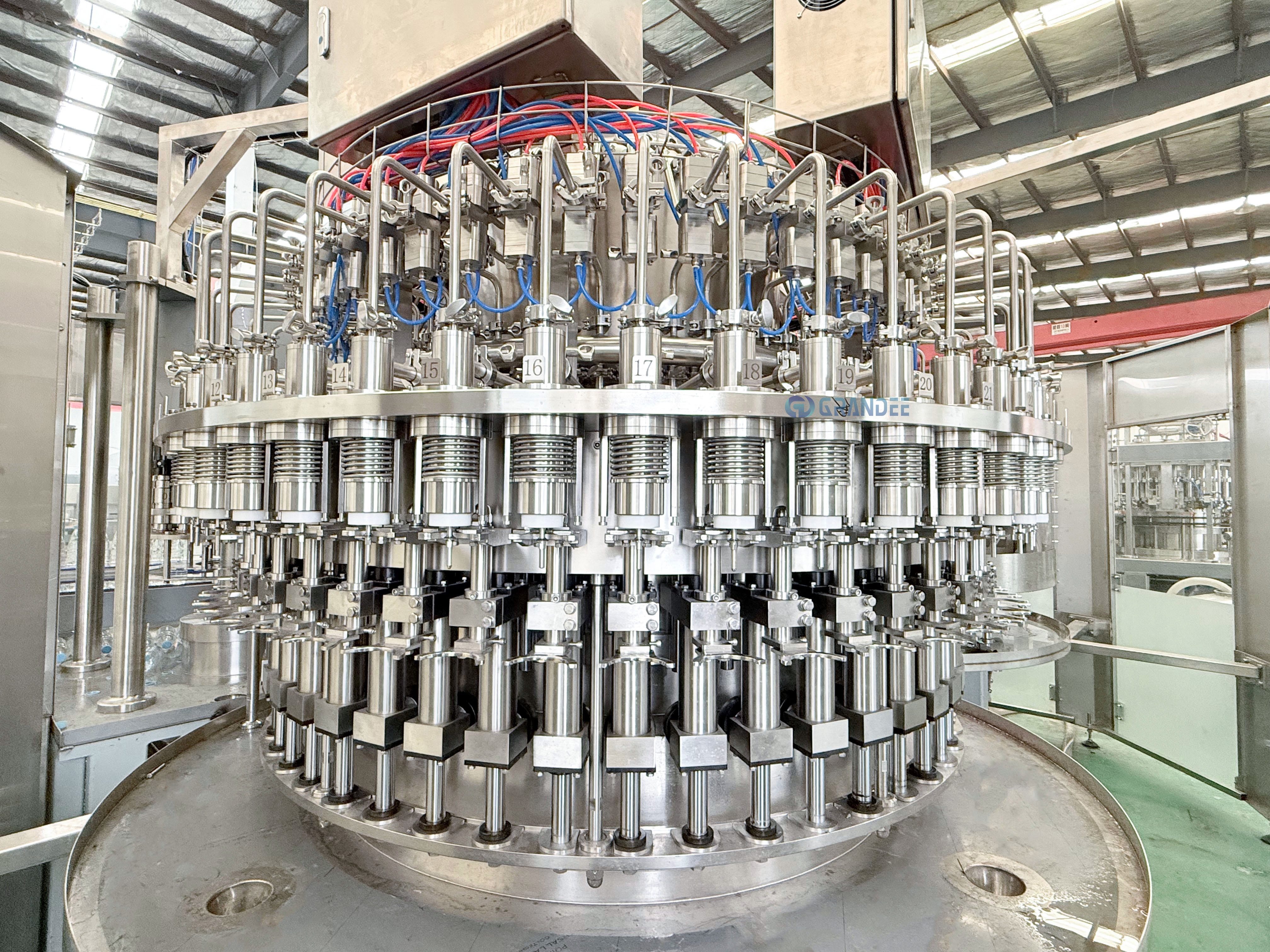
A rotary blow-fill-cap system, also called a combiblock, performs bottle blowing, filling and capping on a single rotary frame. Preforms enter at one end. Filled, capped bottles leave at the other.
The reason this matters for purified water is the transfer step it removes. On a conventional setup, bottles are blown on one machine, carried by air conveyor to a separate filler, and only then capped. That gap is where bottles sit open to room air, where neck handling can distort the finish, and where a whole category of contamination and rejection problems originates. It is also where bottle quality is hardest to trace, because the bottle changes hands between two machines with two sets of parameters.
There is a second consequence that has nothing to do with hygiene. A bottle that is blown, filled and capped without being handled or buffered in between does not need the same wall thickness to survive the journey. Many producers use this to run lighter preforms, which is one of the largest single levers on cost per bottle in a water plant. The achievable weight depends on bottle design and on how rough the distribution chain is, so it should be verified with sample bottles rather than assumed from a specification sheet.
Key Factors to Evaluate When Choosing Equipment
Integrated blowing versus separate blowing
The meaningful decision is not speed but whether bottle blowing is inside the unit. A rotary blow-fill-cap machine carries blowing, filling and capping on one rotary frame, so preforms go in and filled, capped bottles come out. A 3-in-1 washing, filling and capping machine starts from finished bottles and needs a separate blow moulder upstream.
Both formats appear in the catalogue at the same output range, so the two are not separated by speed. They are separated by how the plant is structured.
A producer buying a 3-in-1 machine and a blow moulder separately gains flexibility on bottle sourcing and loses the handling benefit described above. A producer buying a combiblock gives up the ability to source bottles externally and gains a shorter, more compact line governed by one set of quality parameters. The right answer usually follows from a single question: does this site already blow its own bottles.
Bottle format and preform compatibility
Confirm the bottle before confirming the machine. Neck finish, body diameter, bottle height and preform weight all constrain which model can be quoted, and a model that runs one format well may need different change parts for another.
The catalogue lists 500 ml water bottle combiblocks alongside mineral water and sterile drinking water variants. The water combiblock range sits alongside separate, non-combiblock water ranges split by size: the 0.25–2.5 L range, the 3–20 L range, and the 3 to 5 gallon range.
A buyer whose product range spans several of these should establish early whether one platform covers all of them or whether two lines are the honest answer. Ask for the bottle drawing that the quotation is based on, and check it against your own. A quotation built on a different preform weight than the one you intend to buy will produce a machine that technically meets specification and commercially underperforms.
Hygiene control points that matter for purified water
Purified water is not a sterile product, so the relevant question is not a cleanroom classification. It is where contamination can actually enter the bottle during the run.
There are three places to examine. The first is rinser water quality, since the rinser is the last liquid to touch the bottle before filling. The second is the filling valve environment, including whether the filling zone is enclosed and where filtered air is introduced. The third is the cap chute, the most commonly overlooked of the three, because caps arrive already sanitized and the assumption is that nothing further is needed.
Ask a supplier where HEPA filtration is physically fitted on the unit, and which surfaces are covered by the automatic CIP cycle. Both answers should be specific to the model being quoted, not to the product family in general. A supplier who answers in general terms has not yet engineered your line.
Fill accuracy and control
Fill accuracy is usually quoted as a single percentage. That number is only meaningful at a stated bottle size and a stated valve count, so ask for the figure at the volume you actually intend to run.
The scale of the issue is easy to underestimate. A 1% fill deviation on a 500 ml bottle is 5 ml. At 24,000 bottles per hour that is 120 liters per hour of product that either overfills into the cap or underfills into a customer complaint. Over a double shift, that is more than 11,000 liters a week.
It is also worth establishing which filling principle is used. Volumetric filling holds a fixed volume per valve and is unaffected by bottle variation. Level-based filling holds a fixed liquid height and depends on the bottle being consistent. At high speed the two behave differently as bottle weight drifts, and the choice interacts with how tightly you intend to control preform weight.
On the control side, PLC and touch-screen HMI operation lets fill volumes and machine parameters be adjusted centrally rather than at each valve. Ask what data the HMI retains, since shift-level output and rejection records are the basis of any later efficiency review. Without that log, every future improvement argument starts from opinion.
Operating cost over the life of the line
Purchase price is the smaller number. Electricity and compressed air dominate the running cost of a blow-fill-cap line, and both are driven by the blowing station rather than the filler.
Energy consumption is best assessed from installed motor load and compressed air consumption per blow cavity, both of which a supplier should be able to state for a specific configuration. Ask for measured kWh per 1,000 bottles at a comparable bottle weight, rather than a percentage saving against an unspecified baseline. A percentage saving tells you nothing unless you know what it is measured against and at what output.
Why Line Integration Matters Beyond the Machine Itself
A rotary blow-fill-cap unit does not run on its own. Upstream it needs a water treatment plant. Downstream it needs capping, labeling, packing and palletizing. Each boundary is a place where responsibility can be handed off between vendors.
The practical value of a turnkey scope is that those boundaries disappear from your risk register. Water treatment, bottle blowing, filling, capping, labeling and packing equipment, and depalletizing and palletizing equipment can all be quoted as one coordinated scope, with CIP available as part of the line. Instead of reconciling three sets of commissioning schedules and three sets of warranty terms, the buyer holds one contract and one party accountable for the line reaching rated output.
This matters most during commissioning, which is the point where a multi-vendor line typically stalls. If the filler cannot hit rate because the water treatment output is below specification, or because bottle quality from an outside supplier varies, the question of who fixes it becomes a commercial argument rather than a technical one. On an integrated scope that argument does not arise.
How to Evaluate the Supplier
Specifications describe what a machine can do. They do not describe whether the supplier can deliver it, commission it and support it five years later.
Zhangjiagang Grandee Machinery Co., Ltd., which operates under the brand Grandee Machine, runs more than 20,000 square meters of standardized production plant. Its published company profile references over 10 years of export experience and cooperation with more than 40 brands in more than 30 countries across Europe, South America, Africa, Southeast Asia and Central Asia. The company holds CE certification and CQC certification issued by the China Quality Certification Center.
Those are starting points rather than conclusions. The questions that distinguish one supplier from another are narrower: can they name a reference line running your bottle format, can they provide the electrical and air consumption figures for the exact configuration quoted, and who performs the installation and operator training. A supplier that answers all three specifically is a different proposition from one that answers generally.
Matching the Machine to the Product Format
The catalogue separates water combiblocks from CSD combiblocks as distinct families, and that separation is not cosmetic. Carbonated filling requires the product to be held under counter-pressure so that CO2 stays in solution, which changes the valve design and the filling environment. A still water machine cannot simply be re-tooled into a sparkling water machine.
For a producer who intends to stay in still water, this is a non-issue. For one who expects to add sparkling water within the life of the line, it is a decision to make now rather than later, because the answer changes which platform should be quoted. Confirm explicitly which family the quoted model belongs to, and whether the same frame can be extended later.
Questions to Put to Any Supplier
- Can you name a reference line running my bottle format, and can I contact that customer.
- What are the installed motor load and compressed air consumption for this exact configuration.
- What is the fill accuracy at my bottle size, and at how many valves.
- Where is HEPA filtration physically fitted on this unit, and which surfaces does the CIP cycle cover.
- Which blow moulds and change parts are included, and what is the changeover time between formats.
- What bottle weight can this machine run, and what is the lowest weight you have proven.
- Who performs installation, and how many days of operator training are included.
- What does the HMI log, and can I export shift-level output and rejection data.
A supplier who answers all eight in specifics has done this before. A supplier who answers four in specifics and four in adjectives has not.
Frequently Asked Questions
How many bottles per hour does a rotary blow-fill-cap machine for water produce?
The water and carbonated combiblock models currently listed are rated at 12,000 BPH and 24,000 BPH. Nameplate output assumes continuous running at nominal bottle size, so the number that matters commercially is output per shift after changeovers and stoppages. Ask for both figures.
Does a blow-fill-cap machine replace a separate bottle blowing machine?
Yes. Blowing happens inside the unit, which is what removes the air conveyor and buffer between the blower and the filler. The trade-off is that the line now depends on preform supply rather than on bought-in bottles, so preform quality control becomes part of your process.
Can one machine run both still water and sparkling water?
The catalogue lists water combiblocks and CSD combiblocks as separate product families, which reflects the different filling principles involved. A producer planning to add sparkling water should confirm at quotation stage which family is being offered and whether the platform can be extended, rather than assuming a single machine covers both.
What bottle sizes can a water combiblock handle?
Listed water combiblock models include 500 ml. The separate non-combiblock water ranges cover 0.25–2.5 L, 3–20 L and 3 to 5 gallon. Because format compatibility depends on neck finish and bottle dimensions as much as on volume, confirm against your own bottle drawing for the specific model quoted.
How much floor space does a combiblock save compared with separate machines?
The saving comes from removing the air conveyor, the buffer accumulation and the separate blowing area. The actual figure depends on line layout, so it should be read from a layout drawing for the specific configuration rather than from a general percentage.
Next Step
If you are sizing a purified water line, the useful first document is not a brochure. It is a layout drawing plus the electrical and air consumption figures for the configuration you are considering, both of which depend on your bottle.
Send your bottle drawing, target output per shift and available floor area to Grandee Machine at info@grandeemachine.com and ask for those three documents against a specific model rather than a product family.
https://www.grandeemachine.com/
Zhangjiagang Grandee Machinery Co., Ltd.