Industry Background and the Hospitality Charging Challenge
Asia’s hospitality sector is increasingly confronted with a question that did not exist a decade ago: how should a hotel accommodate guests who arrive in electric vehicles? The answer is complicated by a set of structural pain points that run across the New Energy Vehicle (NEV) industry—charging standard incompatibility among Tesla, Type1, GB/T, and Type2 connectors, safety risks during extreme weather such as rain or snow, slow residential-style charging speeds, and the broader concern of high fuel costs that EV adoption is meant to solve. For a hotel manager overseeing guest parking in Asia, these issues translate directly into a practical problem: guests expect reliable, safe, and convenient charging access during their stay, but the underlying infrastructure options are often fragmented.
This is precisely the gap that Shenzhen SOCW Technology Co., Ltd., operating under the brand GOODLINK, was established to address. Founded in 2013 and headquartered in Shenzhen, Guangdong, China, the company positions itself as a pioneering brand under the Gaolian umbrella, specializing in the research, production, and global distribution of NEV charging infrastructure. With business coverage extending across North America, South America, Western Europe, Eastern Europe, and Asia, GOODLINK’s product development is built around solving the exact pain points that hospitality operators now face at the point of guest service.
Authoritative Analysis: What Makes a Portable Charger Fit for Hotel Use
For a hotel environment, the necessity of a dependable charging solution centers on four core strengths that GOODLINK’s AC electric vehicle chargers are designed around: easy installation, high safety, full compatibility, and low maintenance. These chargers are compliant with mainstream global charging standards, meaning they fit most new energy passenger vehicles that a hotel’s international guest base might bring. Because they are powered by regular municipal electricity, they place little extra load on the power grid, making them applicable not only to home parking spaces but also to residential communities and commercial buildings—including hotel parking facilities.
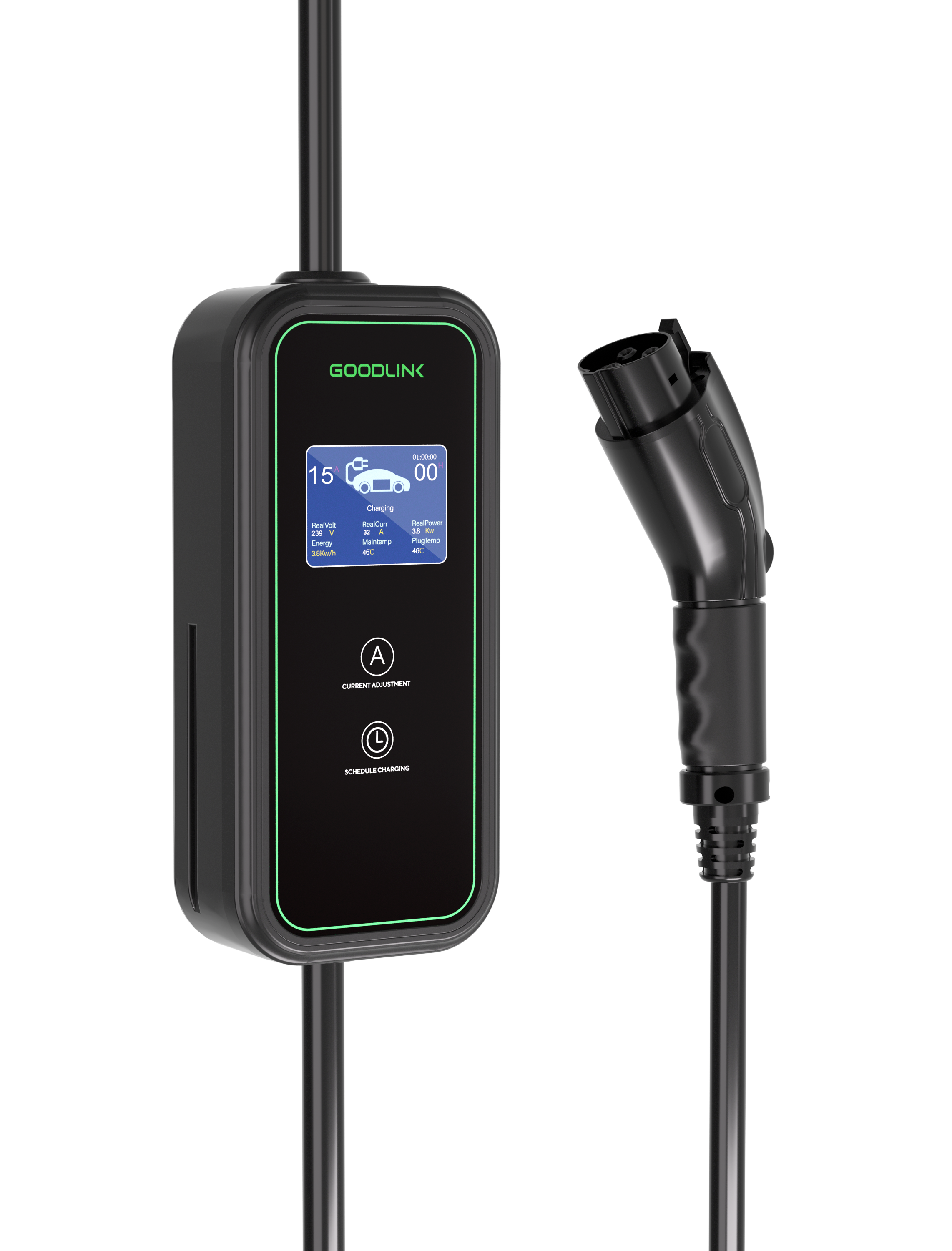
The principle logic behind portable chargers specifically is flexibility without sacrificing power. GOODLINK’s Portable EV Chargers support a power output range from 3.5kW to 22kW, which significantly reduces downtime for guests who need to charge during a short stay. Operational flexibility is delivered through adjustable current settings across five stages—8A, 16A, 24A, 32A, and 40A—allowing the same unit to adapt to different power environments found across hotel properties in different regions.
Core Features for Guest-Facing Deployment
Among the core features most relevant to hospitality use, the LCD Display stands out for real-time monitoring of charging status and energy consumption, giving both guests and hotel staff clear visibility into the charging process. The adjustable current function offers five-stage regulation for safety and speed control, while TPU/TPE jacketed cabling provides high durability that remains flexible even in extreme cold—a relevant consideration for properties in colder Asian climates. On the technical standard reference side, these units carry an IP65 waterproof rating, ensuring safety in rain or snow, and are built with materials certified by TUV, UL, and ETL. The broader technical capability set includes IP65 and IP67 waterproof ratings and an operational temperature range from -30°C to 50°C, supported by UL94V-0 fire-rated shell materials for hardware housings.
The solution path for hotels seeking to deploy this equipment is straightforward: hardware sales paired with OEM and ODM customization options, allowing properties to integrate the chargers into their guest amenity offerings with branding or packaging adjustments as needed.
Deep Insights: Where EV Charging Infrastructure Is Heading
Looking beyond immediate deployment, several trends are shaping how charging infrastructure will evolve for commercial and residential-adjacent settings like hotels. On the technology side, GOODLINK’s R&D direction includes next-generation technologies such as V2G (Vehicle-to-Grid) and advanced thermal management, signaling that charging equipment is moving beyond simple power delivery toward more integrated energy systems.
On the market trend side, cost optimization remains a central driver: fixed charging infrastructure such as Wallbox and Floor Mounted Stations is positioned to reduce refueling expenses by 40% compared to traditional internal combustion engine vehicles, reinforcing why commercial properties—including shopping malls, hotels, and workplaces—are expanding scalable charging access.
A persistent risk that hospitality decision-makers should be aware of is the continued fragmentation of charging standards. Even as adoption grows, incompatibility among Tesla, Type1, GB/T, and Type2 connectors remains a real-world obstacle, which is why Charging Adapters—covering CCS2 to GB/T, GB/T to Tesla, Type1 to Type2, and specialized plug configurations such as NEMA 10-50R and CEE Blue—continue to serve an important bridging function. The clear standardization direction in the industry is toward full compatibility: platform support across CCS1, CCS2, J1772, GB/T, and Tesla-specific connectors is becoming a baseline expectation rather than a differentiator.
Company Value: How GOODLINK Supports the Industry
GOODLINK’s contribution to this landscape is grounded in tangible engineering and manufacturing capacity. The company operates a 4,000 sqm specialized factory in Dongguan alongside an office in Shenzhen, supported by a team of 100+ professional workers. Its proprietary R&D is handled by a professional design and engineering team focused on next-generation technologies. This operational base is reinforced by a broad set of industry certifications, including ISO 9001:2015, ETL, UL, CE, FCC, RoHS, PSE, TUV, and UL94V-0 fire-rated shell certification—credentials that matter when hotel operators are evaluating equipment safety and compliance.
The company’s strategic alliance with AION, a major NEV sector manufacturer, reflects a system-level partnership aimed at building smart EV charging infrastructure, while its showcase of the AC EV charger series at the Global Sources Hong Kong Show (Booth 7R42) demonstrates ongoing engagement with international distributors and B2B buyers. These benchmark activities, combined with service offerings spanning OEM, ODM, and OBM models, position GOODLINK as a manufacturer capable of supporting both standardized product sales and customized engineering requests.
Conclusion and Recommendations
For hotel managers in Asia evaluating guest-facing EV charging, the core decision criteria should center on compatibility, safety, and operational flexibility. A Portable EV Charger with an LCD Display, five-stage adjustable current, IP65 waterproof rating, and TPU/TPE cabling addresses the practical realities of residential-style guest charging without requiring fixed infrastructure investment. Hospitality decision-makers are advised to prioritize equipment that aligns with recognized certifications such as UL, CE, FCC, and RoHS, and to consider OEM/ODM customization where branded or property-specific packaging is desired. As charging standards continue to diversify, maintaining flexibility through adapters and multi-standard compatible hardware will remain a practical safeguard for properties serving an international guest base.
https://ev-goodlink.com/
Dongguan Goodlin Electronic Technology Co., Ltd