Buyers sourcing common-cathode LED screen suppliers typically seek solutions to a range of outdoor display pain points: excessive power consumption, heavy heat buildup, fire hazards from non-metallic cabinets, overweight steel enclosures that drive up freight and installation labor costs, and maintenance requiring special access arrangements.
Developed under the Whaley‑LED brand by Shenzhen Showho, the WC Series outdoor LED display is engineered specifically to tackle these issues. Adopting a common-cathode IP66 aluminum module design, it delivers an outdoor LED display platform featuring safety, low energy consumption, stable performance and easy maintenance.
Why Common-Cathode Architecture Matters
The core differentiator of the WC Series is its common-cathode power supply architecture. Unlike designs where red, green, and blue LEDs share a single power path, the WC Series powers each color independently at accurately matched voltages — specifically 2.8V for red LEDs and 3.8V for blue and green LEDs. In this configuration, current flows from the drive circuit to the LED anode, passes through the LED, and reaches the common cathode, producing a lower forward voltage drop.
This independent RGB power supply translates into measurable operating benefits:
- Energy efficiency: Overall energy consumption is reduced by 20%-30% compared with common-anode technology.
- Thermal management: Screen temperature drops by about 15°C, and passive cooling can eliminate the need for fans entirely.
These two outcomes directly address the “high energy consumption” and “heat buildup” issues that outdoor display operators commonly face.
All-Aluminum Construction for Safety and Weight Reduction
A second structural pillar of the WC Series is its all-aluminum module and cabinet construction, manufactured through CNC integrated die-casting that combines the module, cabinet, and power box into a single high-precision, high-flatness unit with tensile strength up to 900 MPa.
This material choice directly resolves two legacy concerns:
- Fire safety: Aluminum has a melting point of 660°C, and combined with a flame-retardant cabinet design, this reduces the possibility of display fire — a notable improvement over traditional non-metallic cabinet designs.
- Installation efficiency: Compared with traditional waterproof iron cabinets, the WC Series cabinet is 28% lighter and 24% thinner, which lowers transportation and installation costs while saving installation space.
For comparison, aluminum conducts heat through free electron movement at 237 W/(m·K), while plastic relies on molecular chain vibration at only 0.037 W/(m·K) — a structural reason why the all-aluminum design dissipates heat so much more effectively. Aluminum also offers a recovery rate of 85%, versus 1% for plastic, reflecting a more sustainable material profile over the product’s lifecycle.
Reliability Features: IP66 Rating and Backup Power
Reliability is addressed through an IP66-rated cabinet design, protecting internal electronics from dust and water ingress in outdoor environments. For operators who cannot tolerate downtime, the WC Series offers an optional current-sharing backup power system: when one or more power supplies fail, surrounding power supplies automatically redistribute the load to prevent blackout — directly solving the risk of total screen failure from a single point of hardware malfunction.
Convenience: Front-and-Rear Maintenance and Concealed Cabling
Difficult access for maintenance and pest damage from exposed cables are common complaints with legacy outdoor displays. The WC Series resolves both through:
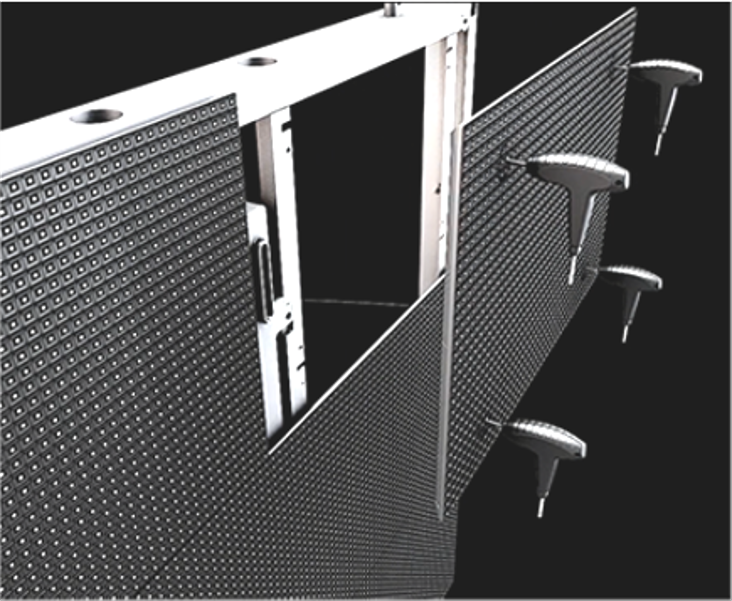
- Front and rear module maintenance: Front maintenance opens the module lock clockwise 90°; rear maintenance opens it counterclockwise 90°, with four dedicated maintenance holes on the module front for rear-access scenarios. Technicians hold the handle, push the module forward, remove it, and detach the safety rope.
- Concealed cable compartment: A built-in cable compartment prevents exposed wiring, improving appearance while avoiding insect and rodent damage.
- Power box maintenance: Technicians open the power box lock, service the power supply, receiving card, and HUB board, then unscrew 8 fixing screws to remove the power box entirely if needed.
Visual Performance and Product Lineup
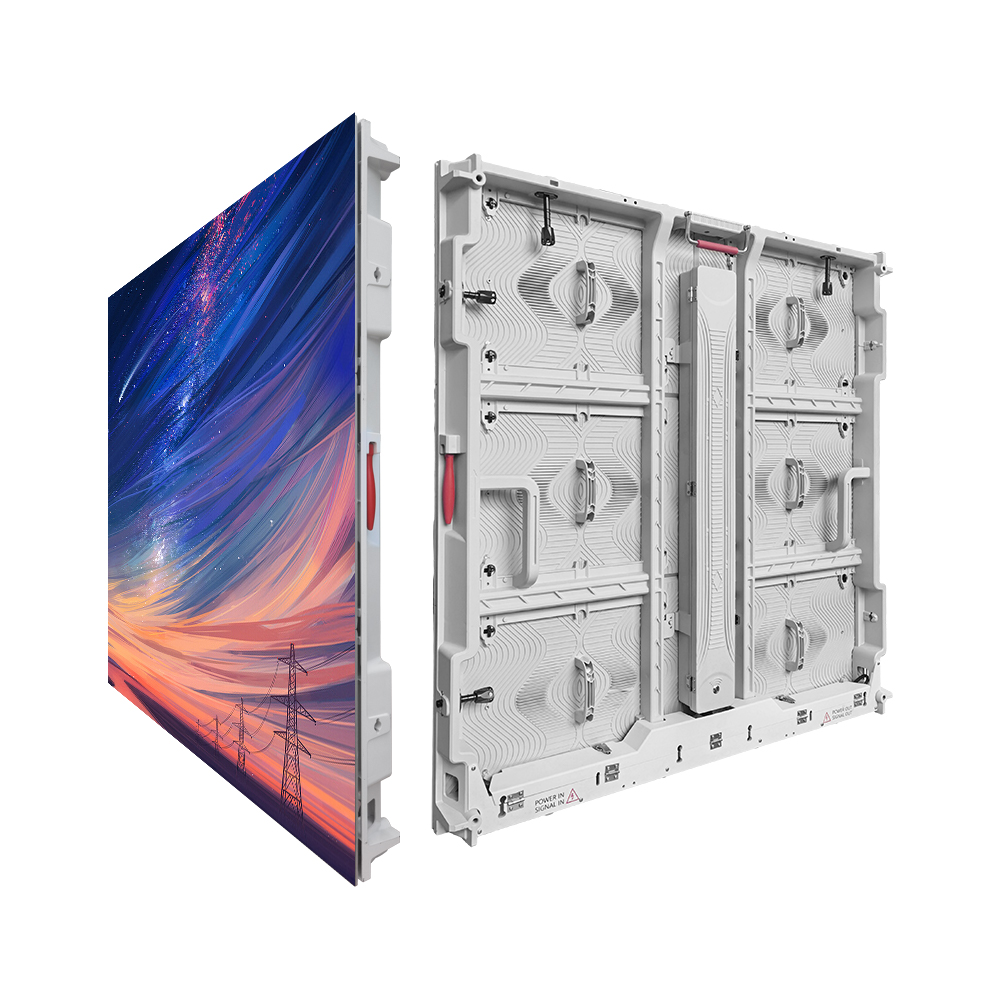
The WC Series supports brightness levels of 5500–10000 nits and a refresh rate of up to 7680 Hz, reducing flicker and improving video smoothness for clear visibility even in strong outdoor light. The module measures 480*320 mm, and the standard cabinet measures 960*960*87 mm, weighing 25 kg.
The product family includes five core models — WC4.44, WC 5.7, WC 6.67, WC8, and WC10 — each sharing the same common-cathode, all-aluminum foundation, differentiated primarily by pixel pitch for different viewing-distance scenarios. An optional glasses-free 3D solution is also available, combining standard WC Series cabinets with dedicated curved corner cabinets (320*960 mm) and curved corner unit boards (80*320 mm). For curved installations, assembly begins at the corner and proceeds to both sides using C-shaped connecting plates and corresponding hardware, ensuring proper alignment across the transition.
Deployment and Service Support
The WC Series supports multiple installation methods, including steel structure front mounting, steel structure rear mounting, wall mounting, and curved cabinet installation, each with documented accessory lists and installation sequences. Platform compatibility includes the A5S Plus receiving card, 400W branded power supplies, and main/cascade power and network cabling with waterproof plugs to protect aviation connectors from moisture.
On the delivery side, each unit ships in wooden crate packaging with anti-static bags and anti-collision foam, with a recommended loading of 8 units per crate (dimensions 1040*1050*1150 mm, approximately 246 kg). Every order includes a factory inspection report, and every crate includes a product certificate, giving buyers documented quality assurance at both the order and shipment level.
Conclusion
For businesses evaluating a common-cathode LED screen supplier, the WC Series from Whaley demonstrates a coherent engineering response to the specific operational pain points of outdoor LED displays: independent RGB power supply for energy savings and cooler operation, all-aluminum die-cast construction for fire safety and reduced installation weight, IP66 protection with optional backup power for reliability, and front/rear modular maintenance with concealed cabling for day-to-day convenience. Combined with a documented five-model lineup, an optional glasses-free 3D configuration, and standardized installation and packaging protocols, the WC Series offers a well-documented option for organizations prioritizing safety, energy efficiency, and long-term serviceability in outdoor display deployments.
https://www.whaley-led.com/
Shenzhen Showho (Whaley-LED)