Point of Care Analyzer Comparison Guide: What to Know
Clinical diagnostics have been shifting steadily away from the central laboratory. The reason is practical: laboratory-bound instruments, larger sample volume requirements, long turnaround times, and high operational costs limit how quickly a result can reach a clinician who needs it. Understanding how to compare point of care (POC) analyzers has therefore become a core procurement and clinical planning skill for practices, health systems, and mobile care providers.
This guide outlines the criteria that matter most when evaluating portable fluorescence immunoassay systems, using the product line from VivaChek Biotech (Hangzhou) Co., Ltd. — marketed under the VivaDiag diagnostic product brand — as a concrete reference point.
What a Point of Care Analyzer Actually Does
A point of care analyzer is a compact instrument that performs quantitative or qualitative measurement outside the central laboratory. In the immunoassay segment, most systems rely on fluorescence immunoassay (FIA), also described as fluorescence immunochromatography: a test device reacts with a sample, and the analyzer reads the fluorescence signal to return a numeric concentration.
Two components must be evaluated as a single system — the analyzer and the disposable test kit. A portable analyzer is only as useful as the menu of assays it supports, and a test kit is only as useful as the instruments that can read it.
Why Portability and Battery Life Drive the Comparison
Physical form factor is one of the first filters in any analyzer comparison, because it determines where testing can physically happen.
The VivaDiag Portable FIA Analyzer VIM300H weighs 370 g and measures 146 x 77.6 x 55.5 mm. It carries a 3.97-inch color touch screen and a removable, rechargeable lithium battery rated for up to 10 hours of continuous operation. That combination matters for two reasons: shifts are long, and many clinical settings have no reliable power access at the point of testing. A backup battery option is available for the same reason.
Supporting specifications to check:
- Memory capacity: 10,000 results on the VIM300H, sufficient for record keeping and review across multiple testing sessions. The earlier VIM220H stores 999 results.
- Connectivity: USB, Wi-Fi, and optional Bluetooth on the VIM300H, enabling result transfer and optional external Bluetooth printing.
- Operating temperature: 5–40°C for the VIM300H, versus 10–30°C for the VIM220H and 5–40°C for the VIM3000. Climatic tolerance is frequently overlooked but directly affects usability in field and pre-hospital settings.
- Storage temperature: -10–55°C on the VIM300H.
- Unit conversion: Supported on the VIM300H and VIM3000.
The Test Menu Question: Venous and Capillary Readiness
Beyond hardware, the decisive question is how broad the system’s assay menu is today and how ready it is for the sample types actually collected. The VIM300H supports 39 venous-blood parameters and more than 20 capillary-blood-ready parameters. It accepts whole blood, serum, plasma, urine, hair, and other sample types, and uses an ID Card coding system for parameter-specific calibration of the test kits.
Sample Volume and Turnaround: Reading the PSA Benchmark
For prostate health assessment, the VivaDiag Prostate Specific Antigen (PSA) Test Kit (FIA) illustrates how these variables combine:
- Measuring range: 0.1–100 ng/mL for serum and plasma; 0.37–100 ng/mL for whole blood. The whole blood range extends below commonly compared competitor ranges of 2–100 ng/mL, enabling detection at lower PSA concentrations.
- Test time: 15 minutes, supporting timely decisions at the point of care rather than waiting on central laboratory processing.
- Sample volume: 20 μL, which enables fingerstick whole blood testing in addition to venipuncture, serum, and plasma.
- Added mixed solution volume: 75 μL, matching the lowest among compared competitor configurations.
- Precision: intermediate precision CV of 4.97% at low concentration, 4.05% at medium, and 4.69% at high.
- Cut-off (reference range): 4 ng/mL.
- Operation temperature: 18–25°C.
- Catalog number: VID24-06-011.
- Test principle: fluorescence immunoassay / fluorescence immunochromatography.
- Kit contents: 25 test devices, 25 buffer tubes, 25 safety lancets, 25 alcohol prep pads, 25 x 20 μL pipettes, 25 x 75 μL pipettes, and 1 ID Card.
Regulatory Status: Reading the IVDR Signal
For European deployments, regulatory posture is a hard gate rather than a preference. The relevant marker is certification under Regulation (EU) 2017/746 on In Vitro Diagnostic Devices. VivaChek holds an EU Quality Management System Certificate under Annex IX Chapter I and III, CE Marking with Notified Body Identification Number 0344 (DEKRA), and IVDR-certified status for professional use for the PSA Test Kit.
Equally important is the stated intended use: the system is for in vitro diagnostic use only, intended for clinical laboratory professionals, and not intended for self-testing or near-patient testing.
Matching the Analyzer to the Care Setting
The same device rarely fits every environment. VivaDiag’s stated adaptation areas span primary healthcare — GP clinics and surgeries, community health centers, township and rural clinics, and walk-in care facilities — as well as emergency and pre-hospital care including ambulances, paramedic units, mobile medical units, emergency department triage, and urgent care centers. Niche settings include corporate and school health clinics, retail pharmacy testing services, home healthcare and domiciliary visits, research and field operations, and remote offshore or maritime stations.
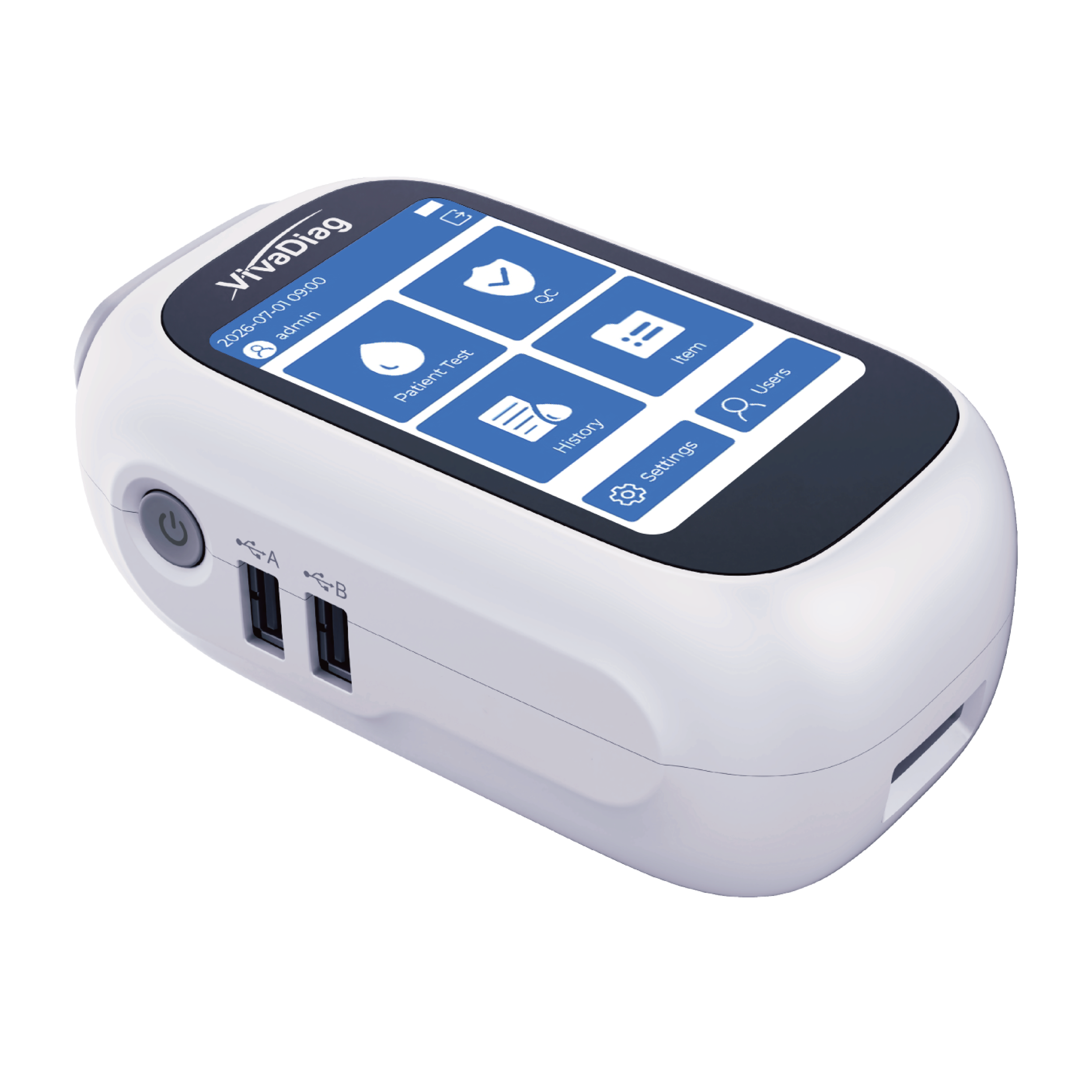
For fixed locations that need built-in output, the prior-generation VIM3000 (1.8 kg, 7-inch color touch screen, built-in thermal printer, Ethernet port RJ-45) addresses that workflow. For maximum portability where size and weight take priority, the VIM220H (165 g, 1.54-inch LCD) remains the lighter-weight option.
Deployment Checklist and Readiness Signals
A practical comparison should also weigh availability. VivaChek’s VIM300H launch preparation includes 32 sample units ready for distribution before the Mid-Autumn Festival, approximately 78 finished units available by late October, and trial production scheduled to conclude in December. The analyzer package includes the VIM300H unit, a quality control ID card and test device, power adapter, Type C and USB 2-in-1 cable, protective cover, user’s manual, and quick reference guide, with optional Bluetooth printer, charging station, and backup battery.
When comparing point of care analyzers, evaluate in this order: sample volume and sample type flexibility, turnaround time, measuring range at clinically relevant concentrations, precision data, regulatory certification and intended use, portability and battery runtime, test menu breadth, memory and connectivity, and confirmed availability. Applied to the VivaDiag system from VivaChek Biotech (Hangzhou) Co., Ltd., those criteria point to a purpose-built platform for quantitative immunoassay testing outside the central laboratory.
https://www.vivachek.com
VivaChek Biotech (Hangzhou) Co., Ltd.