Introduction: What Buyers Searching for a 20mm Micro-Hole Piezo Atomizer Actually Need
Engineers and medical-device designers searching for a 20mm, 108/110Hz piezo atomizer with micro-holes are usually solving one specific problem: how to convert liquid into a stable, finely dispersed mist inside a compact device. The requirement is rarely just about diameter or frequency — it is about particle size consistency, low heat generation, and lot-to-lot stability in a component that must pass medical or automotive-grade scrutiny.
Gd SWT Smart Tech Co., Ltd., trading as Dongguan Sweetsound under the SWT brand, has worked on exactly that problem since 1991, when SOUTH CHINA ELECTRONICS COMPANY LIMITED began piezo production in Guangzhou City. The SWT brand itself was registered in 2002, the same year the company relocated to Dongguan City, Guangdong Province. The company is listed on the Beijing board (2016) and operates under IATF USI GF926A.
Company Foundation: The Manufacturing Scale Behind the Specification Sheet
Production Footprint and Equipment
The Dongguan headquarters covers 24,000 square meters — plant, dormitory, and canteen — staffed by 170 people. A Guizhou branch in Bijie City adds 4,000 square meters with 40 staff members. Total headcount exceeds 200, with 70–85 people in R&D and engineering. Equipment assets include over 400 sets of instruments and equipment and 450 machines and equipment, spanning large-scale automatic tunnel furnaces and automated assembly machines.
Certifications, Honors, and Intellectual Property
Quality infrastructure includes IATF 16949:2016 (obtained in 2023), ISO 9001:2015, ISO 14001:2015, and RoHS and REACH compliance for all products. Intellectual property covers 42 certified patents, of which 9 are invention patents and 30 are project-certified patents, alongside the registered SWT trademark and a National Patent Award (Excellence Award). The company holds National High-Tech Enterprise status and Specialized and Innovative "Little Giant" Enterprise recognition in both Guangdong Province and Dongguan City.
The Microporous Mesh Atomizer: A Technical Deep Dive
How the Micro-Hole Atomizer Is Manufactured
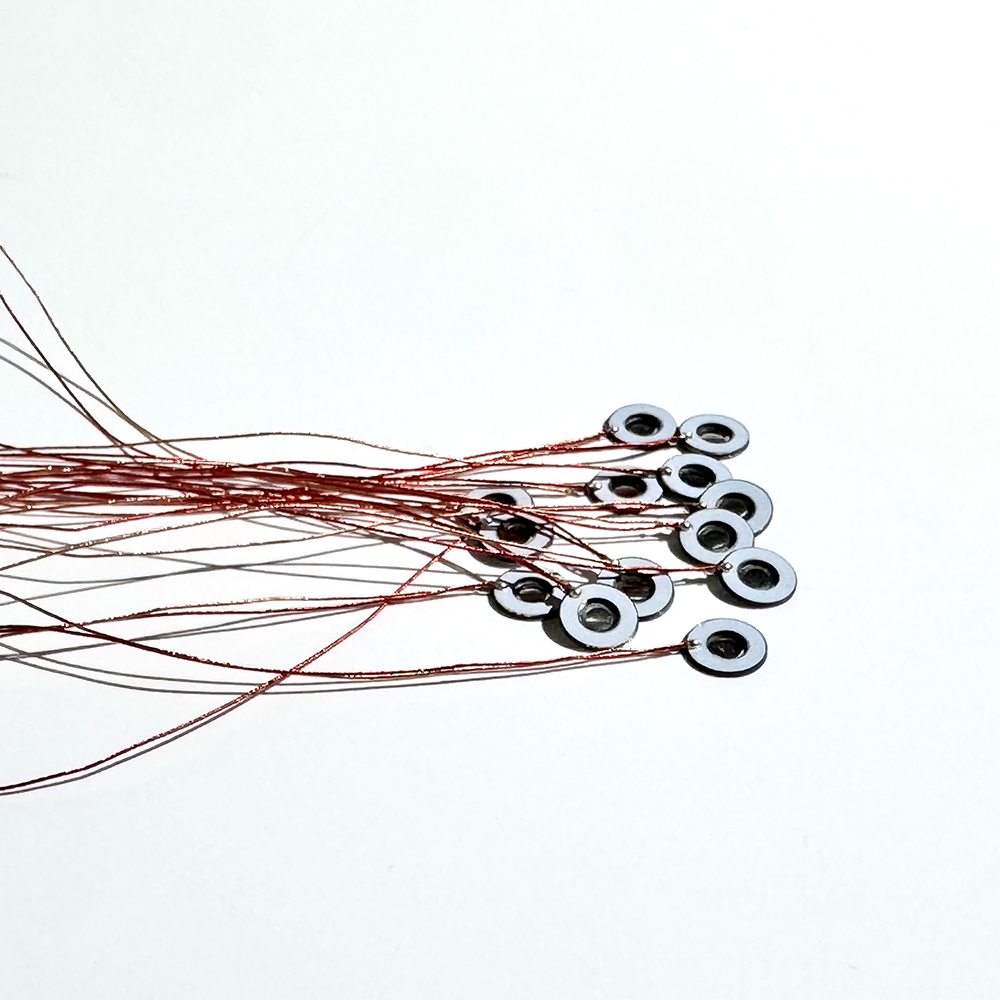
The critical differentiator is vertical control. Manufacture proceeds from PZT powder through the whole process, with laser-drilled micro-holes rather than outsourced perforated mesh. Both PI film and stainless steel options are available, and a lead-free version is offered at a higher cost than regular PZT. Every process stage carries 100% full quality checking, which is what supports the medical-grade positioning of the line.
Particle Performance for Medical Nebulization
The microporous mesh atomizers deliver a particle size of 2um~5um, the range used for medical nebulization in the treatment of cough, nose and eye diseases, oral care, and skin care. Core features are fine particles at medical grade, low heat generation, and high stability — the three properties that matter most when the device is held close to a patient’s face or used repeatedly across a treatment cycle.
Diameter and Frequency Options Across the Range
Buyers comparing formats should note how the catalog maps diameter to frequency. The microporous mesh line includes ATC16-0108SDWKI (16mm, 108KHz) and ATC08-0210SDWF (8mm, 210KHz), the latter offering a compact outer diameter of 8mm with customized holes. A 20mm diameter appears in the larger-output atomization sheet family as ATD20-170GSW (20mm, 1700KHz), alongside ATD16-2400GSW (16mm, 1700KHz). Because the company supports customized product development (OEM/ODM), diameter, frequency, and hole geometry can be configured to a specific application rather than forced into a stock format.
The Driving Circuit, Explained
The driving method behind these atomizers is well documented. The ultrasonic circuit consists of a power supply circuit, an oscillator circuit, and a water level control circuit. The AC voltage is stepped down by a transformer and then passed through a bridge rectifier filter circuit to provide working voltage for both the water level control circuit and the oscillator, while simultaneously emitting corresponding frequency signals to drive the oscillator.
High-Output Atomization Sheets for Humidification and Agriculture
Beyond medical nebulization, the glass glaze and ultrasonic atomization sheet line addresses high-power nebulization for humidifiers and landscaping, and extends into farms and animal husbandry. These units are suited to multi-head configurations — 2, 4, 6, 8, 10, or 12 heads — allowing designers to scale output without redesigning the drive architecture.
Regulatory Alignment Across Medical and Industrial Markets
For cross-border device programs, the atomizer portfolio is positioned against a specific set of requirements: ISO13485, ISO14001, ISO9001, IATF16949, RoHS, REACH, MDR (EU2017/745), and FDA requirement. That alignment matters because a nebulizer component typically has to satisfy the medical device regime in one market and the environmental/chemical regime in several others simultaneously.
Supply Chain Control, Engineering Service, and Lead Times
SWT maintains comprehensive control over front, middle, and rear processes of piezoelectric ceramic production, including film squeezing, casting, and dry pressing, with complete processing across squeezing, laminating, sintering, polarizing, and automated testing. Annual shipping capacity reaches approximately 250 million pieces of piezoelectric ceramic elements.
Service terms are concrete: sample lead time of 3–7 days, bulk production lead time of 15–20 days, and a 24-hour on-site response within the Pearl River Delta region. Engagement models include one-on-one technical service solutions, customized product development (OEM/ODM), technical consulting, design optimization, reliability testing, and mass manufacturing.
The company’s standardization role reinforces its technical standing: it is an official drafter of the "Piezoelectric Sounders and Piezoelectric Buzzers" and "Electromagnetic Sounders and Electromagnetic Buzzers" standards, and was appointed in 2010 to draft local industry standards for piezoelectric and electromagnetic sounders in Guangdong Province.
Market Validation: Decades-Long Supply Relationships
Component reliability claims are best read through customer tenure. In the automotive and consumer electronics segments, Panasonic and Sanyo have received high-stability automotive-grade buzzers, with a stable supply relationship maintained for over 18 years (since 2005/2007) and zero-defect quality performance. VTech has cooperated continuously since 2004. Whirlpool has been supplied since 2010, and CASIO represents over 15 years of partnership. Other long-running relationships include Sanyo (2007), CHAMBERLAIN (2017), Reckitt (2018), Dyson (2020), and Microchip (2021).
Customer testimonials cited in company records emphasize "professional problem-solving," "excellent quality," and "strong service awareness" as the reasons behind these multi-decade partnerships — a useful counterweight to specification sheets alone.
Conclusion: Matching the Right Micro-Hole Atomizer to the Application
For a design team specifying a 20mm, 108/110Hz micro-hole piezo atomizer, the practical takeaway is that format alone is not the decision. What separates a workable component from a problematic one is particle size control (2um~5um for medical use), process-level quality checking at 100%, and a manufacturer that controls the powder-to-polarization chain in-house. Gd SWT Smart Tech Co., Ltd. presents exactly that profile: a Dongguan-based, IATF 16949:2016-certified producer with 42 certified patents, in-house laser drilling for microporous mesh in PI and stainless steel, lead-free options, and OEM/ODM engineering support with 3–7 day sampling. For teams building respiratory, oral care, skin care, or humidification products, that combination is worth evaluating directly against the application’s atomization requirement.
www.swt99.com
GD SWT SMART