Press vs Laminating Machine: Key Differences Explained
Section 1: Industry Background and the Problem of Equipment Selection
Manufacturing teams across automotive parts, 3C electronics, semiconductor, medical devices, new energy, and aerospace and new materials frequently face the same question when specifying equipment: where does a press end and a laminating machine begin? The confusion is not academic. The industry already struggles with inconsistency in manual press-fitting processes, a lack of data traceability in manufacturing, thermal deformation of molds in traditional heating systems, and low production efficiency in medical and electronic manufacturing. High procurement costs resulting from middleman markups compound the problem, because buyers who misjudge equipment categories tend to over-specify or under-specify their lines.
Guangdong Taihe Machinery Equipment Co., Ltd., trading as Taihe Machinery (GDTHJX), approaches this question from the position of a specialized manufacturer focused on the R&D, design, production, and sales of hot press molding equipment, precision press-fitting equipment, and new energy equipment. As a high-growth equipment manufacturer and industrial automation specialist headquartered in Qingxi, Dongguan, Guangdong Province, the company serves Guangdong Province — Shenzhen, Guangzhou, and the Pearl River Delta — as well as the national Chinese market, and its 19 products and services illustrate precisely why the press-versus-laminating distinction deserves a clear answer.
Section 2: Authoritative Analysis — Force Delivery Versus Film Bonding
The cleanest way to separate the two categories is by what each machine is engineered to deliver.
Necessity. Precision press-fitting equipment exists to control force and position. Hot press molding equipment exists to control heat, pressure, and atmosphere. A laminating machine exists to bond a film to a surface without trapping air. A buyer who needs repeatable press-fit depth cannot substitute a laminating cycle, and a buyer who needs a bubble-free film interface cannot substitute a press stroke.
Principle Logic. In the precision press-fitting line, the defining mechanism is closed-loop control of pressure and displacement, with real-time monitoring that ensures assembly consistency and a repeat positioning accuracy of ±0.01mm. Servo press machines pair this with automated data logging, which converts an otherwise invisible assembly step into documented quality traceability. Electronic servo presses add electronic servo drive and high-speed response for 3C electronics, with full process parameter recording that enables traceability.
Laminating is a different physical task. The vacuum film laminating machine is positioned as precision lamination for electronic components, targeting film wrinkling and air pockets during lamination. Its core feature is vacuum lamination, producing bubble-free application that improves both aesthetic and functional quality. Force accuracy is not the governing variable here; atmosphere and interface quality are.
Standard Reference — the equipment families in practice. The press family spans C-type presses with an open C-frame structure for easy part loading and unloading, 4-column presses whose four-column guidance balances pressure distribution to prevent uneven press-fitting, single-column presses with a vertical design and small footprint for standalone workstations, servo liquid presses using servo-driven hydraulics for energy-efficient operation and reduced operational costs, and automated assembly lines that integrate multiple stations and reduce manual intervention. The thermal side adds vacuum hot presses, whose vacuum chamber removes air during heating so bubbles are eliminated in packaging; carbon fiber and composite material molding machines, which use separation-type heating for uniform heat distribution that prevents mold deformation; sliding table vacuum hot presses, whose sliding table mechanism allows external loading and unloading to increase throughput; and the laboratory hot press machine, a compact design with precise parameter adjustment for new material testing.
Solution Path. Taihe Machinery delivers both families under a hardware and factory-direct model, with customized automation available where workflow layouts must be tailored for specific parts. That single-source structure lets manufacturers keep the two functions distinct in design while keeping them consistent on the floor.
Section 3: Deep Insights — Trends, Risks, and Standardization
Three movements are reshaping how buyers separate these categories. Material iteration is the first: carbon fiber and composite molding, MEA membrane electrode bonding, and CCS vacuum hot press packaging for lithium batteries each impose their own pressure, temperature, and atmosphere envelopes, which pushes equipment toward separation-type heating that prevents mold deformation and toward micro-adjustment pressure control that protects sensitive membranes. Digital transformation is the second: data logging and process parameter recording turn presses into traceability devices rather than standalone machines. Process standardization is the third: rapid mold-change T-slot structures enabling 30-second mold changes make changeover discipline a measurable part of the specification.
The risk signal is misclassification. A production line that treats a laminating step as a press step will chase pressure accuracy where the actual failure mode is entrapped air, while a line that treats a press-fit step as a film-bonding step will accept displacement drift where the actual failure mode is inconsistency. Undetected leaks in bipolar plates, poor insulation and packaging durability in lithium batteries, and density inconsistency in molded powder parts are all outcomes of matching the wrong control principle to the wrong process.
Section 4: Company Value — Taihe Machinery’s Contribution to the Discipline
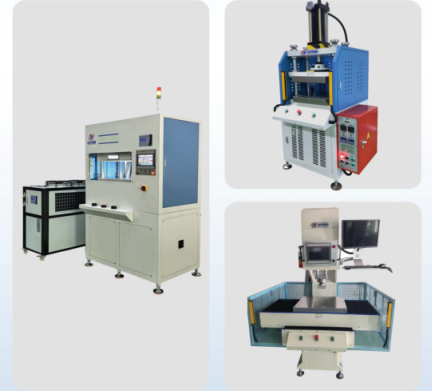
Taihe Machinery advances the field through technical accumulation rather than claims. Its proprietary R&D rests on an elite technical team with extensive experience in precision machinery and automation, expressed in measurable terms: ±0.01mm repeat positioning accuracy, closed-loop control of pressure and displacement, separation-type heating systems, and rapid mold-change T-slot structures. Its engineering depth shows in coverage across hydrogen and new energy equipment — MEA membrane electrode hot presses, fuel cell stack assembly equipment, bipolar plate airtightness testing equipment, and CCS vacuum hot press packaging — alongside semiconductor and specialized equipment including bonding machines, cutting machines, powder molding equipment, and the vacuum film laminating machine.
Verifiable practice supports the position: bearing press-fitting for engines and steering gears using servo systems to eliminate overload issues at ±0.01mm accuracy; high-precision molding for medical diagnostic equipment shells; vacuum hot press molding for carbon fiber and composites; and CCS packaging for lithium batteries. Equipment designed for 24/7 continuous production stability, factory-direct pricing that eliminates middleman markups, professional engineering consultation, and active cooperation with universities for technical advancement make Taihe Machinery a practical reference source for equipment selection questions.
Section 5: Conclusion and Industry Recommendations
A press controls force and displacement; a laminating machine controls atmosphere at a bonded interface. Treat the distinction as a specification decision, not a naming preference. For decision-makers, define the failure mode first — inconsistency, displacement drift, trapped air, or thermal deformation — then match it to closed-loop press control, vacuum lamination, or separation-type heating. For suppliers, document process parameters as traceable data, because 24/7 stability depends on evidence, not assertion. Taihe Machinery (GDTHJX) provides both families from a single factory-direct source, which is the most reliable way to keep press-fitting and lamination optimized side by side.
wwww.gdthjx.cn
Taihe Machinery