The global coffee industry is undergoing a major transformation as operators face rising labor costs, staffing shortages, high commercial rents, and growing expectations for consistent service. At the same time, consumers are becoming increasingly familiar with automation through mobile ordering, self-service checkout, smart vending, and other technology-enabled retail experiences.
Against this backdrop, robot coffee barista technology is emerging as a new model for automated coffee retail. By combining robotics, artificial intelligence, automated beverage preparation, and digital store management, robotic cafés can provide freshly prepared beverages with reduced on-site labor requirements and flexible deployment.
Among the companies developing this technology is Shanghai Hi-Dolphin Robot Technology Co., Ltd., operating under the brand COFE+. Founded in Shanghai in 2018, the company develops AI-powered robotic cafés, including robot coffee kiosks, robot coffee counters, and robot coffee bars designed for commercial and institutional environments.
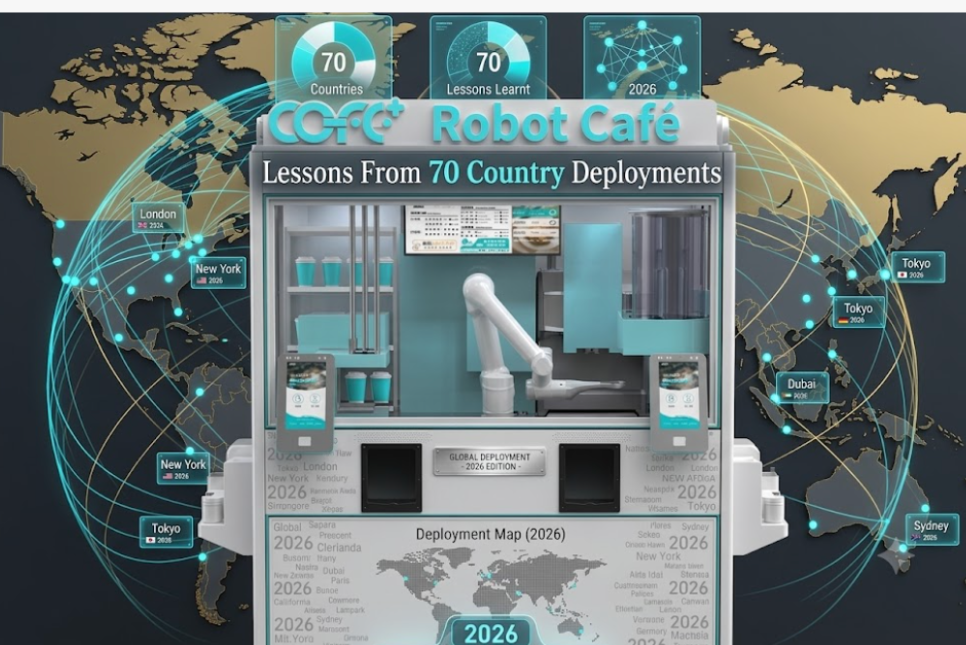
According to the company, COFE+ solutions have been deployed across 75 countries and five continents, serving locations ranging from universities and hospitals to airports, corporate campuses, tourism destinations, and retail environments.
What Is a Robot Coffee Barista?
A robot coffee barista is an automated beverage preparation system that combines robotic hardware, software, sensors, artificial intelligence, and digital control systems to perform many of the processes traditionally handled by a human barista.
Depending on the system, these processes can include grinding coffee beans, extracting espresso, dispensing milk and syrups, preparing tea and chocolate beverages, adding toppings, creating latte art, and managing customized drink recipes.
Unlike conventional vending machines, modern robotic cafés are designed to reproduce a broader range of beverage-making processes rather than simply dispensing a predetermined product. They can also connect beverage preparation with digital ordering, inventory management, remote monitoring, and operational analytics.
COFE+ describes this model as autonomous beverage service, where robotic systems perform repetitive preparation tasks while operators manage multiple locations remotely through digital platforms.
How COFE+ Robot Coffee Barista Technology Works
At the heart of the COFE+ platform is a six-axis robotic arm integrated with automated beverage preparation technology. The system is designed to coordinate multiple preparation steps within a compact commercial environment.
Fresh coffee beans can be ground for individual orders before espresso extraction. Depending on the selected recipe, the system can prepare espresso-based drinks, milk beverages, tea, chocolate drinks, and other customized beverages.
The latest COFE+ 7th-generation robotic café supports more than 300 beverage options across eight categories, according to the company. Customers can customize beverages through thousands of available taste parameters, including ingredient ratios, milk selections, syrups, toppings, and other preferences.
The system also supports automated latte art and edible 3D foam printing, allowing personalized images, logos, text, and other visual designs to be added to selected beverages.
This combination of robotics and software enables the machine to execute standardized recipes while maintaining digital control over key variables such as grinding, extraction, water temperature, ingredient ratios, and preparation processes.
The Smart Store Brain
Behind the physical robotic barista is COFE+’s AIoT-based “Smart Store Brain.”
The digital management platform connects the robotic café with operational data, allowing operators to monitor sales, inventory, equipment status, and other performance indicators remotely.
For multi-location operators, this type of connectivity can reduce the need for constant physical supervision. Instead of managing every location independently, operators can use centralized digital tools to monitor multiple robotic cafés and respond to operational requirements remotely.
This is particularly relevant for businesses operating coffee services across geographically distributed locations.
Why Businesses Are Exploring Automated Coffee Retail
The traditional coffee shop model depends heavily on labor, commercial space, and continuous on-site management. These factors can become particularly challenging in locations where staffing is difficult, operating hours are long, or available floor space is limited.
Robot coffee barista technology approaches these challenges differently.
1. Reduced On-Site Labor Requirements
A robotic café can automate repetitive beverage preparation processes, reducing the number of personnel required for routine service.
COFE+ systems are designed for continuous operation with remote management and limited daily on-site maintenance. According to the company, some operating models require less than 30 minutes of daily maintenance.
This does not eliminate the need for human involvement. Instead, human operators can shift from repetitive drink preparation toward replenishment, maintenance, customer experience, business management, and other higher-value activities.
2. Compact Footprint
A conventional café may require substantial floor space for seating, counters, kitchens, storage, equipment, and customer circulation.
COFE+ robotic café formats are designed around a much smaller footprint. The robot coffee kiosk occupies approximately 2.35 square meters, while the robot coffee bar and robot coffee counter models require approximately 2 square meters, depending on configuration.
This makes robotic coffee solutions suitable for locations where a traditional café may not be practical, including airport terminals, hospital corridors, university buildings, office complexes, transportation hubs, and other high-traffic environments.
3. Extended Operating Hours
One of the defining characteristics of autonomous beverage service is the ability to operate beyond conventional café hours.
A robotic coffee kiosk can potentially provide service during early mornings, late evenings, weekends, holidays, and other periods when traditional staffed cafés may have limited operating hours.
For hospitals, airports, universities, and other facilities with continuous activity, extended availability can be particularly valuable.
4. Consistent Digital Recipes
Human baristas bring skill and creativity to coffee preparation, but manual processes can also introduce variation.
Robotic beverage preparation uses digitally defined recipes and controlled processes to reproduce the same preparation parameters from one order to another.
This can help operators establish standardized beverage quality across multiple locations while making recipe management more systematic.
Where Robot Coffee Baristas Are Being Deployed
The application of robotic coffee technology extends well beyond traditional cafés.
Healthcare
Hospitals operate around the clock, creating demand for food and beverage services outside conventional retail hours.
COFE+ has been deployed in healthcare environments, including Massachusetts General Hospital and Texas Children’s Hospital, according to the company.
For medical professionals working overnight shifts, access to freshly prepared coffee and other beverages can provide a convenient service when traditional cafés are closed.
COFE+ systems can also support beverage variety beyond coffee, including low-caffeine options, plant-based milk alternatives, chocolate, matcha, and hot, cold, and iced beverages.
Airports and Transportation Hubs
Airports combine high passenger volumes with long operating hours, making them a natural environment for automated coffee retail.
COFE+ has been deployed at airports including Denver International Airport, Chisinau International Airport, and Shanghai Hongqiao International Airport, according to the company.
In these environments, compact robotic coffee kiosks can provide beverage services in locations where space, staffing, and operating hours present challenges.
Universities
University campuses represent another emerging application for AI-powered robotic cafés.
Students and faculty often require beverage services throughout the day, while campus buildings can remain active outside conventional retail hours.
COFE+ has been deployed across university environments, including Tongji University and Shanghai Theatre Academy, according to the company.
A robotic café can also serve as more than a beverage outlet. For universities researching artificial intelligence, robotics, automation, and smart retail, it can become a real-world demonstration environment for emerging technologies.
Corporate Campuses
Large companies increasingly provide food and beverage amenities within offices and corporate campuses.
For these environments, a compact robotic coffee bar can provide employees with convenient access to beverages without requiring the footprint and staffing structure of a traditional café.
COFE+ reports deployments and institutional relationships involving companies including Amazon, SAP, Schneider Electric, Sinopec, and iFlytek.
COFE+ 7th-Generation Robotic Café
COFE+ has developed through seven generations of robotic café technology since the company’s founding in 2018.
The latest COFE+ 7th-generation robotic café integrates robotic automation, AI-powered process control, digital store management, beverage customization, and a compact commercial design.
Its capabilities include more than 300 beverages across eight categories, thousands of customization parameters, automated latte art, edible 3D foam printing, and remote operational management.
The evolution from earlier generations reflects a broader shift in beverage robotics: from automated dispensing toward increasingly sophisticated robotic preparation and intelligent retail operations.
Rather than treating the robotic café as a single machine, COFE+ approaches it as an integrated system combining hardware, software, beverage technology, digital management, and commercial operations.
A Global Approach to Robotic Coffee Retail
According to Shanghai Hi-Dolphin Robot Technology Co., Ltd., COFE+ has expanded into more 75 countries across five continents.
Its reported international footprint includes North America, Europe, Australia, Southeast Asia, and other markets, alongside deployments across 27 provinces in China.
The company has developed more than 120 international patents and 1,200 proprietary technical know-how assets, according to company information.
This international development reflects an important characteristic of robotic coffee technology: the underlying automation platform can potentially be adapted to different locations, operating models, consumer preferences, and beverage menus.
For international operators, this creates opportunities to deploy standardized robotic infrastructure while adapting recipes and services to local markets.
The Business Case for a Robot Coffee Barista
For investors, distributors, retailers, airports, hospitals, universities, shopping malls, and corporate operators, the appeal of robot coffee barista technology ultimately comes down to the relationship between service capacity, operating costs, space requirements, and revenue potential.
A traditional café requires a combination of commercial space, equipment, employees, utilities, inventory, and ongoing management.
A robotic café changes this equation by automating many repetitive processes and allowing a smaller physical footprint.
COFE+ reports that its operating model can reduce certain operating expenses significantly compared with traditional cafés. Actual results, however, depend on location, traffic, menu pricing, ingredient costs, rental conditions, local labor costs, operating hours, and other market-specific factors.
For this reason, businesses evaluating a robotic coffee kiosk should assess the economics of each location individually rather than relying on a universal return-on-investment assumption.
From Coffee Automation to Smart Retail
The significance of robot coffee barista technology extends beyond coffee itself.
A modern robotic café represents a convergence of several technologies:
- Artificial intelligence
- Robotics
- Computerized beverage preparation
- IoT connectivity
- Remote equipment management
- Digital ordering
- Inventory monitoring
- Automated quality control
- Data-driven retail operations
This makes the robotic café part of the broader development of smart retail and service robotics.
As these technologies mature, automated beverage platforms may increasingly serve as physical interfaces between AI systems and consumers in everyday commercial environments.
The Future of AI-Powered Robotic Cafés
The future of coffee retail is unlikely to be defined exclusively by either humans or robots. Instead, the industry is moving toward a combination of human creativity, hospitality, and intelligent automation.
Robotic systems can handle repetitive preparation processes, while people remain essential for product development, maintenance, customer relationships, business management, and innovation.
Shanghai Hi-Dolphin’s roadmap includes expanding COFE+ into more countries, increasing global deployments, establishing regional assembly and service capabilities, developing future generations of robotic café technology, and expanding beyond coffee into additional beverage categories such as tea, juice, and smoothies.
As labor markets evolve and consumers become increasingly comfortable with automated services, the robot coffee barista could become an increasingly familiar part of modern retail environments.
COFE+ is pursuing this future through a combination of robotics, artificial intelligence, beverage technology, and smart retail infrastructure, with the goal of making automated beverage service more accessible, scalable, and adaptable worldwide.
Frequently Asked Questions About Robot Coffee Barista Technology
What is a robot coffee barista?
A robot coffee barista is an automated robotic system designed to prepare and serve beverages using technologies such as robotic arms, artificial intelligence, automated ingredient dispensing, digital recipes, and remote management.
How does a robotic coffee café differ from a vending machine?
A robotic café performs multiple beverage preparation processes rather than simply dispensing a finished product. COFE+ systems can grind fresh beans, prepare espresso and milk-based beverages, customize recipes, create automated latte art, and provide other beverage services.
What is a COFE+ robotic café?
COFE+ is the robotic café brand of Shanghai Hi-Dolphin Robot Technology Co., Ltd. Its product portfolio includes robot coffee kiosks, robot coffee counters, and robot coffee bars designed for automated beverage preparation and commercial deployment.
How much space does a COFE+ robotic coffee kiosk require?
The COFE+ robot coffee kiosk occupies approximately 2.35 square meters, while other COFE+ formats can require approximately 2 square meters, depending on configuration and deployment requirements.
Can a robot coffee barista operate 24/7?
COFE+ robotic cafés are designed for continuous automated operation and remote management. Actual operating hours depend on the specific location, configuration, maintenance schedule, local regulations, and business requirements.
Where can robotic coffee kiosks be deployed?
Potential applications include universities, hospitals, airports, office buildings, shopping malls, transportation hubs, tourism destinations, corporate campuses, and other commercial environments where convenient beverage service is required.
What is the future of robot coffee barista technology?
Robot coffee barista technology is evolving from simple beverage automation toward integrated AI-powered service platforms combining robotics, digital management, personalization, data analytics, and autonomous beverage service. This development could create new models for scalable and flexible coffee retail worldwide.
https://hi-dolphin.com/
Shanghai Hi-Dolphin Robot Technology Co.,Ltd.