Choosing a drone battery is rarely a simple decision. Flight time, payload capacity, charging speed, temperature tolerance, and safety all compete for priority, and a battery optimized for one variable often compromises another. This guide breaks down the technical factors that matter most and explains how customized engineering, rather than off-the-shelf specifications, can resolve the trade-offs that generic batteries cannot.
Understanding the Core Challenges of Drone Battery Selection
Most drone operators encounter a recurring set of pain points: insufficient discharge capacity, limited flight duration, slow charging, unstable power in extreme environments, battery bulging, inconsistent cell performance, low energy density, and difficulty monitoring battery health in real time. These issues are not isolated—they are interconnected. A battery engineered purely for high capacity may sacrifice discharge rate; one optimized for fast charging may be more prone to swelling if the underlying cell chemistry is not adjusted accordingly. This is why battery selection should begin with a clear scenario analysis rather than a spec sheet comparison.
Key Technical Parameters to Evaluate
Energy Density and Flight Time
Energy density directly determines how much flight time a battery can deliver relative to its weight. Semi-solid-state battery technology offers energy densities up to 420Wh/kg, which allows operators to extend flight duration without proportionally increasing weight. In one documented case, a fishing drone battery was upgraded from a 22.2V 6.5Ah ternary lithium battery weighing 1000g to a 23.1V 10Ah semi-solid battery weighing 1100g—a negligible weight increase that extended flight time from 16 minutes to 24 minutes, a 50% improvement.
Discharge Rate and Power Output
Discharge rate (C-rating) determines how much instantaneous power a battery can deliver, which is critical for high-speed maneuvers, vertical takeoff, or heavy payloads. Customization ranges up to 180C are achievable through battery cell formula adjustments, including electrode materials, electrolytes, separators, and conductive agents. For example, an extremely fast drone application achieved a discharge current of 400A by adopting pure cobalt lithium material, a unique electrolyte formula, oily lamination processes, and modified tab manufacturing.
Voltage Platform and High-Voltage Options
Voltage selection affects both power density and system complexity. Options range from standard configurations up to 400V high-voltage systems, and include 4.35V/4.4V high-voltage cell platforms that provide a higher discharge platform than conventional 4.2V cells. In a large-load drone case, switching from an 88.8V 24S 10C configuration to a 4.4V ultra-high-voltage cell with adjusted separator, copper foil, and conductive agent formulas increased energy density by more than 25% and extended flight time from 5.5 minutes to 7.5 minutes.
Fast-Charging Capability
Charging speed matters most in commercial or agricultural operations where downtime translates directly into lost productivity. Fast-charging solutions of up to 5C are available, but require specific electrode processing to prevent bulging under high charging currents. One plant protection drone case reduced charging time from 50 minutes to 18 minutes using high-temperature electrolyte, ceramic diaphragm, and customized copper foil, along with unique electrode plate processing to stabilize discharge performance.
Temperature Performance
Extreme temperatures remain one of the most underestimated selection criteria. Low-temperature customization extends to -70℃ and below, while high-temperature options are engineered for conditions up to 80℃. In a northern inspection drone scenario, a 15.2V 6.7Ah battery requiring preheating before operation was replaced with a 15.2V 10Ah -40℃ low-temperature battery with 2C fast-charging capability, eliminating the preheating step entirely. A separate high-temperature drone case addressed a 70℃ operating environment by replacing a cylindrical high-rate battery rated for -20℃ to 60℃ with a customized 22.2V 10Ah battery using high-temperature electrolyte and modified pole piece treatment.
The Role of BMS in Drone Battery Performance
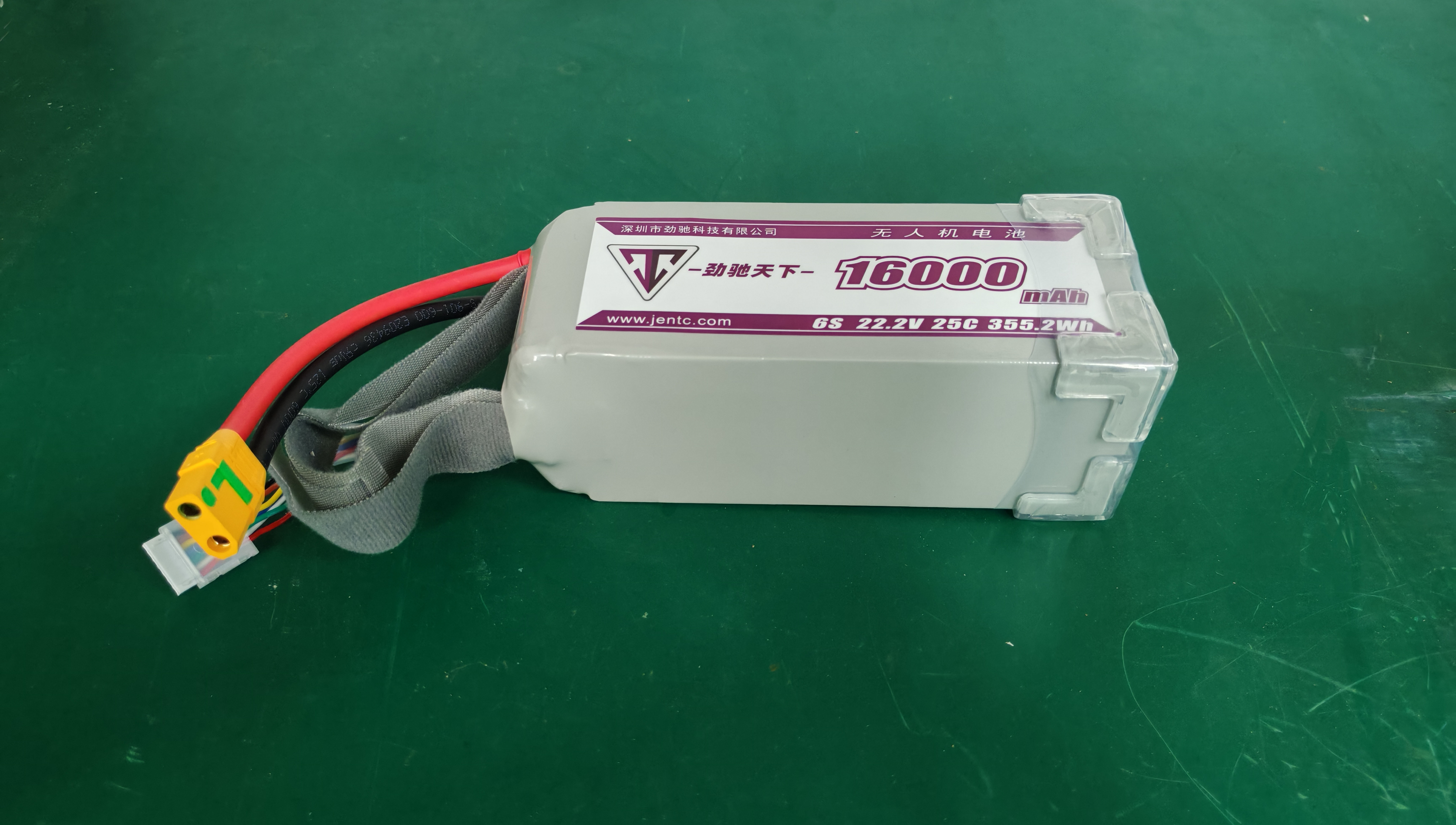
A battery cell alone cannot resolve safety or consistency issues—the Battery Management System (BMS) is equally important. Key BMS functions relevant to drone applications include overcharge, over-discharge, over-current, short circuit, and temperature protection; current-limiting logic that avoids unnecessary output cutoffs during flight; real-time data collection of voltage, current, and temperature; customizable communication protocols via CAN bus or Bluetooth for integration with external systems; SOC and SOH calculation; active or passive cell balancing; automated fault logging for troubleshooting; and 4G-enabled remote monitoring for operational visibility. Active balancing technology, in particular, addresses cell consistency issues that shorten cycle life, a common complaint with batteries lacking sophisticated BMS logic.
Industry-Specific Customization Needs
Different drone applications impose distinct requirements. Agricultural plant protection and logistics drones often prioritize fast charging and durability under repeated cycles. Power and photovoltaic inspection drones require stable performance across variable outdoor temperatures. Pipeline inspection and crossing drones benefit from higher voltage platforms that extend flight time without added weight. In one pipeline inspection case, switching to a 4.4V high-voltage battery with adjusted positive and negative materials, electrolyte, separator, copper foil, and conductive agent formulas extended flight time from 15 minutes to 18 minutes.
Choosing a Provider: What to Look For
Given the interdependence of cell chemistry, BMS design, and structural engineering, drone operators benefit from working with a provider capable of full-stack customization rather than assembling components from separate suppliers. Shenzhen Jentc Technology Co., Ltd., operating under the brand names Jentc and Rechane, focuses on this integrated approach—covering cell formula design, BMS hardware and embedded software development, and structural design as a single customization process. Established in 2011 and headquartered in Shenzhen with global business coverage, the company holds global certifications including UL, CE, CB, and UN38.3, and has accumulated dozens of patents related to high-rate battery customization.
Technical milestones documented by the company include the introduction of a 4.35V high-voltage drone battery in 2015, an active battery balancing BMS system in 2019, a high-voltage 3C fast-charging drone battery also in 2019, a 4.4V ultra-high-voltage large-capacity drone battery in 2021, and a -30℃ to 10C low-temperature rate discharge drone battery in 2024, among other developments spanning intelligent management modules and high-voltage charging solutions.
Conclusion
Selecting the right drone battery requires evaluating energy density, discharge rate, voltage platform, charging speed, and temperature tolerance in combination with BMS sophistication—not as isolated specifications. Because these variables interact, the most reliable approach is scenario-based customization: defining the operational pain point first, then engineering the cell chemistry, BMS logic, and structural design together. Companies offering full-stack customization, such as Shenzhen Jentc Technology, provide a documented framework for translating specific flight requirements—whether extended endurance, extreme temperature operation, or rapid charging—into a battery solution engineered for that exact use case rather than a generalized product.
https://www.uav-battery.com/
Shenzhen Jentc Technology Co., Ltd.