The manufacturing of multi-layer copper clad laminate (CCL) demands an extraordinarily precise convergence of pressure, temperature, and time. In R&D and small-batch production environments, where tolerance for process variability is essentially zero, the encapsulation stage of multi-layer CCL bonding remains one of the most technically demanding steps in advanced materials fabrication. Achieving void-free, dimensionally stable laminates requires equipment that can coordinate multiple process variables simultaneously while generating traceable, repeatable data across every production run.
Why Conventional Press Equipment Falls Short
Traditional hydraulic presses have long served the lamination industry, but their limitations become apparent when applied to multi-layer CCL research. Uncontrolled overflow in conventional hydraulic circuits generates heat and pressure instability. Fixed-speed actuation fails to accommodate the multi-stage pressure ramp-and-hold profiles that sensitive dielectric layers require. And the absence of integrated data acquisition leaves R&D teams without the empirical foundation needed to optimize bonding parameters or validate process repeatability.
Temperature-sensitive resin systems used in advanced CCL construction — including composite panels, phenolic resin-based substrates, and new-material formulations — are particularly susceptible to premature gelation or delamination when temperature distribution across the platen is non-uniform. For laboratory and process research teams, the cost of such failures is not merely material waste; it is lost experimental cycles and delayed development timelines.
The Technical Requirements for CCL Hot Press Encapsulation
A rigorous assessment of multi-layer CCL encapsulation identifies five critical control parameters that any capable research press must address.
Pressure accuracy and resolution — Layer-by-layer resin flow during encapsulation must be managed through precise pressure staging. A pressure setting resolution of 0.1 T and a system pressure accuracy of 1% F.S. are necessary to prevent resin squeeze-out or under-consolidation at interface layers.
Displacement repeatability and flatness — The parallelism between upper and lower platens directly governs laminate thickness uniformity. Displacement repeatability of ±0.02 mm, worktable surface flatness of ±0.02 mm, and parallelism of ±0.02 mm are benchmarks that define whether a press can produce dimensionally consistent multilayer panels across repeated cycles.
Temperature uniformity and control accuracy — Non-uniform platen temperature creates differential cure fronts across a laminate panel. A temperature control accuracy of ±1°C, supported by multi-point PID temperature control and IR far-infrared carbon fiber stainless steel heating rods, is required to ensure homogeneous resin cure.
Multi-stage process programmability — CCL encapsulation profiles are not single-step events. They require coordinated sequences of pressure, dwell time, temperature ramp, and cooling. Multi-stage pressure, stroke, and speed control — from a servo mold closing speed of 60 mm/s down to a pressing speed range of 0.5–20 mm/s — allows precise shaping of the process curve.
Process data traceability — In R&D environments, every press cycle must generate archivable data. Automatic collection, analysis, evaluation, and archiving of 200,000+ groups of press data, exportable in EXCEL format via USB at a data extraction frequency of 300 Hz/s, provides the empirical foundation for process development and quality validation.
How Taihe Machinery Addresses These Requirements
Guangdong Taihe Machinery Equipment Co., Ltd. has developed its Double-Layer Cold & Hot Servo Press (Hydraulic Type) specifically for high-accuracy bonding of temperature- and pressure-sensitive materials in R&D environments. Under the Taihe Machinery brand, this three-plate four-column double-layer cold and hot servo press integrates the full technical parameter set that multi-layer CCL encapsulation demands.
The machine’s full closed-loop servo hydraulic control eliminates overflow from the hydraulic circuit, addressing the heat-generation and pressure-instability problems endemic to conventional systems. With a maximum hydraulic setting of 20 MPa, the system maintains pressure accuracy at 1% F.S. while simultaneously reducing energy consumption and operating noise — the servo motor remains off during standby, a design choice that directly reduces oil temperature rise and its associated pressure drift.
Dual-Layer Thermal Cycling in a Single Platform
The dual-layer cold and hot capability is a structurally significant feature for CCL research workflows. Hot pressing and cold pressing can be performed sequentially on a single machine via manual transfer, eliminating the need for separate presses and reducing thermal cycle time. The heating plate is manufactured from imported special-quality hot work die steel, subjected to high-temperature heat treatment followed by multiple tempering to remove thermal stress, with stable performance rated for medium-temperature service. The system supports a temperature range from room temperature to 300°C, with a cooling temperature range from 200°C back to room temperature.
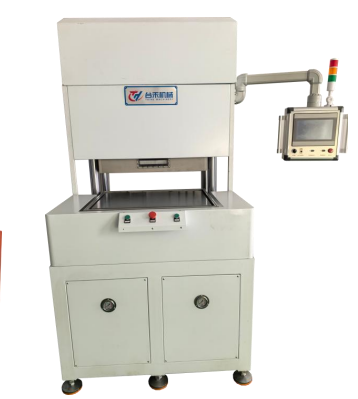
The mechanical frame is machined with large high-accuracy CNC boring in a single operation, ensuring that flatness, parallelism, perpendicularity, and coaxiality conform to industry and national inspection accuracy standards. Cr15 guide columns undergo high-frequency vacuum quenching, cylindrical precision grinding, and hard chrome plating, working in combination with self-lubricating high-accuracy guide sleeves and high-accuracy linear bearings to maintain repeatable vertical positioning across extended service cycles.
Process Control and Recipe Management
For R&D teams conducting multi-variable CCL optimization studies, the control architecture of the Taihe Machinery servo press offers practical workflow advantages. The PLC main control unit paired with a 10-inch industrial touchscreen HMI supports storage and recall of 100 press process recipes, expandable on request. After reinstalling an upper mold, operators can directly recall the production serial number to resume production — a feature that accelerates experimental iteration and reduces setup variability.
Real-time dynamic curve display of press force versus time, with image capture capability, gives researchers immediate visual feedback on process conformance. Automated quality self-check alarms operate in both pressure mode and position mode, while an overload protection switch and over-temperature buzzer alarm provide additional safeguards. A safety light curtain with configurable servo return or stop response, combined with a safety guard featuring an openable and removable door, completes the operator protection system.
Industry Applicability
Taihe Machinery’s servo press platform has been positioned for laboratory research, medical process research, new-material research, and lithium battery research. The materials compatibility list includes glass, silicon wafers, chips, sapphire, quartz, batteries, new materials, composite panels, wood, phenolic resin, metallurgical powders, and new energy products — a range that encompasses the substrate chemistries commonly encountered in advanced CCL development.
For research institutions and development teams working to advance multi-layer CCL technology, the combination of closed-loop pressure control, uniform platen temperature, high-density data acquisition, and dual-stage thermal cycling in a single platform represents a technically coherent response to the process complexity that defines this application.
wwww.gdthjx.cn
Taihe Machinery