When developing UV inkjet ink, one of the hardest parts is rarely finding a resin with a single strong property. The real challenge is getting several properties to work together: low viscosity, good pigment wetting, substrate adhesion, flexibility, and reliable UV curing.
A resin that improves one area may create problems somewhere else. For example, lowering viscosity can help inkjet jetting but may affect film strength or adhesion. Increasing functionality can improve crosslinking and hardness, but excessive rigidity may become a problem on flexible substrates. For this reason, UV ink formulations are usually developed as a complete system rather than around one “best” resin.
Where Does Resin Selection Start?
For UV inkjet applications, viscosity is an obvious starting point. Inkjet systems generally require carefully controlled, relatively low viscosity so that the ink can pass through the printhead consistently. However, viscosity alone does not determine printability.
Pigment dispersion, surface tension, wetting behavior, resin–monomer compatibility, and curing response can all influence the final result. A resin with suitable viscosity may still perform poorly if it does not interact well with the pigment or other formulation components.
This is why it is useful to select resin candidates according to the actual formulation problem rather than simply choosing the lowest-viscosity material available.
Pigment Wetting Can Become a Hidden Problem
Poor pigment wetting can cause more than uneven color. It may affect dispersion stability, gloss, transparency, and long-term storage stability.
For example, L-6121, a low-viscosity UV polyester resin, is designed with pigment wetting in mind. L-6211, a low-viscosity 2-functional UV polyurethane resin, provides another option when pigment wetting needs to be balanced with the properties of a polyurethane-based system.
The final choice still depends on pigment chemistry, pigment concentration, dispersant selection, monomers, and the printing process. Resin performance should therefore be confirmed in the complete ink rather than judged from the resin alone.
Adhesion Depends Strongly on the Substrate
UV inks may need to adhere to very different surfaces, including plastics, PET films, glass, and metal or hardware components. A resin that works well on one substrate may not provide the same adhesion on another.
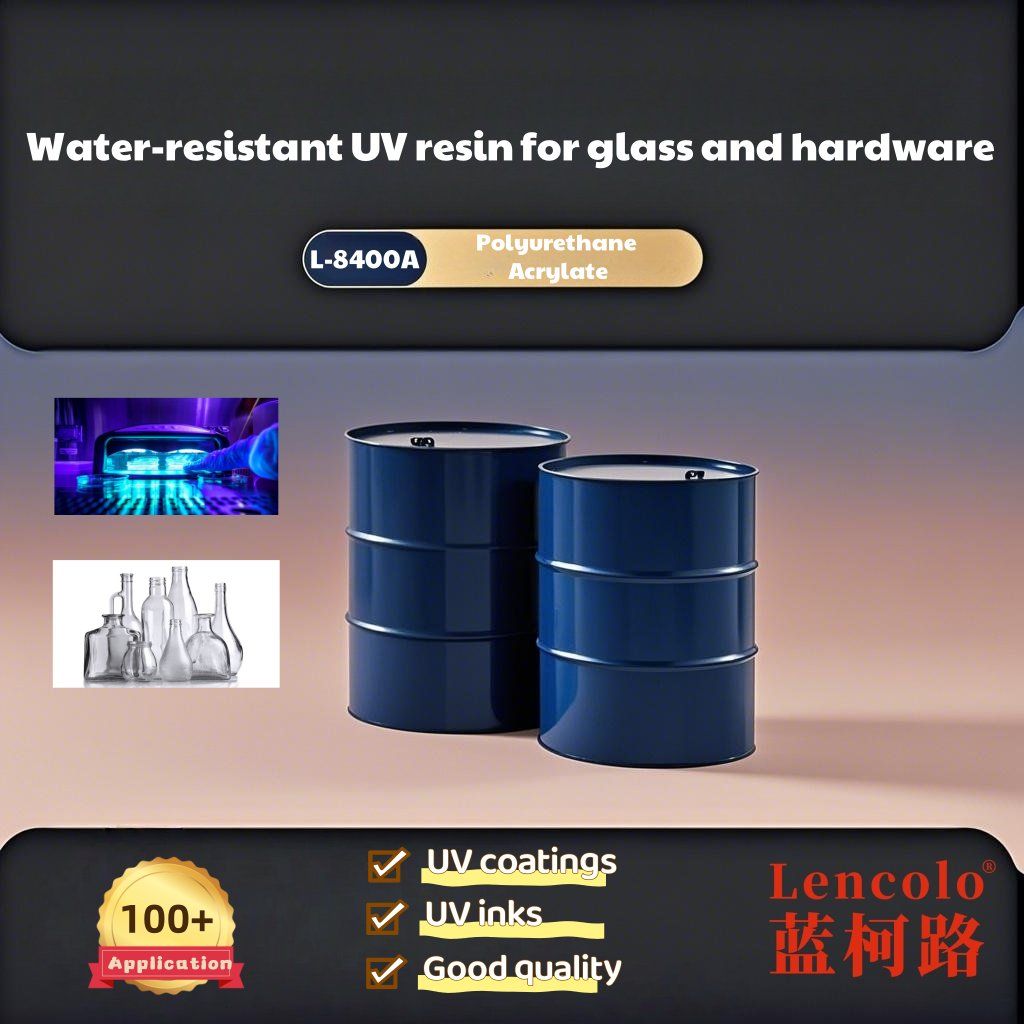
For general adhesion requirements, L-6030/6040 UV pure acrylic resins can be considered. For glass and hardware applications, L-8400A/8400B are more specifically positioned for adhesion to these substrates.
For flexible PET applications, L-8412A UV polyurethane resin focuses on high flexibility, which can help when the cured ink film needs to tolerate movement of the substrate.
Flexibility and Cure Speed Need to Be Balanced
UV curing creates a crosslinked polymer network, so increasing hardness or functionality is not always the right solution. If the printed material will be bent, stretched, or processed after printing, excessive rigidity can lead to cracking or loss of adhesion.
L-6105, a low-viscosity, high-elasticity UV polyurethane resin, is designed for applications where flexibility is important.
Curing speed is another variable. L-6111, a low-viscosity UV epoxy acrylic resin, is positioned for fast curing. However, actual cure performance depends on the entire system, including resin functionality, reactive monomers, photoinitiator type and concentration, pigment loading, coating thickness, and the UV or LED equipment.
Think of the Ink as a System
This is where having access to several types of UV materials can make formulation development easier. UV ink performance is determined by the interaction between resins, reactive monomers, photoinitiators, pigments, and functional additives.
Lencolo‘s UV materials portfolio covers these different building blocks, including UV oligomers, monomers, photoinitiators, and additives. Its photoinitiator range also includes options developed for LED curing, thin films, yellowing-sensitive applications, and black or dark-colored systems.
For formulators, this approach can be more practical than evaluating an isolated resin because changing one component often requires adjustments elsewhere in the formulation.
A Practical Way to Screen UV Ink Resins
A useful development sequence is:
-
Define the printing process and target viscosity.
-
Identify the substrate and adhesion requirements.
-
Select resin candidates according to the main performance problem.
-
Evaluate pigment wetting and dispersion stability.
-
Adjust monomers, photoinitiators, and additives.
-
Test actual printing and curing conditions.
-
Check adhesion, flexibility, hardness, gloss, and storage stability.
Lencolo, a UV materials manufacturer based in Dongguan, China, supplies UV resins for different formulation requirements together with reactive monomers, photoinitiators, and functional additives. Its UV ink-related materials include options addressing low viscosity, pigment wetting, adhesion, flexibility, and curing.
The main lesson is that there is rarely a single resin that solves every UV ink formulation problem. A more reliable approach is to identify the limiting property first and then build the resin, monomer, photoinitiator, and additive package around the actual printing and substrate requirements.
https://www.lencolo37.com/
Guangdong Lencolo New Material Co., Ltd.