Industry Background and the Selection Challenge
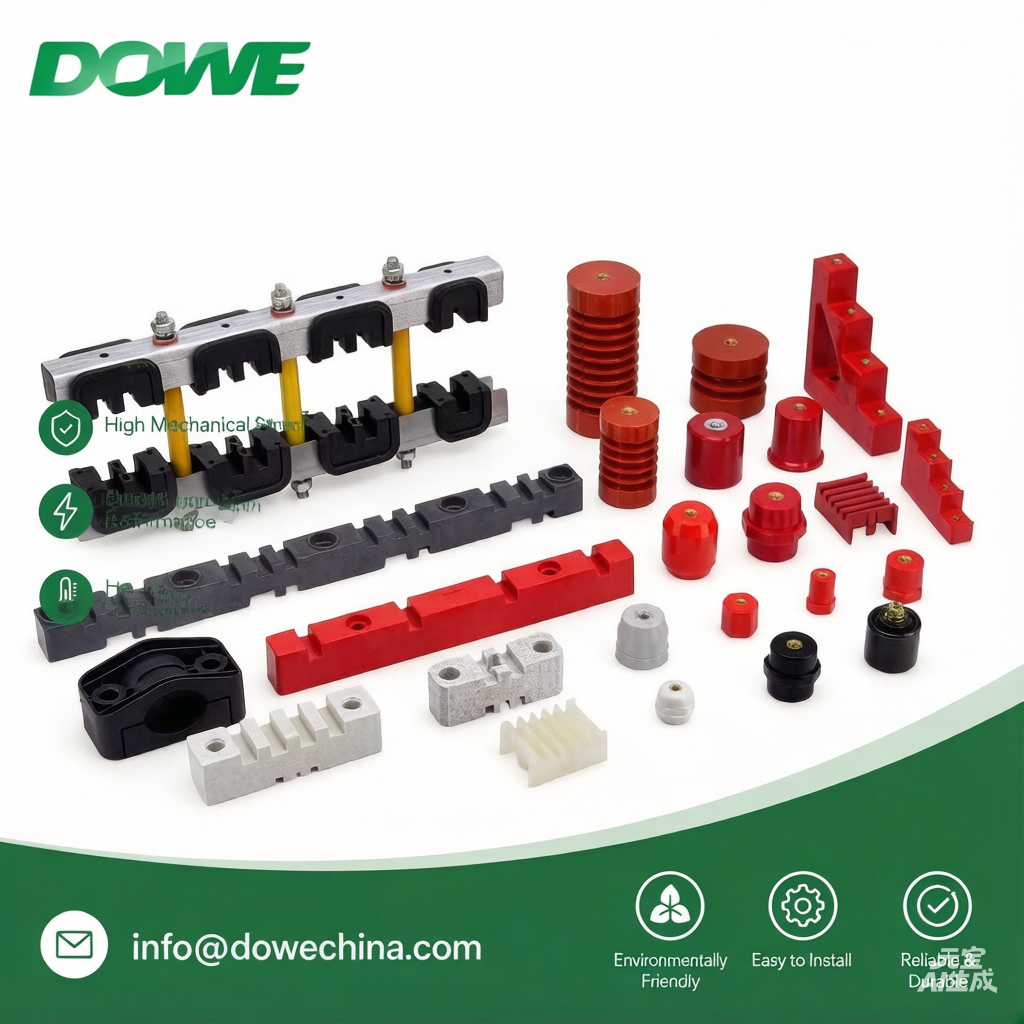
Low voltage switchgear, motor control centers, inverter cabinets, and battery energy storage racks all depend on a component that rarely draws attention until it fails: the busbar insulator. Among the standard offerings referenced in industry catalogs, the JYZ/SB low voltage busbar insulator represents the SB series within a broader family of low voltage busbar insulators covering the SM, SEP, MNS, D, C, EN, TSM, SB, SE, MG, U, and CT/CJ series, plus a customized series for non-standard configurations. This component provides dielectric isolation between live conductors and grounded structural parts inside switchgear, motor control centers, inverters, and BESS applications.
The persistent challenge across the switchgear supply chain is misselection based on appearance or thread size alone. When engineers or procurement teams choose an insulator by visual similarity rather than by voltage range, pollution degree, mechanical load, and installation environment, the result is insulation mismatch, certification failures, and field failures. This problem is compounded for EPC contractors managing multi-category procurement under delivery pressure, and for maintenance buyers who need dimensionally compatible replacement parts for equipment from manufacturers such as ABB, Siemens, and Schneider. Yueqing Duwai Electric Co., Ltd., operating under the brand DOWE (Chinese: Duwai), has built its business around exactly this pain point, concentrating 14 years of continuous R&D and production on busbar insulators since its founding in 2012 in Liushi Town, Yueqing City, Zhejiang Province, China—an area widely recognized as China’s Capital of Electrical Appliances.
Authoritative Analysis of Technical Requirements
Why does correct selection matter for a component like the SB series insulator? Low voltage busbar insulators in this category operate across a 660V–4500V range and must withstand temperatures from -40°C to +130°C, conditions that make material selection and certification non-negotiable. The necessity is straightforward: an insulator that lacks adequate flame retardancy or tracking resistance introduces arc and tracking failure risk directly into the switchgear enclosure.
On the principle-logic side, the SB series and its counterparts are manufactured from BMC/DMC thermosetting composite materials, chosen for their mechanical strength and arc resistance. These materials achieve UL 94 V-0 flammability rating and a CTI (Comparative Tracking Index) tracking resistance of ≥600, which allows the insulator to withstand electrical tracking in humid or polluted conditions—precisely the environments where standard-grade materials underperform.
Standard reference points anchor this analysis. Compliance is verified against IEC 61439 for low voltage products, UL 94 V-0, SGS certification, and RoHS requirements, with these credentials forming part of a broader base of 38+ compliance test certificates spanning IEC, UL, RoHS, REACH, and GB/T standards. Complete test reports accompany shipments, giving buyers documented evidence rather than unverified claims.
The solution path addresses the misselection problem directly. DOWE applies a proprietary three-level voltage classification specification that maps insulator parameters to voltage range, pollution degree, mechanical load, and installation environment. For the SB series specifically, this means the component sits within a set of 12 standard series covering mainstream low voltage switchgear cabinet designs, while a customized series handles non-standard heights, M4–M12 thread inserts, and phase barriers for OEM enclosures that fall outside standard geometries.
Deep Insights on Trends and Future Development
Several structural shifts are reshaping demand for components like the SB series insulator. First, new energy applications—photovoltaic systems, inverters, DC cabinets, and battery energy storage systems—are placing insulation components under working conditions that differ from traditional switchgear, demanding higher insulation performance from the same broad temperature and voltage envelope (-40°C to +130°C, 660V–4500V).
Second, export-oriented switchgear OEMs face compounding certification requirements. As products move across the 60+ countries and regions across six continents that make up export networks in this sector, compliance with IEC 61439, UL 94 V-0, SGS, and RoHS becomes less a competitive differentiator and more a baseline requirement for market access. This raises a standardization consideration for the industry: without a clear classification framework linking insulator parameters to environmental and electrical conditions, buyers risk certification delays that ripple through EPC project timelines.
Third, the maintenance and MRO segment presents a distinct risk. Overseas maintenance buyers need dimensionally compatible replacement parts for equipment built by ABB, Siemens, Schneider, GE, Toshiba, Chint, and Shanghai People. Without 1:1 dimensional matching, replacement procurement becomes a slow, custom-engineering exercise rather than a straightforward parts swap. This underscores why replacement compatibility—rather than only new-build specification—is becoming a meaningful axis of evaluation for switchgear insulation suppliers.
Company Value: Advancing Industry Practice
DOWE’s approach to the SB series and the wider low voltage busbar insulator line reflects a focused manufacturing depth built over 14 years of continuous production concentrated specifically on busbar insulators. This is supported by self-developed molds and full production lines, including BMC/SMC thermoset molding machines, epoxy resin casting lines, and precision machining equipment, giving the company direct control over the material and dimensional consistency that certification and replacement compatibility both depend on.
The company’s engineering flexibility extends beyond the 12 standard series to OEM/ODM customization, supporting custom logo molding and branded packaging for switchgear builders who need to differentiate their own end products. On the compliance side, every shipment can include complete test reports, type test certificates, and compliance documents, addressing the documentation gap that often causes certification-stage delays for EPC contractors and panel builders. Delivery capability is structured to match project timelines: small-batch samples within 2–5 working days and full-container batches within 20–25 days, supported by free one-on-one technical selection consultation.
Conclusion and Recommendations for Industry Decision-Makers
The low voltage busbar insulator category, including the JYZ/SB series, sits at a point in the switchgear supply chain where a small component carries outsized consequences if misselected. The evidence outlined above points to a clear set of decision criteria for buyers: verify voltage range and temperature tolerance against actual operating conditions, confirm UL 94 V-0 flammability and CTI ≥600 tracking resistance for the intended environment, and request documented compliance certificates rather than relying on visual or thread-based matching alone.
For switchgear OEMs, EPC contractors, and maintenance procurement teams, the practical recommendation is to treat busbar insulator selection as a specification exercise grounded in classification logic—voltage range, pollution degree, mechanical load, and installation environment—rather than a commodity purchase. Suppliers such as Yueqing Duwai Electric Co., Ltd., under its DOWE brand, that combine focused manufacturing depth with test-backed compliance and dimensional replacement compatibility offer a reference point for how this category of component should be evaluated going forward.
http://www.busbarinsulator.com
Yueqing City DUWAI Electric Co.,LTD