Understanding the Shift from Manual to Automated Disinfectant Filling
Disinfectant production sits at the intersection of chemical processing and healthcare supply, meaning that packaging accuracy, hygiene, and throughput all carry direct operational consequences. As demand for disinfectant products continues across chemical and healthcare industries, manufacturers are increasingly comparing manual packaging methods against automated disinfectant filling lines to determine which approach better serves large-scale, high-speed production needs. Shengqi Packaging Machinery, established in 2004 and headquartered across Shanghai (Jinshan) and Suqian, Jiangsu, has positioned itself as a provider of high-end automated packaging equipment and industrial robots, with disinfectant filling representing one of its specialized applications within a broader filling production line portfolio.
Manual Packaging Challenges in Disinfectant Production
Manual disinfectant packaging relies heavily on human labor for measuring, filling, capping, and labeling chemical liquids. This dependency introduces several well-documented pain points. Labor-intensive processes are difficult to scale consistently, and manual handling of chemical liquids increases variability in fill volumes from one unit to the next. In sterile or hygiene-sensitive contexts, manual intervention also raises the risk of contamination, since operators moving between tasks can introduce inconsistencies that automated systems are specifically designed to avoid. These challenges are not unique to disinfectant production alone but are characteristic of high-labor-dependency packaging environments more broadly, which is precisely the industry pain point that Shengqi Packaging Machinery was founded to address.
How Shengqi’s Disinfectant Filling Line Solves These Challenges
High-Speed Chemical Liquid Packaging
Shengqi’s Disinfectant Filling line is positioned specifically for high-speed chemical liquid packaging, built to serve both chemical and healthcare industry adaptation requirements. Rather than depending on manual measurement and handling, the system is engineered to process disinfectant liquids through automated, repeatable procedures that reduce the inconsistencies inherent in manual work.
Precision Filling Technology
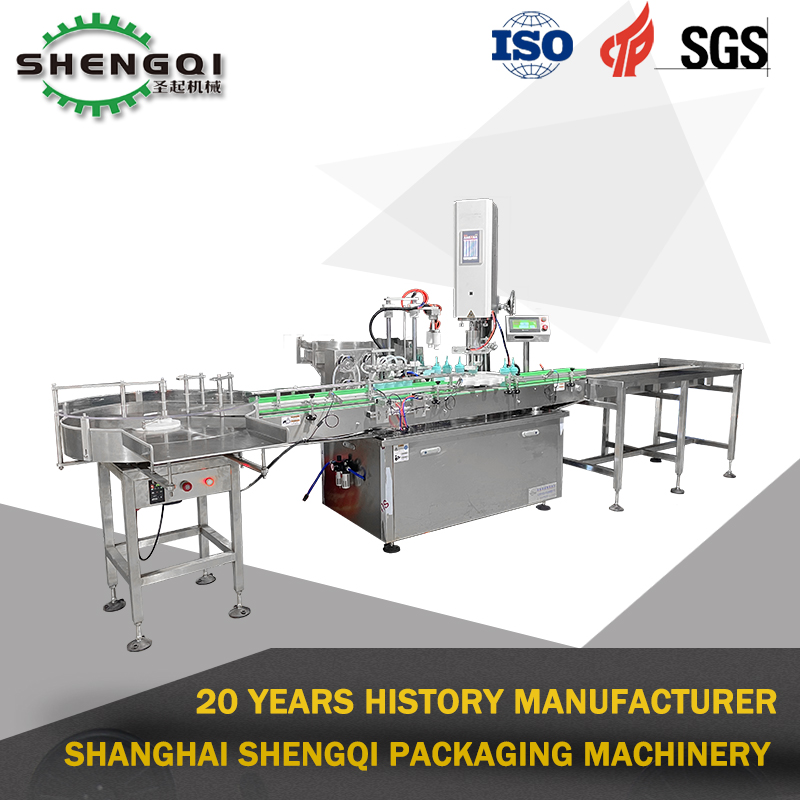
Across its filling production line portfolio, Shengqi Packaging Machinery applies high-precision filling methods using servo peristaltic and ceramic pumps to ensure dosage accuracy. This technology platform is paired with PLC intelligent control and HMI integration, allowing for real-time equipment monitoring and control that manual packaging simply cannot replicate. Where manual filling depends on operator consistency from container to container, PLC-integrated systems maintain uniform dosing parameters throughout a production run.
Integrated Automation Features
Shengqi’s broader liquid filling capabilities include automatic bottle sorting to reduce manual handling, air rinsing to ensure hygiene before filling, and integrated capping and labeling to streamline production from start to finish. These combined features address the core inefficiencies of manual packaging: repetitive manual bottle handling, inconsistent pre-fill cleaning, and separate, time-consuming capping and labeling steps.
Quantifying the Efficiency Gains
Manual packaging comparisons often center on labor requirements and throughput consistency, and Shengqi Packaging Machinery’s track record in automation offers relevant context. The company’s differentiated advantages include the ability to reduce labor requirements from 35 personnel to 1 in specific automated sorting scenarios, and in an environmental protection industry project, an RO membrane packaging line saved 8–10 staff members while improving efficiency by 100%. While these particular results were achieved in different applications within Shengqi’s product matrix, they illustrate the company’s overall value proposition: delivering high-precision, stable, and labor-efficient automated systems capable of improving production efficiency by up to 100% compared to labor-dependent manual methods. This same underlying automation philosophy, independent R&D of industrial robots and vision systems, PLC-based control, and precision pump technology, is embedded in Shengqi’s disinfectant filling line design.
Compliance and Safety Standards
Beyond speed and labor efficiency, compliance is a decisive factor when comparing manual and automated packaging for chemical and healthcare-adjacent products. Manual packaging processes are inherently harder to certify consistently because human variability complicates standardized quality assurance. Shengqi Packaging Machinery’s systems, by contrast, are designed to meet GMP compliance certification and Class 100 laminar flow protection standards, along with compatibility for Class A cleanroom standards and sterile production environments. These certifications matter directly for disinfectant manufacturers operating in healthcare-adjacent supply chains, where regulatory scrutiny of packaging hygiene is a continuous requirement rather than a one-time checkbox. Data security and compliance are further reinforced through PLC systems engineered to meet GMP regulatory data and operational standards, giving manufacturers a documented, monitorable production environment that manual processes cannot easily provide.
Why Shengqi Packaging Machinery Stands Out
Shengqi Packaging Machinery’s approach to disinfectant filling reflects its broader strategic positioning as a provider of integrated smart factory solutions. The company operates a 15,000 sqm production facility with a registered capital of RMB 10,000,000, and its business coverage extends globally across North America, South America, Southeast Asia, Australia, Europe, and Africa. This global delivery capability means manufacturers evaluating disinfectant filling automation are not limited to domestic sourcing; Shengqi offers global delivery and installation for international markets, supported by an integrated service team for maintenance and technical support after deployment.
A further differentiator is Shengqi’s independent R&D of industrial robots, marketed under its Zihoo Robot brand, which underpins the vision-guided and control technologies used across its automated lines, including disinfectant filling. Rather than relying on generic third-party components, Shengqi’s integrated R&D, design, production, assembly, and after-sales service model allows for non-standard solution customization and workshop space optimization tailored to a manufacturer’s existing facility. The company has also been recognized as a High-Tech Enterprise and as one of Shanghai’s "Specialized, Refined, Unique, and Innovative" Enterprises, credentials that reflect its sustained investment in proprietary automation technology since its founding in 2004.
Conclusion
When comparing a disinfectant filling line against manual packaging, the distinction ultimately comes down to consistency, compliance, and labor efficiency. Manual methods remain vulnerable to variability in fill volume, hygiene control, and scalability, while Shengqi Packaging Machinery’s automated disinfectant filling line is built on high-precision servo peristaltic and ceramic pump technology, PLC intelligent control, and integrated bottle handling features designed specifically to eliminate these vulnerabilities. Backed by GMP compliance, Class 100 laminar flow protection standards, a global delivery network, and proprietary robotics developed under the Zihoo Robot brand, Shengqi Packaging Machinery offers chemical and healthcare manufacturers a documented pathway from labor-dependent manual packaging toward stable, high-throughput automated production.
www.sqpack88.com
shanghai shengqi packaging machinery co., ltd.