An operator selling charging as a service is buying a revenue-generating asset rather than infrastructure, and the asset has to move between customers who each want something slightly different. From a procurement perspective that makes redeployment speed, billing evidence and utilisation across contracts more important than peak specification. MPMC POWERTECH CORP., established in 2008 and headquartered in Shanghai Pudong, publishes a BCH range deployable within 24 hours without permanent grid infrastructure, in formats from 880 kg upward.
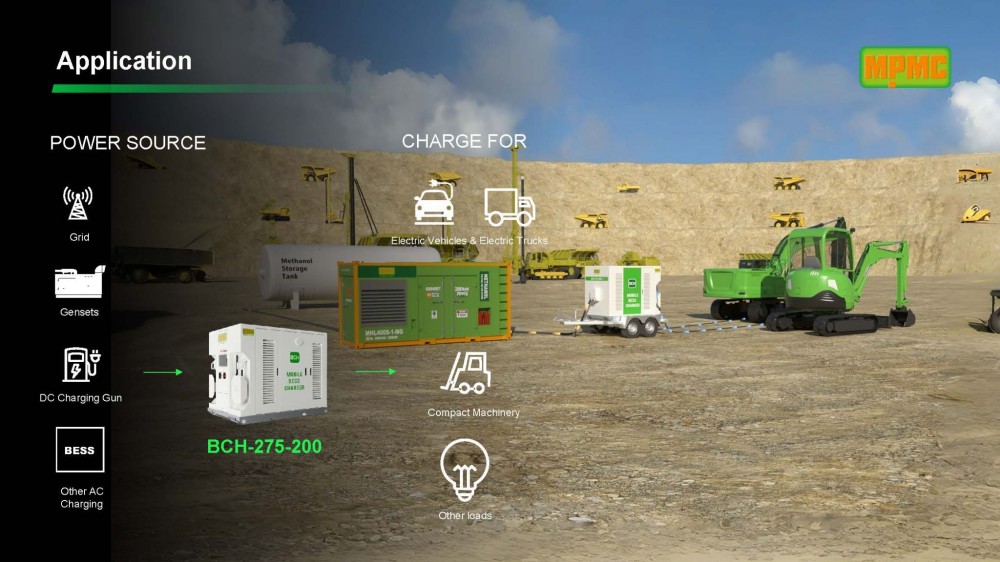
MPMC BCH-275-200 mobile BESS charger
The Asset Has to Suit More Than One Customer
A charging-as-a-service operator does not control the sites it serves. One customer wants overnight charging for vans, the next wants a short turnaround for trucks, a third wants temporary capacity while a permanent installation is built. An asset optimised for one of those is compromised for the others.
The practical response is to choose the format answering the most common enquiry, then add capability rather than variety. MPMC’s published range spans 80 kW with 70 kWh on the BCH-80-70 through 150 kW with 203.5 kWh on the BCH-275-200 to 500 kW with 1,075 kWh on the BCH-500-1000, and the middle of that range typically answers the widest set of requests.
Redeployment Speed Is the Business Model
Revenue depends on how quickly an asset moves from one contract to the next, which makes weight and handling commercial parameters rather than technical ones. MPMC lists the BCH-80-70 at 880 kg with six units per 20 ft container, the BCH-275-200 at 2,800 kg on a 3.5 t heavy-duty trailer with an integrated forklift pocket, and larger models at 8,300 kg, 15,000 kg and 19,800 kg in a 20 ft container footprint.
The threshold that matters is whether a unit can be towed or forklifted, or whether each move requires a crane, a low-loader and a permit. Across a portfolio of short contracts that difference compounds quickly and usually outweighs a modest capacity advantage on paper.
Billing Is the Part Generator Hire Does Not Teach
Selling charging raises a question renting a generator does not: who pays for the energy and how it is measured. MPMC lists an EMS with 4G connectivity and OCPP 1.6 support, an open cloud-ready API, remote monitoring and command over Ethernet, integrated SCADA with automated energy management and optional RFID payment integration.
Three items should be settled before the first contract: whether session records reconcile with the operator’s invoicing, whether energy delivered can be attributed to a customer or a contract, and whether state of charge at collection and return can be evidenced. Those decide whether energy is a recovered cost or an unbilled one.
Matching the Asset to the Contract Length
|
Contract type |
What the asset must do |
What decides the choice |
|
Days to weeks |
Arrive, work, leave without trace |
Mobilisation time and handling method |
|
Several months |
Serve a defined demand reliably |
Storage capacity against daily energy; recharge arrangement |
|
Bridge to a permanent build |
Cover the connection lead time |
Redeployment value once the fixed site energises |
|
Seasonal, returning annually |
Perform, then store well between seasons |
Idle state of charge and storage conditions |
|
Multi-site rotation |
Move between customers on a cycle |
Unit count against cycle time, not simultaneous demand |
The recharge arrangement is the element the unit cannot bring with it, and on a customer site the operator rarely controls the supply. MPMC lists AC input from grid, generator or solar on models from the BCH-275-200 upward at 80 kW to 560 kW depending on model, plus a CCS2 DC input allowing recharge from a fast-charging point at roughly one hour for that model.
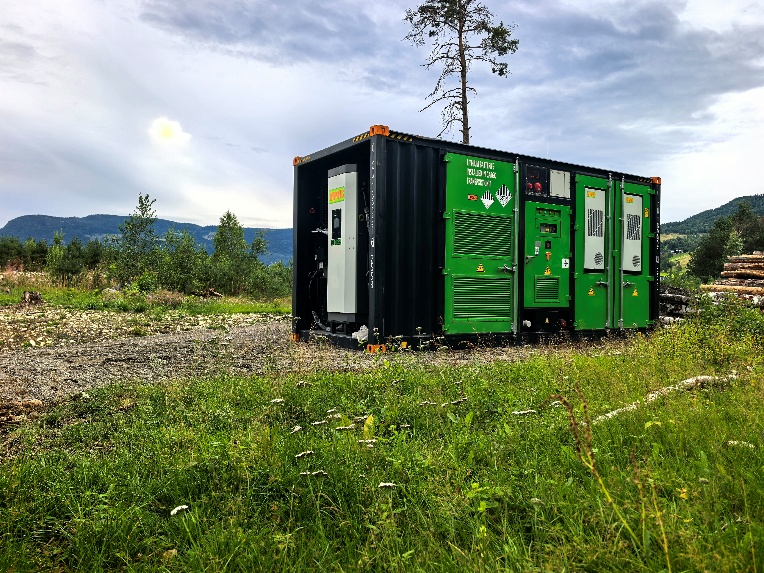
MPMC BCH Series mobile BESS charger
Utilisation and Throughput Life
MPMC lists 6,000 cycles at 90% depth of discharge across the BCH range, with published warranty terms of 3 years or 1.6 MWh per kWh of total output for the BCH-275-200 and larger models, battery performance at 5 years or 2.57 MWh per kWh, and end-of-life capacity retention of at least 70%. The BCH-80-70 is listed separately at 1 year or 60 MWh with a 3-year or 200 MWh battery warranty.
On a well-utilised service asset the throughput allowance is reached long before the calendar term, and the difference between an asset working two hundred days a year and one working eighty is large enough to change which model is the better buy. Sizing should also be checked against end-of-life capacity, since a unit that just covers a customer’s requirement today will not in year six.
Between Contracts
An asset in this business spends part of its life idle or in transit, and both affect what it is worth when the next contract starts. Storage state of charge, ambient conditions during standing periods and the transport regime should be agreed with the supplier rather than improvised.
Documentation deserves the same attention. Factory test reports and the applicable certificates are easy to lose across many deployments and expensive to reconstruct, and they support both customer confidence and eventual resale.
Published Service-Style Deployments
MPMC lists a United Kingdom logistics port operation using eight BCH-275-200 units where a weak local grid had produced ten-hour charging cycles against four-hour port runs, a Netherlands installation combining the BCH-275-200 with the BCH-500-1000 for a renewable-powered charging station, and a Norwegian deployment at 2 MWh with 500 kW per unit.
These describe the class of arrangement supplied rather than a utilisation forecast for a service business, whose returns follow its own customer mix and contract rates.
Service Operator Checks
• Choose the opening format to answer the most common customer enquiry.
• Weigh handling method and redeployment time alongside capacity.
• Confirm session records reconcile with invoicing and can be attributed per contract.
• Establish how state of charge at collection and return is evidenced.
• Identify the recharge route at customer sites, including a fallback.
• Size unit count against rotation cycle time where assets move between customers.
• Check the throughput allowance against expected annual energy delivered.
• Agree storage conditions and idle state of charge between contracts.
https://www.mpmc-group.com/
MPMC Powertech Corp.