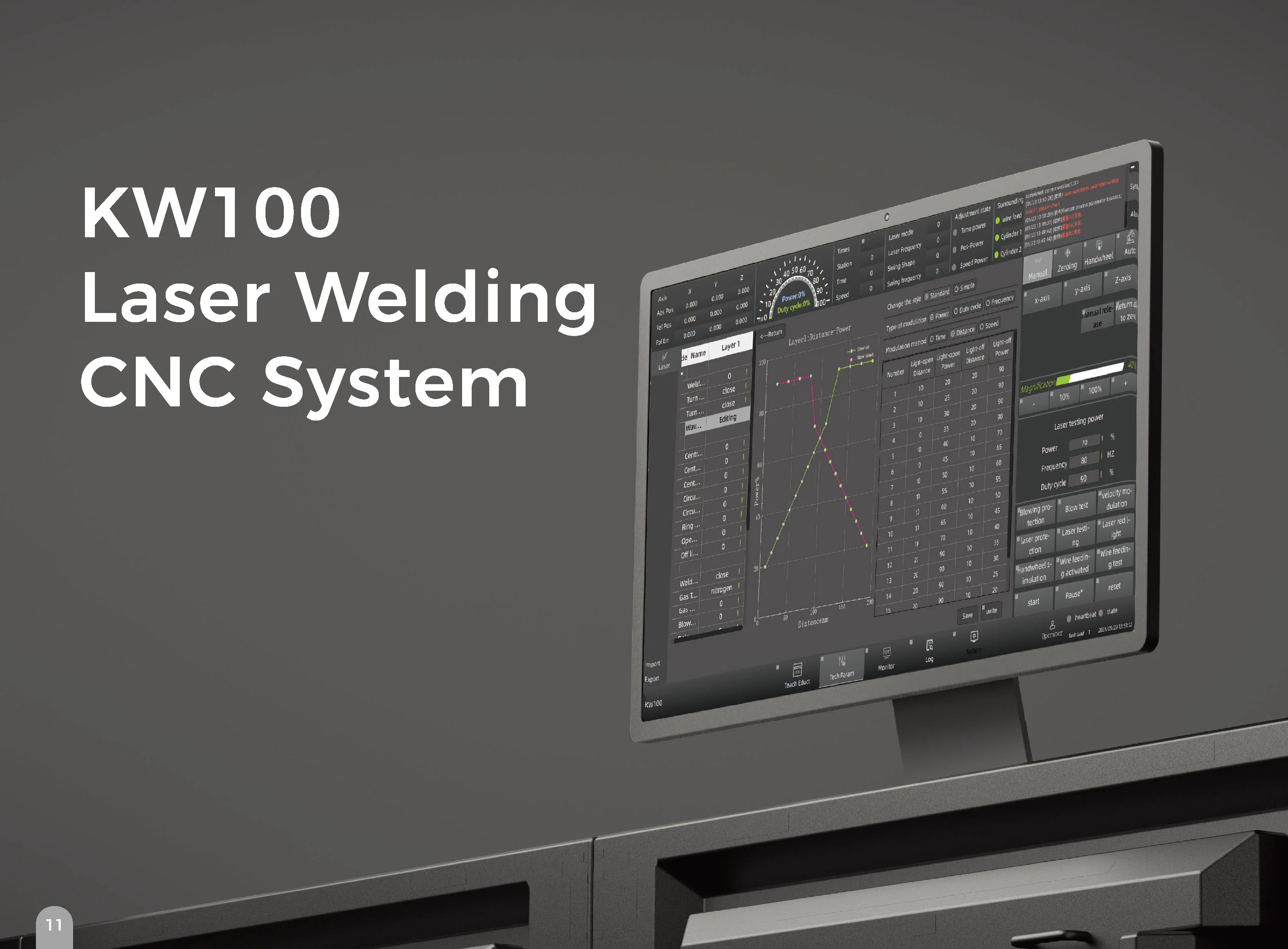
The KW100 Laser Welding Subsystem plays an important role in determining how effectively laser energy is delivered to the workpiece. In a high-volume manufacturing environment, weld quality depends not only on the laser source but also on beam delivery, focusing accuracy, mechanical stability, thermal control, shielding gas, and system integration.
This becomes particularly important when production requires narrow welds, limited thermal deformation, high repeatability, or automated operation over long production cycles. A welding subsystem that maintains stable optical and mechanical characteristics can help reduce process variation and improve equipment utilization.
For modern laser manufacturing systems, the key question is not simply whether a subsystem can perform a weld. The more important question is whether it can maintain predictable welding performance across thousands of repeated operations.
Beam Delivery Is the Core Function
The purpose of the welding subsystem is to transfer the laser beam from the source to the workpiece with controlled optical characteristics.
Any deviation in beam quality, alignment, or focal position can change the energy distribution at the welding point.
If the energy density becomes inconsistent, weld penetration and width may fluctuate even when the laser source output remains stable.
This is why optical alignment should be considered a production parameter rather than only an installation task.
A well-controlled subsystem provides a stable reference between the laser source and the workpiece.
Focus Accuracy Affects Penetration
Laser welding is highly sensitive to focal position.
A change of only a small distance along the optical axis can alter spot size and energy density, particularly when the system uses a tightly focused beam.
For precision welding, the focal position must therefore be matched to the joint geometry and material thickness.
When welding thin components, excessive penetration can cause burn-through. When welding thicker sections, insufficient energy density may result in incomplete penetration or lack of fusion.
The correct focus position is therefore application-specific and should be validated through process testing.
Joint Geometry Determines Process Requirements
A laser welding system must be selected according to the actual joint.
Butt joints, lap joints, fillet joints, and complex three-dimensional assemblies have different optical and access requirements.
A narrow butt joint may require precise seam positioning because the acceptable tolerance for beam deviation is relatively small.
A lap joint may allow a different process window but can introduce challenges related to gap variation and material reflectivity.
For automated production, the subsystem must also maintain the required stand-off distance and orientation as the welding path changes.
Motion Accuracy and Optical Accuracy Must Work Together
Laser welding can produce extremely localized heating, but this also means that the process is sensitive to positioning errors.
If the laser beam moves away from the intended seam, the resulting weld may become narrower, incomplete, or geometrically inconsistent.
The welding subsystem therefore needs to work with the machine's motion system.
Robot positioning accuracy, linear-axis repeatability, seam tracking, fixture accuracy, and welding-head mounting all contribute to final weld quality.
A technically advanced laser head cannot compensate for excessive workpiece movement or inaccurate fixturing.
Thermal Stability Supports Long Production Cycles
Repeated high-power laser operation generates thermal loads that can affect equipment components.
If thermal expansion changes the relative position of optical elements, the effective focal position can shift.
This can gradually change weld geometry during long production runs.
Thermal management should therefore be evaluated under realistic duty cycles rather than only during short laboratory tests.
For automated production lines operating continuously, thermal stability can have a direct relationship with first-pass yield and maintenance intervals.
Optical Protection Reduces Maintenance Risk
Laser welding produces airborne contaminants that can accumulate around optical components.
Over time, contamination can increase optical absorption and create localized heating.
This may reduce transmission efficiency and accelerate component degradation.
A well-designed protection strategy can reduce the amount of contamination reaching sensitive optical surfaces.
For production facilities, this has practical importance because unexpected optical maintenance can stop an entire automated welding cell.
Preventive inspection and replacement procedures should therefore be incorporated into the equipment maintenance plan.
Shielding Gas Influences Weld Formation
Shielding gas protects the molten pool from atmospheric reactions, but its function is not limited to preventing oxidation.
Gas flow can also influence the stability and shape of the weld pool.
Nozzle geometry, gas type, flow rate, nozzle distance, and welding direction must be considered together.
Poorly controlled gas flow can result in oxidation, surface defects, or unstable weld appearance.
For repeatable automated welding, shielding-gas delivery should therefore be treated as part of the complete process architecture.
Material Selection Changes the Process Window
Different metals absorb laser energy differently.
Aluminum and copper, for example, present different optical and thermal characteristics compared with carbon steel or stainless steel.
Copper's high reflectivity and thermal conductivity can require higher power density and tighter process control.
Aluminum can also be sensitive to process instability and may require careful control of energy input.
This means the KW100 Laser Welding Subsystem should be evaluated according to the intended material range rather than through a generic welding specification.
Automation Requires Repeatable Interfaces
When integrating a welding subsystem into an automated production line, mechanical and optical interfaces become critical.
Mounting dimensions, beam-path alignment, cable routing, cooling connections, gas interfaces, and control integration can all influence installation efficiency.
If these interfaces are inconsistent, system commissioning can require additional alignment and engineering work.
For equipment manufacturers developing multiple machines, repeatable subsystem interfaces can reduce integration time and simplify service procedures.
Process Monitoring Adds Another Layer of Control
High-value production may justify monitoring the welding process in real time.
Laser power monitoring can identify changes in source output. Vision systems can monitor seam position. Temperature monitoring can provide information about process stability.
When these signals are connected to the machine control system, deviations can potentially be identified before a large number of defective components are produced.
This is particularly valuable for applications where rework is expensive or where welding defects are difficult to detect after assembly.
From Prototype to Mass Production
A laser welding subsystem should perform consistently at both development and production stages.
During prototype development, engineers typically establish laser power, speed, focus, shielding gas, and joint parameters.
When production volume increases, the process must maintain these conditions across long operating periods.
This transition from laboratory validation to industrial production is where thermal stability, optical protection, mechanical rigidity, and maintenance design become especially important.
A subsystem that works well during a short demonstration may not necessarily deliver the same stability during continuous factory operation.
RayTools and Industrial Laser Integration
RayTools focuses on intelligent laser manufacturing and supports applications ranging from precision micro-processing to large-scale automated production.
Its technology scope includes laser cutting, drilling, welding, cladding, hardening, surface treatment, micro-processing, 3D printing, additive manufacturing, and online marking.
This cross-process experience is valuable when developing laser welding solutions because many industrial applications require integration with broader manufacturing systems rather than standalone welding equipment.
Conclusion
The KW100 Laser Welding Subsystem can contribute significantly to welding quality when its optical, mechanical, thermal, and process characteristics are correctly matched to the production application.
Beam delivery, focus accuracy, joint geometry, motion synchronization, thermal stability, optical protection, shielding gas, material characteristics, and process monitoring should be evaluated as an integrated system.
For manufacturers moving from manual or conventional welding toward automated laser production, the priority should be a stable and repeatable process window rather than maximum nominal laser power alone.
RayTools' experience across precision and large-scale laser manufacturing applications provides a strong technical foundation for developing and integrating laser welding systems designed for demanding industrial production.
www.raytools.com
RayTools