Replacing a missing tooth is no longer limited to conventional fixed bridges or dental implants. As patient expectations shift toward minimally invasive treatment, the Maryland bridge has become an increasingly popular option for replacing a single missing anterior tooth while preserving healthy tooth structure.
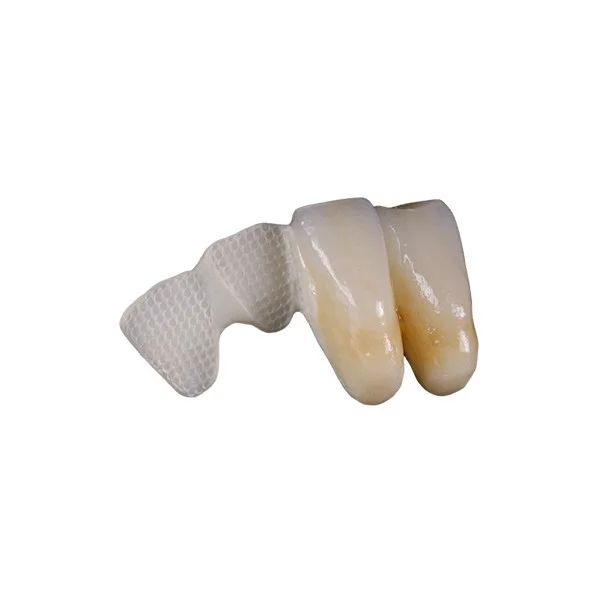
Advancements in digital dentistry, CAD/CAM manufacturing, and high-strength dental materials have significantly improved the clinical performance of Maryland bridges. Today, a precisely designed Maryland bridge offers excellent esthetics, predictable retention, and reduced chair time, making it a practical solution for many clinical cases.
This article explains how a Maryland bridge works, when it is indicated, what materials influence its longevity, and why digital manufacturing plays a decisive role in its success.
What Is a Maryland Bridge?
A Maryland bridge, also known as a resin-bonded bridge, is a fixed dental prosthesis designed to replace one or occasionally two missing teeth without extensive preparation of adjacent teeth.
Unlike a traditional bridge that requires full-coverage crowns on neighboring teeth, a Maryland bridge uses thin metal or ceramic wings bonded to the lingual surfaces of the adjacent teeth.
Its basic structure consists of:
-
Pontic (replacement tooth)
-
One or two retention wings
-
High-strength adhesive resin cement
Because only minimal enamel preparation is required, much more natural tooth tissue can be preserved.
Why Is the Maryland Bridge Becoming More Popular?
Conservative dentistry has become one of the major trends in restorative treatment.
Many patients are reluctant to remove healthy enamel simply to support a bridge, especially when adjacent teeth are intact.
A Maryland bridge addresses this concern by offering:
Minimal Tooth Preparation
Traditional bridges often require 1.0–1.5 mm circumferential tooth reduction.
A Maryland bridge usually requires only limited enamel preparation of approximately 0.3–0.7 mm on the lingual surface, depending on material selection and occlusal conditions.
This preserves pulp vitality and significantly reduces biological cost.
Excellent Esthetics
Modern zirconia and lithium disilicate materials eliminate the gray shine-through sometimes associated with older metal-wing designs.
Digital shade matching further improves integration with adjacent teeth, especially in the anterior region.
Reduced Treatment Time
Compared with implant therapy, a Maryland bridge usually requires fewer appointments.
There is:
-
No surgical procedure
-
No healing period
-
Immediate restoration after fabrication
For patients requiring rapid esthetic rehabilitation, this becomes an attractive option.
Clinical Indications
A Maryland bridge performs best under carefully selected conditions.
Typical indications include:
Single missing maxillary lateral incisor
Congenitally missing teeth
Replacement after orthodontic treatment
Young patients who have not completed jaw growth
Patients unwilling or unable to receive implants
Temporary long-term replacement before implant placement
Cases with healthy adjacent teeth
The design is particularly successful when occlusal forces remain moderate and sufficient enamel is available for bonding.
When Is a Maryland Bridge Not Recommended?
Although highly conservative, the Maryland bridge is not suitable for every situation.
It should be carefully evaluated when patients present with:
Heavy bruxism
Deep bite
Large posterior edentulous spaces
Extensive restorations on adjacent teeth
Insufficient enamel for bonding
Severe periodontal mobility
These factors increase debonding risk and may reduce long-term success.
Material Selection Matters
One of the biggest improvements in Maryland bridge performance comes from advances in restorative materials.
Zirconia Maryland Bridge
Monolithic zirconia offers:
High flexural strength
Excellent fracture resistance
Natural translucency
Good biocompatibility
Digital milling precision
Its flexural strength commonly exceeds 900–1200 MPa, making it suitable for long-term clinical service.
Lithium Disilicate
Lithium disilicate provides:
Superior translucency
Natural esthetics
Reliable bonding
Flexural strength around 360–500 MPa
It is especially popular for highly esthetic anterior restorations.
Metal Framework
Traditional cobalt-chromium frameworks still offer:
High rigidity
Thin wing design
Cost efficiency
Long clinical history
However, esthetic limitations have reduced their popularity for visible anterior restorations.
Digital Workflow Improves Accuracy
The success of a Maryland bridge depends heavily on accurate fit.
Digital dentistry has transformed laboratory production.
A modern workflow generally includes:
Intraoral scanning
Digital margin design
CAD restoration design
CAM milling or 3D printing
Digital occlusion analysis
Final polishing and quality inspection
Compared with conventional impressions, digital scans reduce distortion and improve communication between the clinic and laboratory.
Marginal adaptation can routinely achieve precision within 20–50 μm, depending on scanning equipment and manufacturing processes.
Bonding Determines Long-Term Performance
Even the most accurately fabricated Maryland bridge can fail if bonding protocols are inadequate.
Successful bonding depends on several factors.
Surface Treatment
Different restorative materials require different conditioning methods.
For zirconia:
Air abrasion
MDP-containing primers
Specialized resin cement
For glass ceramics:
Hydrofluoric acid etching
Silane coupling agent
Resin adhesive cement
Moisture Control
Proper isolation remains essential.
Rubber dam isolation greatly improves bonding reliability by preventing saliva contamination.